

‘Original in Magenta & Yellow’ is made for visual readability, like a neon, ancient sign of woes.
I made four awesome versions of “$seven trillion dollar question” with a further nine versions purely for a GIF animation.

‘Senseless Manmade Heatwaves version’ – the artwork appears scorched, burned and ruined to show the terrible environmentally damaging affects upon Earth.

‘CH4 CO2 NOx Pollution version’ draws attention to the excessive release of noxious gases by manmade commercial activities irrefutably affecting global weather. Irrefutably since I have already prove its adverse affects through personal scholarly research.
My scientific findings were shared with international media.
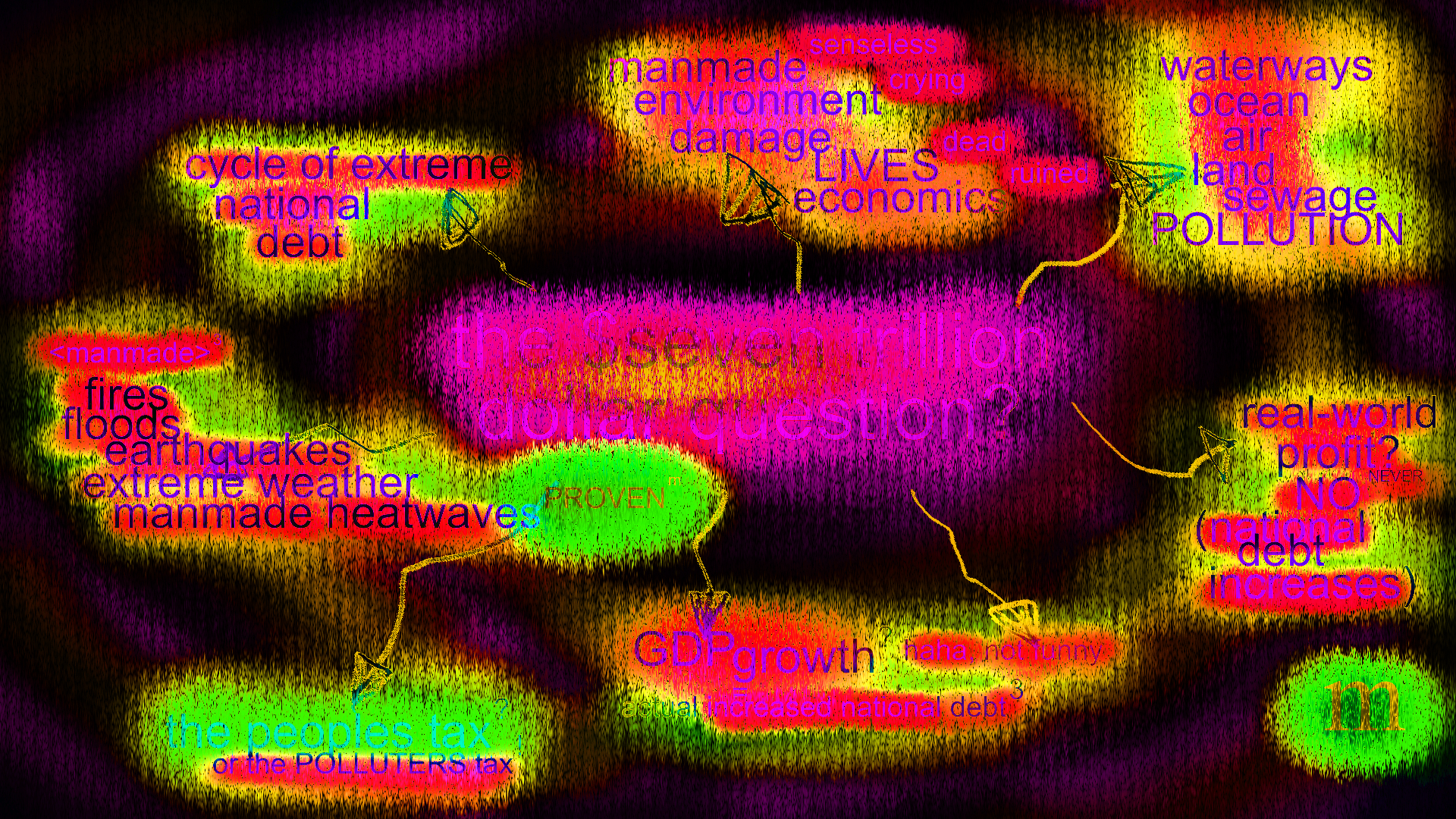
‘Animalistically Branded Against Green version’ highlights negative commentary.
Here is the GIF animation:
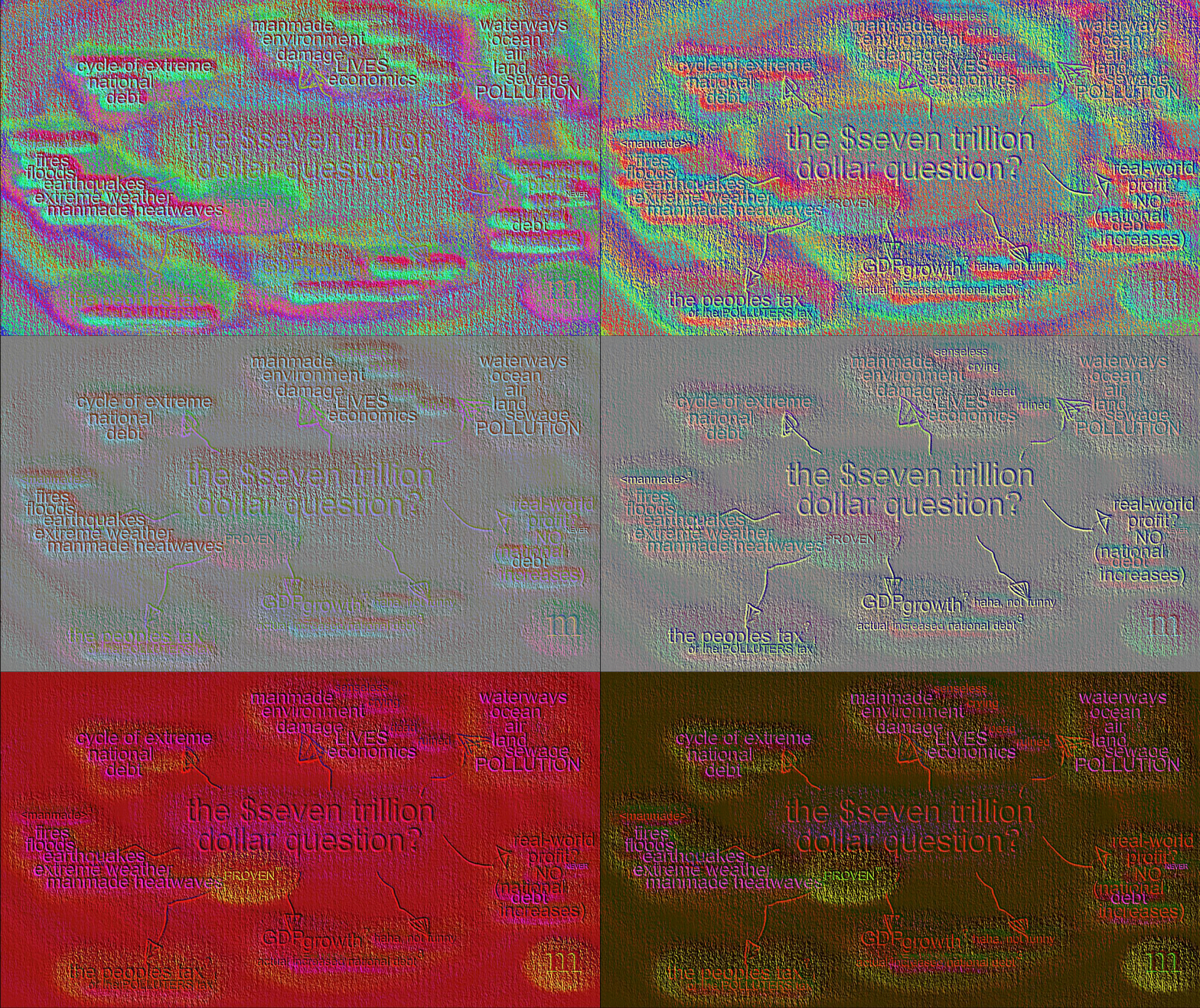
”$seven trillion dollar question – GIF animation“ extols the idea of a global heatmap of planet Earth.
The name of the title ”$seven trillion dollar question” is taken from IMF (International Monetary Fund) research.
Here is an excerpt of their publicly available 2023 research paper into fossil fuels subsidies enclosed in brackets (I have included bold type for you to see the $7 trillion I am referring to in my artworks):
[ IMF Fossil Fuel Subsidies Data: 2023 Update
Author/Editor: Simon Black ; Antung A. Liu ; Ian W.H. Parry ; Nate Vernon
Publication Date: August 24, 2023
Disclaimer: IMF Working Papers describe research in progress by the author(s) and are published to elicit comments and to encourage debate. The views expressed in IMF Working Papers are those of the author(s) and do not necessarily represent the views of the IMF, its Executive Board, or IMF management.
Summary:
This paper provides a comprehensive global, regional, and country-level update of: (i) efficient fossil fuel prices to reflect supply and environmental costs; and (ii) subsidies implied by charging below efficient fuel prices. Globally, fossil fuel subsidies were $7 trillion in 2022 or 7.1 percent of GDP. Explicit subsidies (undercharging for supply costs) have more than doubled since 2020 but are still only 18 percent of the total subsidy, while nearly 60 percent is due to undercharging for global warming and local air pollution. Differences between efficient prices and retail fuel prices are large and pervasive, for example, 80 percent of global coal consumption was priced at below half of its efficient level in 2022. Full fossil fuel price reform would reduce global carbon dioxide emissions to an estimated 43 percent below baseline levels in 2030 (in line with keeping global warming to 1.5-2oC), while raising revenues worth 3.6 percent of global GDP and preventing 1.6 million local air pollution deaths per year. Accompanying spreadsheets provide detailed results for 170 countries. ]
$7 trillion = $7,000 billion!
For a perspective to compare $7trillion ($7,000 billion), the entire U.S. Department of Defense spending totalled circa $558.7 billion in 2022 (budget figures from the official D.o.D website).
 The Unfathomable Artist