‘type: The Unfathomable Artist #1’ [19th February 2020] by Matt The Unfathomable Artist, Digital Pop Artwork, MS Shell Dig 2 and Times New Roman fonts, 7016 x 4951 pixels, 600dpi, A4 Landscape format.
Digital Pop Artworks digitally produced to technologically articulate the need for global climate change policies.
Subtle version two shown immediately below, with the future idea to create written words and iconography throughout the blue canvas space:
‘type: The Unfathomable Artist #2’ [20th May 2020] by Matt The Unfathomable Artist, Digital Pop Artwork, MS Shell Dig 2 font, 4412 pixels x 3981 pixels, 600dpi, A4 Landscape format.
Version three with Times New Roman ‘type’ font and ITC Kristen chosen for the main green yellow alternating Unfathomable text shown below:
‘type: The Unfathomable Artist #3’ [24th May 2020] by Matt The Unfathomable Artist, Digital Pop Artwork, Times New Roman and ITC Kristen fonts, 7016 pixels x 4961 pixels, 600dpi, A4 Landscape format.
At the time of editing this page on 24th May 2020 I have started work on two oil paintings for my ‘type: The Unfathomable Artist‘ series of pop artworks. The blue screen backgrounds are already completed. I’m waiting for the refined linseed oil mixed within the oil paints to dry before adding the painted fonts.
I’m likely to choose version #3 as the first oil painting artwork for me to finish. Then version #1, as seen in these Digital Pop Artworks. The blue backgrounds already look delicious.
‘Cold Autumn Walk on the Downs’ by David Brammeld RBA, Acrylic, 41cm x 51cm.
Inspired by Trees
The Royal Society of British Artists 303rd Annual Exhibition features a forest full of trees.
20 to 29 February 2020, 10am to 5pm
Mall Galleries, The Mall, London SW1
Admission £5, 50% off with Art Fund pass, Free for Friends of Mall Galleries and under 25’s
Mall Galleries is happy to offer my Readers Free Entry for Two to the exhibition when quoting this publication at the gallery desk (normal price £10)
Visitors to the Mall Galleries will shortly be able to experience a ‘forest experience’ as the Royal Society of British Artists highlights the potent inspiration trees provide for artists in its annual exhibition opening 20 February. Two clusters of tree images showcase a wide variety of styles, locations and moods, in highlighted sections of the show which overall features more than 500 works on myriad subjects. Trees captivate artists and fascinate the viewer with their life-force, symbolism and extraordinary architectural variety and beauty.
Some works featured are portraits of individual trees, such as Mark Welland’s Reach For The Sky II, which is part of a series commemorating a 300 year old oak tree finally felled by storm Katie in 2016; some scenes of woodlands, trees on the horizon or trees in the garden offering shelter on a sunny day.
‘Reach For The Sky II’ by Mark Welland, Mixed media, 21cm x 21cm.
Urban life also features. Melissa Scott-Miller RBA RP NEAC, known for depicting London’s streets says of the capital’s trees: “In London the trees are often restricted by the buildings and paving slabs, but they have still kept going, their branches making beautiful patterns and shapes, the lichen on the bark has spread on to the rooftops and brickwork, in summer the canopy of leaves produce areas of shade, and they are a haven for wildlife, birds, squirrels even domestic cats, the changes of colour and shape they display through the seasons lift the spirits, trees are essential to city living!”
Beautiful urban landscape by Melissa Scott-Miller RBA RP NEAC
Environmental themes emerge strongly. While many of these paintings of tree suggest at themes of longevity, ideas of mortality and of the fragility of the environment are never far away. Gary Cook’s watercolour 1058: Melbury Beacon No8 stands as a record of the 1,058 UK species associated with ash trees, ranging from beetles to birds, lichens to mammals. Some of these species are written into the background. All will be affected when we lose up to 90% of the UK’s 70 million ash trees from dieback disease. Of the 1,058 species 40 of them live only on ash trees. The Centre Barred Sallow moth is one of those 40. Research is ongoing into replanting these trees with ash bred with tolerance to the infection.
‘1058: Melbury Beacon No. 8’ by Gary Cook, Watercolour & charcoal, 28 x 39 cm.
Cheryl Culer PPPS RBA suggests we should all try our hand at drawing trees: “Trees are great to draw and as long as they get thinner as they go up and the branches get skinnier as they reach out, then even the simplest scribble can be a tree.“
Alongside the exhibition, member artists will be demonstrating their techniques and there are a number of opportunities to join in; including a free drawing session where you will be serenaded by Classical Harpist Eleanor Dunsdon.
Visit www.malllgalleries.org.uk for a full list of the events taking place.
The Royal Society of British Artists (RBA) is dedicated to promoting the highest standards of skill, concept and draughtsmanship in painting, sculpture, printmaking and drawing.
The exhibition is sourced from member artists and through open submission, to bring together works of the highest standard in an eclectic mix of style and media. Most works are for sale, with prices starting from £140.
We are happy to offer your Readers Free Entry for Two to the exhibition when quoting your publication at the gallery desk (normal price £10)
Royal Society of British Artists 303rd Annual Exhibition 2020
20 to 29 February, 10am to 5pm
Mall Galleries, The Mall, London SW1 www.mallgalleries.org.uk
Header image: David Brammeld RBA Cold Autumn Walk on the Downs
Peter Brown RBA PNEAC RP PS ROI – ‘Towards the Fatih Mosque from the Galata Bridge’
Royal Society of British Artists 303rd Exhibition
Join us for the Private View
Wednesday 19th February, 11am to 8pm
Exhibition open
20th to 29th February, 10am to 5pm
Tickets £5, Free to Friends of Mall Galleries and under 25’s
The Royal Society of British Artists (RBA) is dedicated to promoting the highest standards of skill, concept and draughtsmanship in painting, sculpture, printmaking and drawing.
The exhibition is sourced from member artists and through open submission, to bring together works of the highest standard in an eclectic mix of style and media. Most works are for sale, with prices starting from £120.
Clare O’Brien, CEO of Federation of British Artists and Mall Galleries said:
“The artists have been out documenting the world around them and the many diverse landscapes and locations featured in the exhibition include the Faith Mosque in Istanbul, the White Cliffs of Dover and Billingsgate Fish Market.
We see joyous expressionistic dancers by Susan Bower, young men in photo-real pencil drawings by Malcolm Ashman, father and son historical Harp restorers by Lewis Hazelwood-Horner, the artist and her dog, Joey, painting in an Islington back garden by Melissa Scott-Miller, a portrait bust of Beatle George Harrison by Clive Duncan, a contemporary Venus of Willendorf by Callum Stannard – the whole of human life is here.”
With such a wide variety, RBA exhibitions always guarantee that no matter what your preferred subject matter, style, medium, colour palette or budget, you will be sure to find a work of art you would love to own.
Clive Duncan RBA – Bronze ‘Portrait of George Harrison’
Malcolm Ashman RBA – ‘Wrapped’
Susan Bower RBA ROI – ‘Headlong’
Cheryl Culver RBA PPPS – ‘Looking Across the Channel’
Lewis Hazelwood-Horner RBA – ‘Harp’
Callum Stannard RBA – ‘Venus’
We are happy to offer your Readers Free Entry for Two to the exhibition when quoting your publication at the gallery desk (normal price £10)
The Royal Society of British Artists 303rd Exhibition
‘Little Girl Knitting’ [1918] by Daniel Garber, Charcoal on paper, 18.25 inches x 23.25 inches.
Before I make commentary regarding the four artworks in this blog article, please let me continue my oft tradition of utilising Wikipedia pages. You can read about the artist Daniel Garber’s career on his profile page by clicking here: Daniel Garber Wikipedia page.
‘Little Girl Knitting’ by American Impressionist painter Daniel Garber, shown above, is a charcoal monument.
Technical depth, emotive concentration, focused thoughtfulness and masterly shadow.
Defined clothing with hyper-realist skin and hair, details Tanis, the painters daughter at a determined eleven years of age. The heavily constructed background is completely engaging whilst the patterned textural garment foreground appears almost lattice life-like.
Viewing further Garber charcoal works you will appreciate his off-the-scale pencil work.
‘Students of Painting’ [1923] by Daniel Garber, Oil on compositional board, 18 inches (h) x 21 15/16 inches (w).
‘Students of Painting’ by Daniel Garber has all the romanticism of the 1920’s art deco era. Sort of dancing women and champagne flutes. The full impressionistic style graces the wall with ghostly aplomb. The pastel windowed garden contrasts the serious business of work.
Like the efforts to make movie pictures and King Kong. I mention King Kong for its fictional story where art is entangled unto human tragedy.
Technological brute force combined with mass cultural decadence turning civilisation into the wild jungle. The writer creates the apocalyptic city scenario envisioned of man kind(?) pitted against a prehistoric untamed gargantuan primate.
A primordial beast they cannot contain through sheer apex entitled delirium.
The beast is not Planet Earth or its earliest inhabitants.
‘Students of Painting’ likely explains the studies required before graduating to plein air techniques. It’s also reasonable to believe there is a subtle allusion to gender equality through the left and right depiction of the students’ dominant hands.
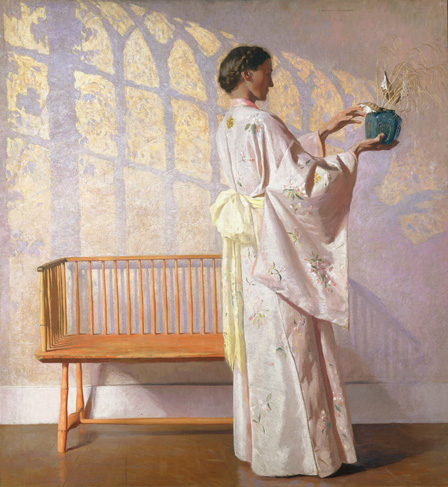
‘The Studio Wall’ [1914] by Daniel Garber, Oil on canvas, 56 inches x 52 inches.
With ‘The Studio Wall’ by Daniel Garber the artist distorts the natural light throughout pleasantly fashioned fabrics, the astonishing dappled wall ‘window frame‘ work, an earthy reflective floor and a singular piece of intricately fanciful furniture.
I think the onomatopoeian word we’re looking for to describe this painting is yummy. Yes, I do accept cookies.
Beyond Words to be honest, albeit a thousand words is good to spring to mind.
The lady in the painting is Mary Franklin Garber, Daniel’s wife. Mary is cousin of Anna Whelan Betts [link here to Anna Whelan Betts Wikipedia page] both of whom are artists themselves. Mary is sister to John Franklin Garber, who himself made careful documentation and academic promotion of his late father’s work from 1958.
Further research resource regarding Daniel Garber’s work can be found here: Daniel Garber: Romantic Realist – A Teacher’s Guide published online as a collaboration between the Pennsylvania Academy of Fine Arts and the James A Michener Art Museum.
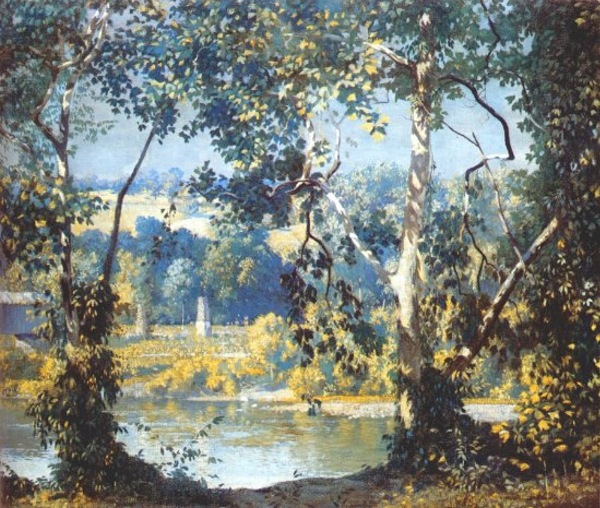
‘Fields in Jersey’ [1909] by Daniel Garber, Oil on canvas, 36 inches x 44 inches.
I’ve included ‘Fields in Jersey’ by Daniel Garber to highlight the beautiful strength of his foreground trees’ vine-like branch work. As a complete painting there are complex shade effects to lap up, advancing depth of field changes and dreamy hues.
I want to swing on the branches like a boy eleven years of age. What I’m actually doing is admiring the way Garber solidly painted the foreground trees. Having perhaps worked the background trees first, then fully completing the foreground trees afterwards.
Every artist has their own way of working.
Garber’s techniques continued to be honed and passed onward through 40 years of art teaching. Etching, printing, painting, charcoals and sketching. Daniel’s natural talent coupled with his professional draughtsperson’s hands make for his exceptional detailing abilities.
Daniel retains the romantic feeling of Impressionism within most of his artworks, whilst clearly enjoying Realist working also as seen through works such as the ‘Little Girl Knitting’.
In concluding this article I’d like to share a YouTube video showcasing Daniel Garber‘s artworks courtesy of Learn from Masters:
‘superconductivity’ text for blog article. Please note this is not a formal artwork :} currently.
I’ve chosen the title ‘Soundwaves with Steel Spun around Copper’ as this makes for a wonderful artwork. An artwork as yet conceptualized by me with dramatically commercial applications in mind.
‘I was greatly interested in Gravity, so I wrote about this. I was greatly interested in soundwaves and the sonic boom, so I wrote about this. Some weeks ago “i saw a buzzard flying overhead, near over my house. It made its call. Eureka. I saw its wingtips and from this i determined soundwaves could be changed by engineering the surface ⚡”. Now I’m considering superconductivity.’ – a digital writing of September 23rd 2019 1555hrs.
My true parallel of that beautifully squawking buzzard is, of course, referring to the sonic boom.
Let me please share some further thoughts with you dear Readers.
Instantaneous and visceral thoughts as I write:
‘Some days ago I was thinking about steel spun around copper ⚡ The concept is for a stronger material super compacting a conductive ‘element’. Its a theory requiring physics, engineering and electrical experts to quantify‘ – a digital writing of November 8th 2019 1121hrs, following my personal thoughts days before.
I literally imagined how a spider produces silk, extrapolating the idea for superconductivity.
My aforementioned quotation arose directly due to my interest in solving a superconductivity problem.
Wikipedia explains superconductivity as follows:
“Superconductivity is the set of physical properties observed in certain materials, wherein electrical resistance vanishes and from which magnetic flux fields are expelled.”
My immediate thoughts aforementioned of November 8th 2019 1121hrs were explained, fore and aft, as follows:
‘… superconductivity works historically at {local} Universal space temperature. Very interesting. Possibly a safety net(?), I think. Idkw, exactly. Does SC require contraction(?), super exerted pressures(?), compaction(?). Is it extreme cold or merely the atomic structural change {with the temperature changes}(?) It’s likely the latter.’ – a digital writing dated September 23rd 2019 2238hrs.
‘Do you think there is a light we as humans have yet discovered? The basis being just as infrared and ultraviolet was fairly modernly discovered, so too a new type of light is yet to be discovered‘ – a digital writing also dated November 8th 2019 1142hrs.
Unedited ‘Art Blog’ Signature using carbon pencil [c2014] by Matt The Unfathomable Artist.
The refined photographic version is shown below, here:
Digitally edited ‘Art Blog’ Signature [c2014] by Matt The Unfathomable Artist using carbon pencil.
I think with this article I’m trying to say be instinctive about creating art.
For whatever reason I liked the idea my art blog should display a different signature to my oil paintings. Kind of like my oil paintings are particular, therefore my art blog branding must be particular too.
You can see my oil paintings’ signature plentifully on my art blog. It’s just that my oil paintings’ signature didn’t seem to suit the digital representation of myself for my blog. Besides, I loved playing with my art signature in deciding who I am as an artist.
An art signature is wonderfully personal.
I appreciate I’ve wrote about my Grandad George within the pages of my blog before. However, as a boy I actually sat with my Grandad George to practice my formal signature. Vividly I remember him showing me his elaborate style of writing. So I incorporated this into my own formal signature at the time. Even into my latter teens.
Looking at my formal art blog signature, shown above, I see the continuity in that originating style. Scrolls, loops and swirls.
Yes, i very much love the art of our individual styles.
The idea of creating art pieces purely of my signatures excites me.
‘Clay Jug’ [2012] by Matt The Unfathomable Artist, Sketch on A4 card paper.
Photograph taken by bending the card into a three dimensional curved form to emulate the physical properties of the clay.
I prefer that those appreciating my artworks might fully understand my interest in clay works such as this jug pictured. For clarification I’d like to share some of my reasons for loving clay works.
Firstly my hometown is quite literally referenced upon natural red clay itself. The area surrounding my birthplace is also notable for its Middle Ages trade in pottery. The jug dated sometime between the 12th to the 14th Century, sketch pictured, is on display at my local city museum.
It’s delightful to me that my early art classes included much clay making using my middle school’s professional kiln and glazes. Metal, wood, textiles and paper mache classes would all become a regular part of my week to week schooling growing up into high school.
17th July 1986 is the date I completed a pottery piece for my Grandad George. Even though my Grandad George passed away 2007 I still have that very pottery I gave to him in 1986. He kept it proudly on his windowsill for years where the Hills smile gently upon the Plains.
My early pottery piece makes me laugh to this day, particularly describing his exceptional sense of humour.
Love of clay works, to me, is all about an existential sense of Continuity.










 The Unfathomable Artist