le Renoir Surérogatoire

‘Luncheon of the Boating Party’ [1880 to 1881] by Pierre-Auguste Renoir, Oil on canvas, 51.26 in (h) x 69.13 in (w).

Continuing my tradition of providing Wikipedia links for artists, here is a link to the page of renowned French Impressionist painter Pierre-Auguste Renoir:

https://en.wikipedia.org/wiki/Pierre-Auguste_Renoir

For an interactive image ala ‘Luncheon of the Boating Party’ please click here and hover your mouse over the people in the painting: https://en.wikipedia.org/wiki/Template:Renoir-BoatingParty-ImageMap

Interlude.  I will return to writing this article after eating some much needed food and drinking a lovely cup of tea.  Sorry, Renoir’s painting has made me hungry and I simply cannot write another word after this one.

I wish my thoughts to flow satiated as I am.  Renoir’s work is precise, pastel-soft at times, spontaneous like eating, romanticized, prettily arranged and sometimes pre-Renaissance and/or pre-Raphaelite in style.

Pierre-Auguste is capable of realist depictions wherever he felt the subject material became ameliorated.  We see examples of this in his portraits of Claude Monet and Alfred Sisley, elevating their dignity and social standing.  Quite likely Renoir ‘clung to them’ with strong regard.

At this latter well known saying I thought immediately of Michel de Nostredame [Nostradamus – https://en.wikipedia.org/wiki/Nostradamus] and his distinctive oddities.

‘If a meteorologist predicts troublesome weather, for thoust seeth through eyes that you do not see – do you then say that the meteorologist is a god bringing it upon you?’

Eau de toilette.  It seemed strange for me to write this spontaneously until I then quickly read:

“Painting must not stink (purr) of the model and one must, neuertheless, smell (sentir) nature in it.” – Pierre-Auguste Renoir.  Quotation online in Bodies of Art: French Literary Realism and the Artist’s Model” by Marie Lathers.

__________________________________________________________________________

I wish to talk about ‘Luncheon of the Boating Party’ [1880 to 1881] by Pierre-Auguste Renoir.

The interaction between the characters is truly exceptional by any normal standards of paint art working.  Care, observance, ponderance, yearning, aloof inexperience, nervousness, mutual co-equal friendship, comfort, serious business discussion and guarded affection from others. __________________________________________________________________________

Thoughts arriving like the Sun at its travelling.  My brain is acting gregariously with a multitude of thoughts as I type.  Renoir’s artworks are enlivening my inspirations so I shall share a new saying from last night inspired of an ancient saying:

‘That we are travelling with the Sun at great speed in all four directions, actually seven, is insight beyond my comprehension at this time.’ – by Matt The Unfathomable Artist, September 2017.

G.R.A.V.>i>T.Y.

Σ

__________________________________________________________________________

‘Study of a Seated Bather’ [1897] by Pierre-Auguste Renoir features a dainty composition of a model bathing nude, shown immediately below:

‘Baigneuse Assise. Study of a Seated Bather.’ [1897] by Pierre-Auguste Renoir, Original softground etching in black ink [1897] signed with the artist’s signature stamp Also signed in the plate. From the edition printed by Louis Fort for Renoir (circa 1910). Edition first issued by Vollard to accompany the album: ‘La Vie et l’Oeuvre de Pierre-Auguste Renoir’, Paris 1919, On light cream wove paper. Sheet: 12 1/2 x 9 1/4ins. Plate: 8 5/8 x 5 3/8ins (220x137mm).

I enjoy all his nude artworks.  There is nothing more honest, intimate and natural than the naked human body as an artform.  Intimacy need not be brash, disrespectful or undignified.

Respecting the beauty of the human form, its near miraculous function and the emotions we feel through our bodies begins as a true gift.  The nakedness at birth.

The idea of birth brings me to the next painting, shown here:

‘Pink and Blue – The Cahen d’Anvers Girls’ [1881] by Pierre-Auguste Renoir, Oil on canvas, 119 × 74 cm (46.9 × 29.1 in).

The pensive almost lost-looks upon the girls faces is a glorious masterpiece within ‘Pink and Blue – The Cahen d’Anvers Girls’ [1881] by Renoir.

The sisters are trying to appear comfortable holding hands.  Alice Cahen on the left resting a hand upon her ribboned belt, no doubt tired from posing.  Her sister Elisabeth imagining her smile as best she can from quite sometime ago, I expect, as they patiently stand in complex finery.

They are so sweet.  Each expression a breath-takingly triumphant replication of life by the painter.

Quite Beyond Words.

Let’s take a look at ‘Pont-Neuf’ by Pierre-Auguste Renoir, shown below:

‘(le) Pont-Neuf’ [1872] by Pierre-Auguste Renoir, Oil on canvas, 74 cm × 93 cm (29.1 × 36.6 in).

It’s always very difficult to choose artworks for my page, however, I usually select spontaneously the paintings that appeal to me personally in some way.  If I wrote an article on a different timeframe a different painting would likely be presented.

We’re all influenced by mood and learned coincidence.

English artist L. S. Lowry must have loved this painting, well, I do hope he did see this artwork.

The symmetry, lines and perspective in ‘Pont-Neuf’ make this one of the most perfect cityscape paintings I’ve seen.  As a comparison of styles from the late 19th Century Impressionist Era to Contemporary early-21st Century artworks I would encourage you to view Titus Agbara‘s cityscapes:

‘Sunday Morning at Kessington Park Road’, also

‘Cambridge Circus – Where Thoughts Meet’ and his four-hour completed artwork of Scotney Castle as appropriate for this article, here:

https://www.saatchiart.com/titus_agbara

Renoir is to French Impressionist art as Titus Agbara is becoming to Nigerian Contemporary art.

Famous.
Standard

Pablo Picasso The Realist

Studying Pablo Picasso tells us one thing immediately..

.. Picasso could paint especially beautifully.

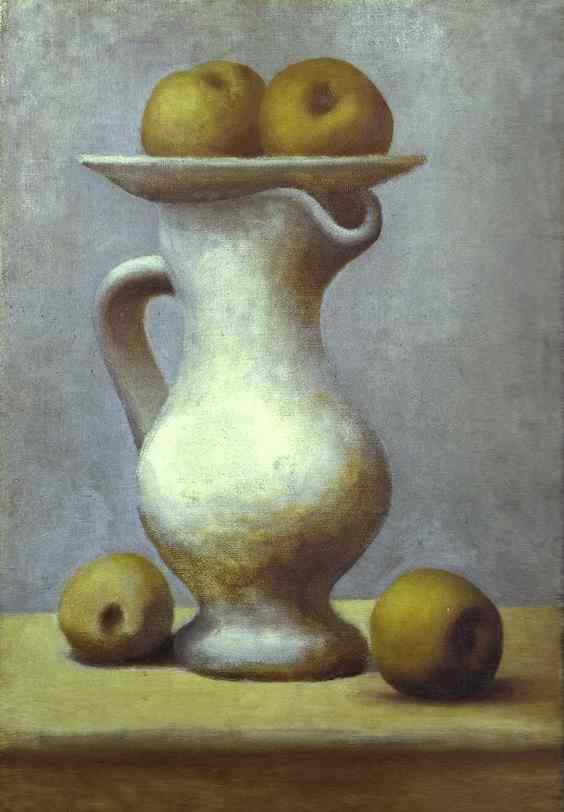
‘Still Life with a Pitcher and Apples’ [c1919] by Pablo Picasso, artwork on paper.

Picasso was sensuous and humorous, see ‘Still Life with a Pitcher and Apples’ by Pablo Picasso, above.

‘Still Life with a Pitcher and Apples’ [c1919] by Pablo Picasso, artwork on paper.

Picasso was a perfectionist, determined to change perspectives and produce art his own way.

Another example of ‘Still Life with a Pitcher and Apples’ [also c1919], shown above, provides rays of his artistic style.  Picasso didn’t view the world the way non-artists do.  Everything exuded personality and uniqueness.  He loved to turn the ordinary into curiosity.

Picasso couldn’t be ordinary even if he tried his very best.  He had the quality of human magnetism through exceptional gifts of persona and talent.

‘Still Life with Compote and Glass’ [1914-15] by Pablo Picasso, Oil on canvas, 63.5 x 78.7 cm (25 x 31 in).

I can look at any year of his artworks, just as I did in choosing ‘Still Life with Compote and Glass’ [1914-15]  to pick out any artwork.. and look!.. it’s a masterpiece.

If you would like to read more about Pablo Picasso, please do so here:

https://en.wikipedia.org/wiki/Pablo_Picasso

‘It is that glass library with a man walking about appearing and disappearing throughout intervals of Time.  Telling you all the facts and details of human history, holographically as your kindred spirit, by the use of one indefinite Supercomputer.’

by Matt The Unfathomable Artist, 24th August 2017.

Standard

a most mysterious ‘FMR’ artwork

As yet to be verified ‘FMR’ painting [with accompanying writing and photo placed within the frame] – 20 cm x 15 cm.

To appreciate my latest blog article whilst dining on a belly full of edible delights from the sea, please firstly read an earlier blog I posted April 2016 about Mr FMR, here:

https://theunfathomableartist.wordpress.com/2016/04/07/the-family-knight-and-the-artist/

This photograph of a painting (or print) shown above with the signatory ‘FMR‘ came to me by way of a blog reader.  Incredibly they had this ‘FMR’ artwork in a frame as yet waiting to be identified.

I almost couldn’t believe it, however, I need more information to confirm the artist.

My artist relative ‘FMR’ had most definitely painted an umber coloured boat in a previous pastel entitled ‘Swan Lake’.  I’ve carefully kept a printed card of ‘Swan Lake’ and may publish this on my blog in the future, along with further artworks by Frank Malcolm, Jnr.

Please take a look at two additional pieces of this provenance puzzle:

Handwriting on the back of the artwork shown at the top of this blog article.

The handwriting is in the style of the period.

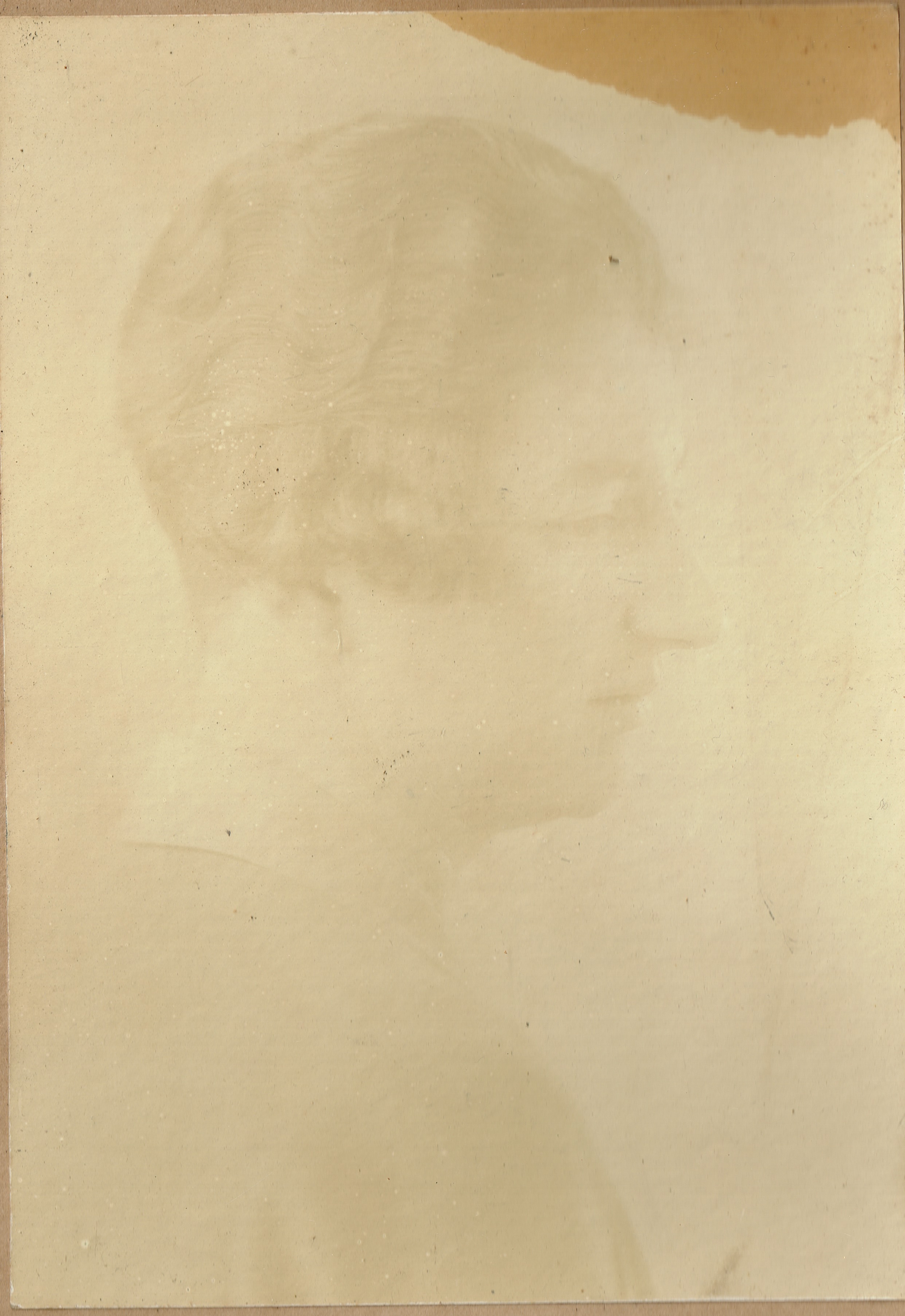
Accompanying the painting, hidden inside the frame is a photograph of a lady, here:

Faded monochrome photograph of a lady hidden inside the frame.

I do have useful ability at handwriting analysis from the personality perspective.  However, assigning handwriting to a particular person for the purpose of identification is not my professional forte.

Presently I cannot ascertain the identity of the lady in the photograph.  Although it would be reasonable to believe it has connection to the artist.

We all love a mystery and personally I’m excited to receive information of possible Frank Malcolm ‘FMR’ artworks.

In my living room an original framed printed greeting card entitled ‘Sunset Over Lake Kariba, Zimbabwe’ signed by FMR takes pride of place on a table.  Again, I shall publish this artwork in a future blog.

I’m in the process of establishing whether my relative ‘FMR’ produced reproductions.  Clearly seascapes and landscapes feature strongly in his portfolio of work.

Original paintings, cards and prints of his work is of great interest to me.  Please send me a WordPress message if you see any further examples of his artworks.

Thank you – I shall post up-to-date news following on from this blog article as soon as I find out anymore.

Standard

The Tyger, Lion, Wolf and a Boy

My Dad was presented with ‘The Jungle Book’ as a reward for becoming Top Boy at his school on his first teenage year.

I also became Head Boy of my school at around the same age.

It’s fair to say he loved this book and the musical animation of the story.  Interestingly his favourite poem was ‘The Tyger’ by William Blake – no coincidence.

A copy of that poem, in artistic form, is here to read:

Copy A of Blake’s original printing of The Tyger, c. 1795. Copy A is currently held by the British Museum – courtesy of Wikipedia.

Here is a photograph of my Dad’s originally presented ‘The Jungle Book’ by Rudyard Kipling:

Opened book cover photograph of ‘The Jungle Book’ by Rudyard Kipling 1955 edition, presented to my Dad on becoming Top Boy at his school.

The Art of Books and words wrote is a unique art.

Here is the front cover of a school project I produced in the year I also became a teenager:

‘World Safari’ A4 paper cover page art, school project by Matt, pencil & orange crayon – during my first teenage year.

Practice makes perfect.

Standard

Gu Kaizhi The Sequel

Please take a look at Wikipedia’s Gu Kaizhi page here:

https://en.wikipedia.org/wiki/Gu_Kaizhi

Gu Kaizhi is described as a Royal Officer, poet, painter, calligrapher and prolific art writer of the 4th and 5th Century C.E (c. 344–406).  Of the clan Gu, raised in the Wuxi, Jiangsu district.

Lu Tanwei, his latter art contemporary (circa late 5th Century), painted murals whereas Gu Kaizhi crafted his works almost entirely on scrolls.

Whilst writing I’m keen to read the ‘Shishuo xinyu’ [A New Account of the Tales of the World] dated circa 430 which provides further historical legends and factual commentaries about hundreds of early Chinese writers, painters and musicians including, I understand, Gu Kaizhi.

Modern era painter Maeda Seison spent fifty days in the British Museum sketching and copying The Admonitions Scroll as a painting exercise of its [original] mastery.  Please see pages 12 & 13 of the following online pdf for further details:

http://eprints.soas.ac.uk/12784/1/Court_Ladies_Scroll.pdf

– Courtesy of The Admonitions of the Instructress to the Court Ladies Scroll by Kohara Hironobu.

Reverence for Gu Kaizhi and his work is genuine and sufficiently documented.  Historical writings of Kaizhi show him as an empathic, emotional, articulate, intellectual and deeply respectful person.

Due to language barriers I’m not able, through internet searches, to find as much information as I’d like about Gu Kaizhi as a person and artisan.  Without question I also require further information about Zhang Hua (232–300) – https://en.wikipedia.org/wiki/Zhang_Hua

and Cao Zhi (192-232 CE) – https://en.wikipedia.org/wiki/Cao_Zhi

Cao Zhi wrote ‘The Nymph of the Luo River‘, describing the nymph here:
‘Her body soars like a startled swan
Gracefully, like a dragon in flight,
In splendour brighter than the autumn chrysanthemum,
In bloom more flourishing than pine in spring;
Dim as the moon mantled in filmy clouds,
Restless as the snow whirled by the driving wind.
Gaze far off from a distance:
She sparkles like the sun rising from the morning mists;
Press closer to examine:
She flames like the lotus flower topping the green wave.’

‘Hylas and the Nymphs’ by John William Waterhouse immediately sprang to mind, one of my all-time favourite paintings.

Ancient oriental poems and paintings sharing themes of folklore with Western culture is deliciously fascinating.  Having recently viewed ‘The Great Wall’ [2016] starring Matt Damon, our appetite for myths and legends cannot ever be satiated.

Watching along with Willem performing ‘You can visibly see that stone floors prevent not the curtain nor Heights the Depths.’

Happily Ever After just like ‘The Highlander’ [1986].

I would love to see a verified original Gu Kaizhi painting in its likeness as we see here:

https://www.youtube.com/watch?v=TxRsjzK7bH0

‘There Can Be Only One’

– by The Unfathomable Artists

Standard

The British Museum featuring Gu Kaizhi

British Museum copy of Gu Kaizhi’s scroll entitled ‘Admonitions of the Court Instructress’ originally dated from the 5th Century C.E.

I’m currently studying Gu Kaizhi’s life and works.  However I wanted to share some of the artworks accurately attributed to him in this article.

‘Goddess of the Luo Shui’ [scroll] originally attributed to Gu Kaizhi.

‘Admonitions of the Instructress’ shown below with expert analysis (please click the hyperlink) :

‘Admonitions of the Instructress to the Palace Ladies’ originally by Gu Kaizhi – a section of the first scroll (shown above).

Further information about the Admonitions Scroll can be read here:

http://www.bbc.co.uk/ahistoryoftheworld/about/transcripts/episode39/

I have particular interest in ancient paintings, poetry, calligraphy and scribal writings from China.

Standard

Sir George Clausen on Morality

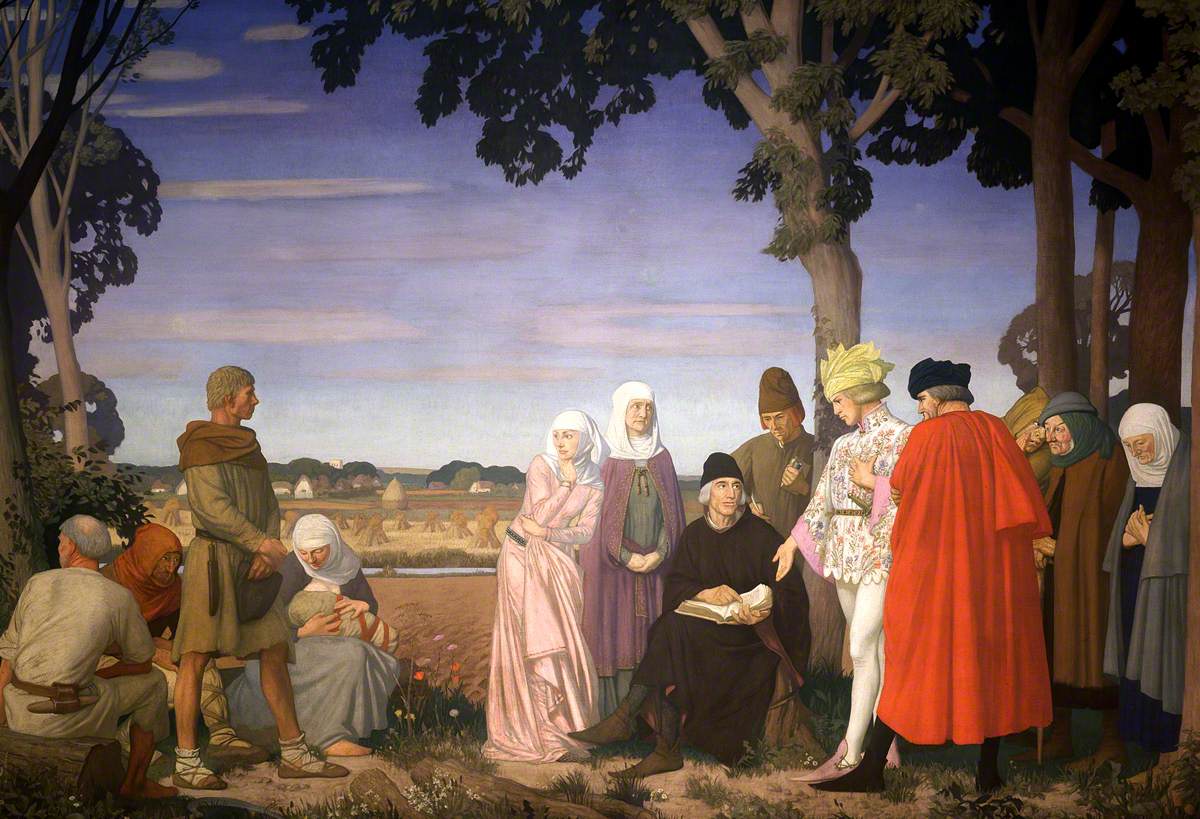
‘The English People Reading Wycliffe’s Bible’ [1925-27] by Sir George Clausen, Oil on canvas, 304.8 cm x 442 cm

Have a real good think about what’s happening here.

In this painting.

The aforementioned oil on canvas is depicting noble persons and ‘ordinary’ folk huddled in close proximity to one another.  Whilst there is a distinct separation between their social classes, including a cringingly aghast demeanour upon the mid-left lady, we do see a coherence of unity.

Religion can stir up avoidably provocative feelings.  Society always has two classes however which way you look at it.  Food for thought, whichever side of the bench you’re on.

The vivid colouration of this piece and realistic yet stylistic representation harks at pre-Raphaelite construction.  It’s a medieval masterpiece.

Given the influence of French artists upon leading British Impressionists towards the late 19th Century, we do see as with all art painters a yearning to ‘the old ways’.  Sir George Clausen is highly experimental.  His body of work unafraid to grace us with fog, dawn/dusk-haze, Realism, Impressionism, Stylistic and (near) Surrealist master classes.

A melted clock and a Dalian signature are not too far-fetched to envisage amongst a select few Clausen works.  Yes, that’s his ability to influence.

I’ve prided myself on keeping my blog neutral in political, religious and current affairs.  Whilst visual art and music are powerful motivating forces my interest has always been social commentary through art.  I make no PR judgements and steer clear of garnering partial affinity with any reasonable PR view as regards my art writing.

What I do-do (sidenote #1 – I found this highly amusing to attract younger Readers) is present information through art and actuate an empowerment throughout all the ages..

.. by allowing you, the Reader, to continuously develop your own knowledge, opinions and beliefs about what you artfully digest.

For the record (sidenote #2 – total vinyl art fan, Darren Baker smiley) I’m indifferent really to searching for the ‘Juju at the bottom of the sea’.

We’re all uniquely homo sapiens, here and now.

Do, do, do, do, do, do, do, do, do, do, do, do, do, do, do, do.

It’s right here, explained in this article cryptically.

Isn’t life about operating humanely, co-existing as closely to our respective laws as we each can with good intentions by the by.

Art has the very capacity to connect people, share views reasonably and agree to disagree amicably.  Our Children Inherit The Art Around Us.

We are all ‘The Torch Bearers’.

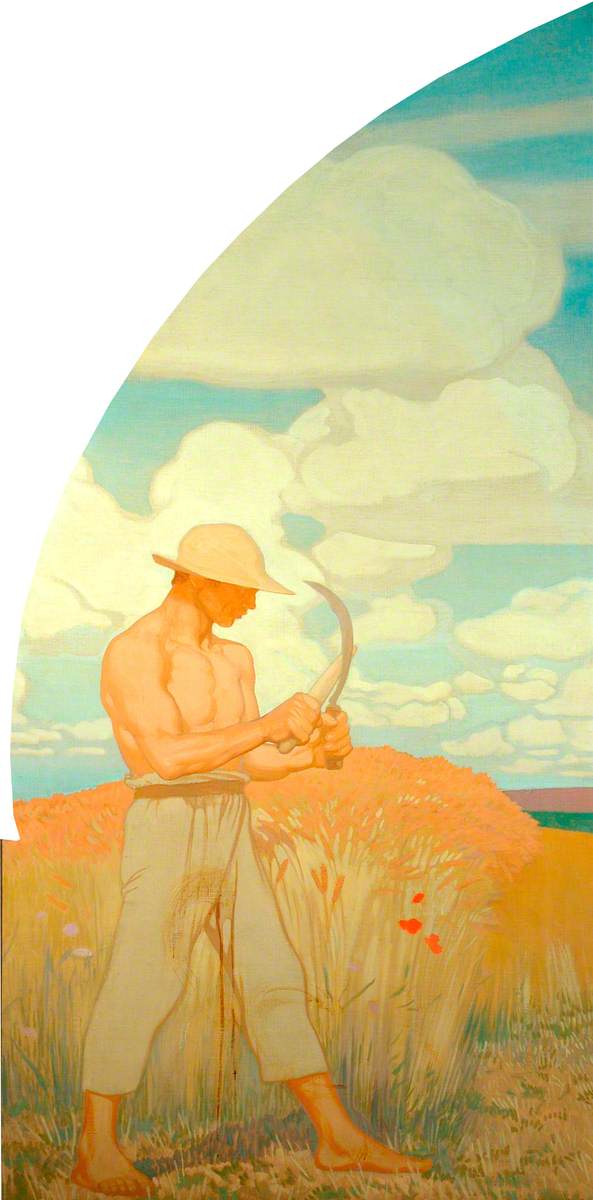
‘The Golden Age’ [1919] by Sir George Clausen, Oil & encaustic on canvas, 305.7 cm x 174 cm.

Ancient Egypt.  Pugilism.  Pompeii.  Dainty flowers.  Breezy air.  Working focus.  Craftspersonship.  Oneness with nature.  His Signatory trademark.  Physical exertion.  Protection from the elements.  Fruitage of the Yellow Sun.  The beauty of nakedness.  Love of clouds.

Those were my immediate thoughts about this iconic looking artwork ‘The Golden Age’ by Sir George Clausen.  Art makes me so happy.

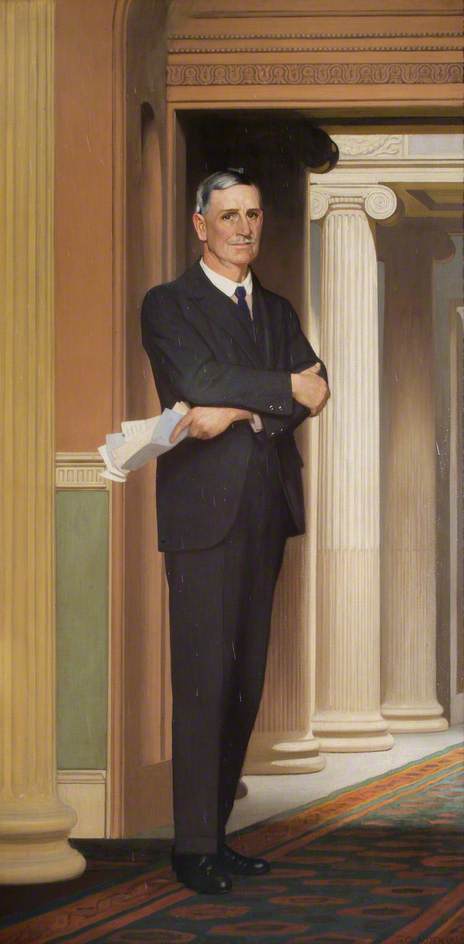
‘William Henry Clegg (1867-1945), Director of the Bank of England (1932-1937)’ by Sir George Clausen, Oil on canvas, 235 cm x 120 cm.

First, musical art – “Fidelity Fiduciary Bank” – https://en.wikipedia.org/wiki/Fidelity_Fiduciary_Bank

This portrait shown above by Sir George Clausen is austere, dignified and slightly awkward about his business to pose.

Business from bisig – care, anxious, occupation.

Work consumes.  I never cease to feel confounded by the working desire of triple-millionaires (£100 millions+) and billionaires.  Business is fun.  Profit is good.  Working can be enjoyable especially from a social perspective.

Would you make it your business to stop people in their efforts to work?

Sounds absurd doesn’t it.  That would be called persecution.

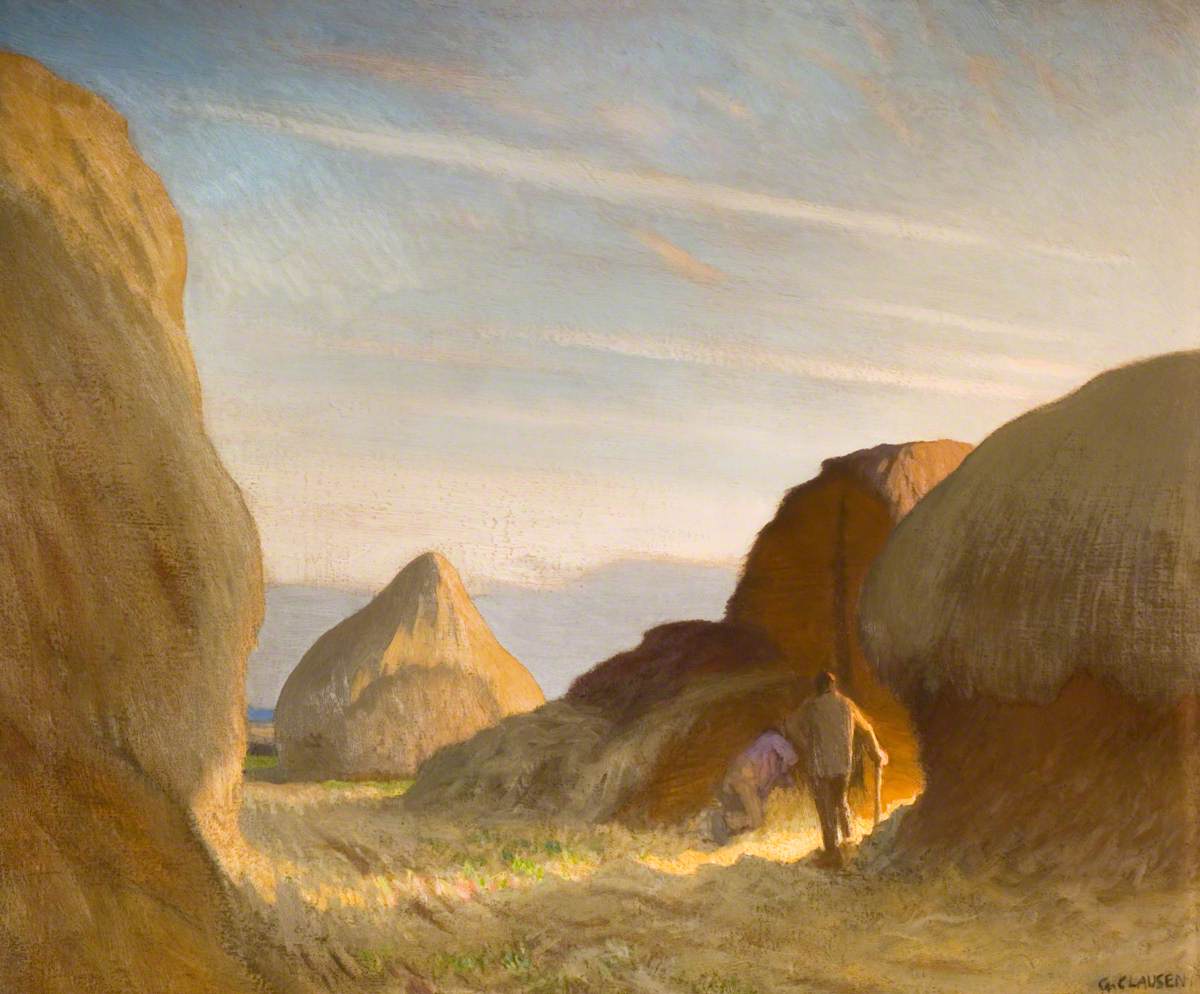
‘Rickyard, Morning’ [1923] by Sir George Clausen, Oil on canvas, 52.50 cm x 60 cm.

I’ve included ‘Rickyard, Morning’ by Sir George Clausen for his application of shade, positioning of the working farmers, unusual composition choice, angle of the clouds and use of negative space.

Having closely observed field workers on a livestock-and-barley farm with all their modern machinery gathering hay in large perfectly round bundles this painting kind of called out to me.

Those farmers I watched working until the minutest aperture of dusk is the very reason why the hint of light in this painting is EVERYTHING.

Never say never to underestimating the ineffable intelligence of a Master at their life’s work.

– Matt The Unfathomable Artist, 15th June 2017.

Standard

Sir John Lavery to Cara Delevingne

‘The Tennis Party’ [1885] by Sir John Lavery, Oil on canvas, 76.2 cm x 183 cm.

Let’s first enjoy additional expert detail about the painting shown above in the following video by the Aberdeen Art Gallery & Museums:

https://vimeo.com/123716025

As explained in the video Lavery’s friends, the Scottish painters Arthur Melville, Edward Arthur Walton and James Guthrie feature in this painting of  ‘The Tennis Party’ (see photo above).

I love tennis.

When I first received a wooden tennis racket as a boy my brother and I would play tennis in my Grandad George’s well-kept garden in Malvern.  Towards the end of the garden was two apple trees we’d climb.

We played makeshift tennis on a rather modest sized rolled lawn adjacent of two wooden tool sheds.  Bees buzzed busily next door for Grandad’s Beekeeper neighbour, harvesting their sweet-solid honey.

Professionally labelled jars given to us every summer.

To practice tennis I would quite often hit balls against the side of our family house on my own prior to and into my mid-teens.  Thankfully, being so young I didn’t serve the ball at the wall too hard.  We know that serves of 137mph are possible on tennis courts these days.

During a very closely contested three sets friendly match, a 27 year old professional full-time tennis coach credited me with the fastest serve he had ever received.  I was 25 years old at the time.

Two sets to one in his favour were quite okay for someone who had never been professionally coached.

Sport is in my blood.  It’s part of my DNA.

‘The Tennis Party’ therefore invokes strong emotional memories for me.  Holidaying in Bude, Devon early 2000’s my ex-girlfriend asked me to play nice and actually rally with her.  Only love could have possibly made me avoid those all too inviting lines and send the ball happily back to her.

It was the most beautiful English day.  Clear blue sky, onward humid heat.

Relationships.  Again, we see a British Impressionist of this era depicting a thoroughly modern view of gender equality within a mixed doubles tennis game.  The gate is open and inviting us to come along and play this wonderful game too.

Young and old.  Social status is irrelevant.

Playful vs Relaxed.  Spectator or eager participant.  A Field of Dreams.

‘Violet Keppel, Mrs Denys Robert Trefusis’ [1919] by Sir John Lavery, Oil on canvas board, 33 cm x 25 cm.

‘Violet Keppel, Mrs Denys Robert Trefusis’ was a must.  Upon viewing this artwork I had to include this in my blog.

It’s precisely the sort of painting I’m looking for.  For instance ‘The Tennis Party’ has unique compositional angles.  What makes the painting ‘Violet Keppel, Mrs Denys Robert Trefusis’ so artistically commendable is her proud, inquiring pose.

The state of her undress is risqué for the time.  Quite in keeping with Violet Keppel as a liberal woman of the early 20th Century.  1920’s extravagance, flair and impassioned art-deco high-society.  I think the 1920’s and 1960’s share artistic freedom to the height of luxury, fashion and mild decadence.

Whereas the 1960’s spread the pursuit of Hieronymus pleasures to the masses, the 1920’s seemed all too intrinsically linked to monetary power and status.  By the 1930’s the masses wanted some of the action.

Moonshine and parties followed.  Mob rule.  Disorder.  Chaos.  Great photography too.  If you love photography and movie art please look up the documentary film of Weegee (born Usher Fellig) entitled:

‘ “I Am Rebel” – Weegee The Famous ‘  [Series 01/Ep02 – 2016, IMDb]

You may even see echoes of Danny DeVito in L.A. Confidential [1997] – if you’re of the appropriate age.

Through this we see the 1920’s morph like clay to become the 1930/1950’s.  Just like Doris Delevingne becomes ‘The Viscountess Castlerosse, Palm Springs [1938]’ by Sir John Lavery.

Yes, Cara Delevingne is her grand-niece.  How cool is that!  Interesting too that Cara is especially creative.  As previously stated in my blog, David Hockney really is a serious art student and a master art working genius.

Value ‘The Viscountess Castlerosse, Palm Springs [1938]’ as a piece of art history entwined.

Living Art, Girls On Film.

The paint application of ‘Violet Keppel, Mrs Denys Robert Trefusis’ is urgent, exquisite and untamed.  Perhaps Violet is portraying herself in a new way for the world to respect her?

“I Am As I Find” a saying by Matt The Unfathomable Artist.

Respect is not necessarily what we do as people.  It’s the inner motivation and intent of what we are.

‘Boating On The Thames’ [1890] by Sir John Lavery,

Anyone wishing to master water painting should check this preposterously life-like painting by Sir John Lavery called ‘Boating On The Thames [1890]’.

We believe the foreground lady is laid-back relaxing in the boat.  We believe the ripples of bluish-green water by wind and movement.  I also thoroughly enjoy those two swans making a quiet appearance.  The sense of reflected light upon the water is carefully considered and astonishingly accurate.

Sir John Lavery shows skilful draughtspersonship.  Detail you can take hold of.  If the nearest boat was at the waters edge we could likely reach out and make it swirl around.  Purely for our amusement.  Maybe they’d fall in?  Oh how that would make us laugh.

What really is man’s work?

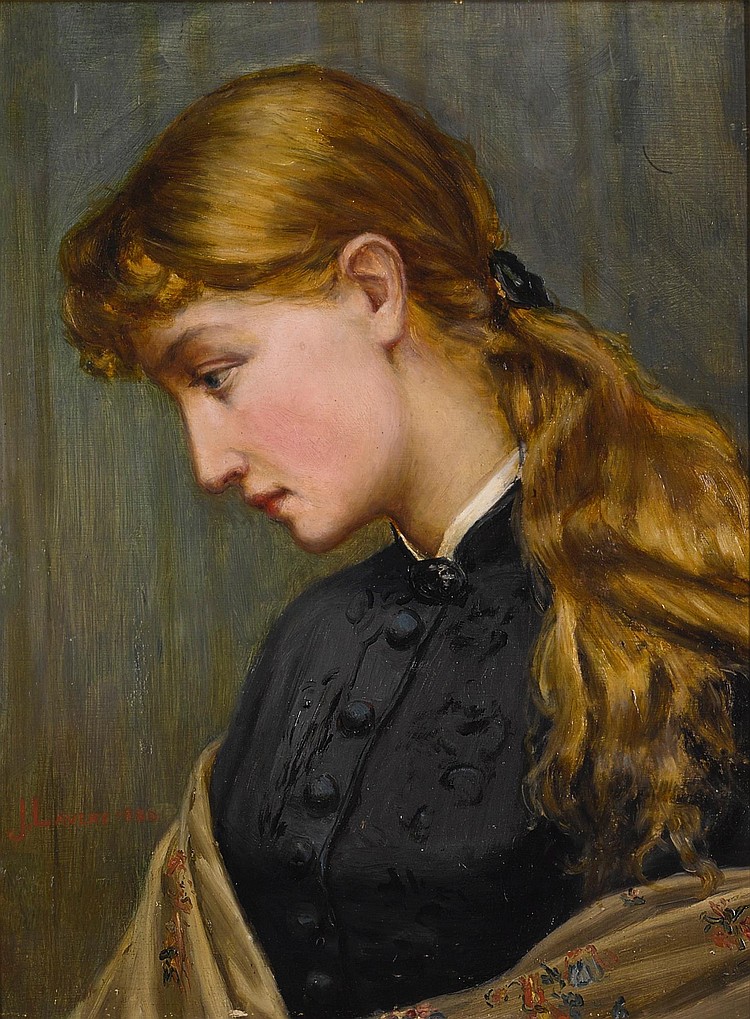
‘Mariana, ‘Is this the End? To be Left Alone, To Live Forgotten and Die Forlorn.’ [1880] by Sir John Lavery, Oil on board, 30 cm x 23.5 cm.

Another painting by Sir John Lavery that was a must to include in my blog..

‘Mariana, ‘Is this the End? To be Left Alone, To Live Forgotten and Die Forlorn.’ [1880] is stylistic and colour rich like those glossy hair adverts.  Mariana is voluptuously attractive yet despondent with loss.  Everything about her screams ‘help and comfort, please apply’.

Her most outer garment beckons us to cuddle her to a modicum of happiness once again.  The tone of her buttoned tunic is solemn, guarded, prim and proper.  Background detail is uncheery and perfectly balanced.

Using hues that replicate foreground detail is an excellent way to balance a painting’s composition.  Here Sir John Lavery uses this method cleverly.  The background does not compete for our attention.

Rather this accentuates our selective viewing order of eyes, the portrait expression/feeling, her facial shape, hair and lighting detail contrasts, clothing choice and her bodily structure/positioning.

I love this painting for in this very artwork it is absolutely clear why Lavery was later commissioned to represent Irish banknotes and coins.  This he achieved through his outstanding artwork of Lady Lavery for some 49 years!

Stylistic artworks require great story telling ability.  Throughout his works Sir John Lavery establishes himself amongst Irish folklore, art history and popular culture as a collectors dream.  Lavery portraits are triumphant and his architectural scenes definitive.

Some of my personal favourites by Sir John Lavery – ‘Under The Cherry Tree’, ‘Viscount Morley Addressing the House of Lords’, ‘Loch Katrine’, ‘Edne May in the Belle of New York’ and ‘A Lady In Brown’.

Standard

The La Thangue Angle

‘An Autumn Morning’ [1897] by Henry Herbert La Thangue, Oil on canvas, 47.5 inches x 37.5 inches.

‘An Autumn Morning’ by Henry Herbert La Thangue features the prettiest young lady exerting herself in forestry work whilst an older male colleague is cryptically obscured in the background vista.

During the late 19th century photography had grown into a fashionable medium for societal sublimation and the cataloguing of everyday events.  Creative painting had already scribed itself into this cultural mechanism for millennia.  For instance, ancient Egyptians crafted pictorial ‘movie’ reliefs to affirm various belief systems to their populace.

The Mummy and her Children.

In ‘An Autumn Morning’ La Thangue’s attractive lady displays a determined working ethic.  We could take the painting at face value as merely a woman bending a stick.  Considering the political mindsets of her generation there is a plethora of social commentary going on within his innovative composition.  Along with an impressionistic focal merging to highlight the foreground.

Both subjects, man and woman, have their heads momentarily cast downwards in an equality of effort.

Let’s call this young lady Kirsty for the purpose of explaining my reasoning.  Kirsty is very strong.  Look at her hands bending the wood.  Her measured grip.  Kirsty is not shy of putting her knee into the work to muscle a stubborn obstacle in her path.

Would you agree that this painting represents an intellectualised struggle?

Dignified.  Independent.  Womanly strength with purpose and vigour.

Henry Herbert La Thangue absorbed modern cultural ideas and inventions to bring forward his unique perspective of art.

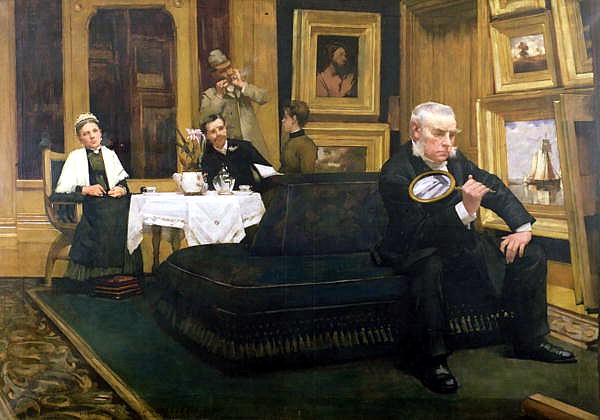
‘The Connoisseur’ [1887] by Henry Herbert La Thangue, Oil on canvas, 44.88 inches x 63 inches.

Abraham Mitchell can be seen, shown above, contrary to his family whilst socialising in this masterful composition entitled ‘The Connoisseur’.  Mitchell is seriously pondering a recently purchased painting, magnifying glass in hand.

‘Dear Mr Holmes, did you notice.. the year is 1887..

‘..and there is a simile of “Boat in an Estuary”‘ on the wall?!’

Here Mitchell’s art collection surrounds everyone present in his gallery area.  Abraham Mitchell is clearly engaged in his endeavours with absolute exclusivity.

La Thangue’s painting suddenly reminded me of the Hen and Chickens in Ludlow.  My dear paternal Gran with all her quality coffee consumptions had numerous footrests available throughout the guest rooms of the Hen & Chickens in Ludlow.  Now three decades past during my early teens.

Freshly caught rainbow trout from the river makes for a marvellous dinner.  Ludlow Castle.  Chocolate truffles.  True stories of her life in Saudi Arabia and Africa.  Visiting the cellar, beer barrels on tap.  Ice cold glass bottled Cola.  Darts.  The Garden.  Postcards.  Nostalgia.  Ye Olde English culture and architecture.

I’d like to mention that Mr R. H. La Thangue, father of the artist, is an extraordinary likeness of my Gran’s second husband.

Great art stirs emotion.

During research about La Thangue I found highly insightful information online about ‘The Connoisseur’ in a direct quotation, shown immediately below in bold.

With the kind courtesy of Dr Grosvenor’s enjoyable art blog: http://www.arthistorynews.com/

“The Connoisseur” by Henry Herbert  La Thangue is actually of Mr Abraham Mitchell, aged 53 at the time, a Bradford textile tycoon and a Methodist of “reserved and retiring nature”.

He and his brother Joseph built neighbouring mansions (called “The Parks”), his with a picture gallery, which is the setting for this work. He was one of La Thangue’s principal patrons.

In the background are his wife and their two sons Tom (standing) and Herbert, and one of his daughters either Edith or Annie. Mitchell had been a local councillor, alderman, JP and refused the mayoralty of the town (see “A Painters Harvest”. Oldham Art Gallery catalogue 4 November -12 December 1978 Page 22 & 23).”

Many thanks also to a contributory reader of the ArtHistoryNews blog.

Artistic Analysis:

Like most exceptional artists La Thangue enjoyed particular focal references and the crafting of new compositional versions within a given theme.  Examples of this can be found in:

‘A Sussex Farm’ and ‘The Watersplash’ – a gathering of birds in a forced perspective, facing the camera.

‘Boy Filling Water Jars at Well’, ‘Ligurian Roses’ and ‘Winter in Liguria’ – a water well positioned right, standing or stooped singular character interacting with the well.

‘Gathering Bracken’ and ‘An Autumn Morning’ – two field forestry workers, one male, one female in complimentary working actions.  Intelligently contrived.

Studying La Thangue paintings further, as if with magnifying glass in hand, I noticed he uses favoured compositional arrangements to great effect.  Two distinct distances in contrast or harmony with each other to draw the eyes naturally to his intended descriptive. 

In ‘From a Ligurian Spring’ La Thangue repeats this structural arrangement of subjects/objects three or four times.  Tree branches, two carefully placed wooden posts, two adjacent stone walls and contrary ’emotional reflections’ of the painted characters foreground to background.

This structural observation can also be seen between the wheels of a cart; the outstretched shoulder-length arms of one person (there are exciting examples amongst his paintings of this inventive idea); two toy boats set to sail by a boy; general foreground to background character placements; person to working animal/s positionings and even two trees carefully framed to unify our attention.

My latter observation is clear to see in his painting ‘A Sussex Hayfield at Graffham’ [1912] shown immediately below:

‘A Sussex Hayfield at Graffham’ [1912] by H. H. La Thangue’, Oil on canvas, 25 ¢ inches x 29 1/4 inches.

From an online reference..: http://www.graffhamparishnews.org.uk/Magazines/GPN2009_11.pdf

..pages 20 to 27 is a treasure trove of art history about La Thangue.  Superlative publications like these are wondrously revealing to read.

La Thangue had residency in Chelsea – London, South Walsham – Norwich, Rye – East Sussex, Horsey Mere – Norfolk Broads and Bosham – West Sussex.  All prior to settling with his actress wife Kate Rietiker in Graffham – West Sussex whom he married in 1885.

Living in Graffham from 1898 to 1926, La Thangue clearly established his artistic influence following his early art apprenticeship with Jean-Leon Gérôme in Paris, France.  As previously stated regarding his admiration of Bastien-Lepage and Léon-Augustin Lhermitte, La Thangue’s connection to French art heavily influenced his work.

The sophisticated art sales platforms of Paris invigorated him into fine tuning British Art institutions and art communities in the UK.  Working on these worthwhile professional endeavours with much assistance from his highly accomplished artist colleagues.

The Graffham Parish News, hyperlink immediately above, specifically mentions The New English Art Club.  La Thangue also became an Associate Member of the Royal Academy of Arts in 1912.

Without question La Thangue is a very important British artist.

Visits to Provence, France follow during the early 1900’s along with Liguria, Italy (paintings aforementioned) and the Balearic Islands.  Reference Wikipedia –https://en.wikipedia.org/wiki/Henry_Herbert_La_Thangue

Let’s take a look at another Henry Herbert La Thangue masterpiece:

‘A Farmyard Scene’ [1905] shown immediately below – oh me, oh my – quite super.  Truly a charming painting par excellence.  La Thangue incorporates an honest application of sunlight in a natural residential setting.

‘Farm Yard Scene’ [1905] by Henry Herbert La Thangue, Oil on canvas, 73cm x 81cm.

Viewing this ‘Farm Yard Scene’ of Italy I’m picturing a past visit to Rhodes, recalling the Old Town chickens roaming freely between garden pathways – wild with their interactive noisy squawking.

With thanks to dear Henry Herbert La Thangue for his time honoured contribution to international art.

Next artist writeup is.. well you shall need to read my blog to find out.

Thank you dear Readers.

Standard

Anna Hyatt Huntington – The Sculptress

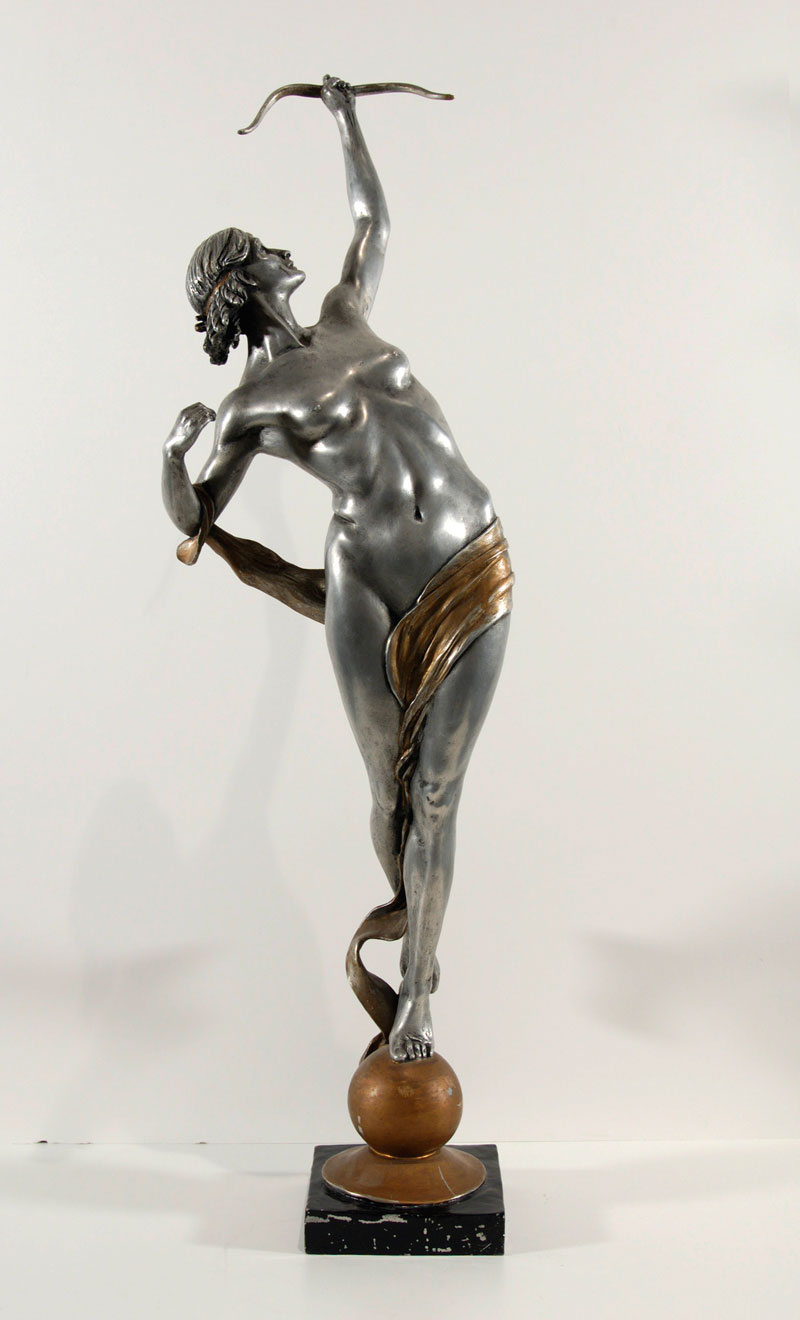
‘Diana’ [1932] by Anna Hyatt Huntington, Aluminum, gold plate and silver plate, 32 1/2 x 9 1/2 x 8 1/2 in.

Anna [Vaughn] Hyatt Huntington born 1876 shared her birthday of March 10th with her wealthy husband Archer Milton Huntington whom she married in 1923.

Relocating to New York City to enable her career to flourish in 1902, A.H. Huntington is one of the greatest representations of female empowerment within art.

Truly inspiring.

Her ‘Diana’ figure shown above was produced in varying sizes, cast materials and alternative compositions.  The New York Historical Society and NYC’s National Academy of Design have two larger versions of this cast.

The beauty of this sculpture is immediately eye-catching.

Okay, what does this sculpture reveal to us?

The bow points upwards signalling a contrary position to divinity.  Artemis, the Greek name of the latinised Diana, is posturing her own divine power.  An understanding of specific ancient texts regarding the usage of arrows in ancient culture as ‘signs’ is intimated in this piece.

Likely Anna Hyatt Huntington was aware of such understated references during her prior sculptural studies and research.

Art professionals know that Anna was particular about physiological designs in terms of historical, anatomical and cultural placement.  The ‘Diana’ figure has symbolised adoration of the female form for millenia.  From a military perspective the upward positioning of the bow could also represent ambition to further exceed in contested plans.

‘Here on Earth the answer is always a matter of the Height, the Breath and the Depth of things.’

The way Huntington has intended her Diana to pose alluringly beckons the viewer in a feminine way to support her cause.

The figure is both subjective and authoritive in design – a uniquely crafted balance.  This might help us to gain insight into Anna’s idea of marital harmony.  Anna is not forcing her artistic idea of ‘Diana’ upon you.

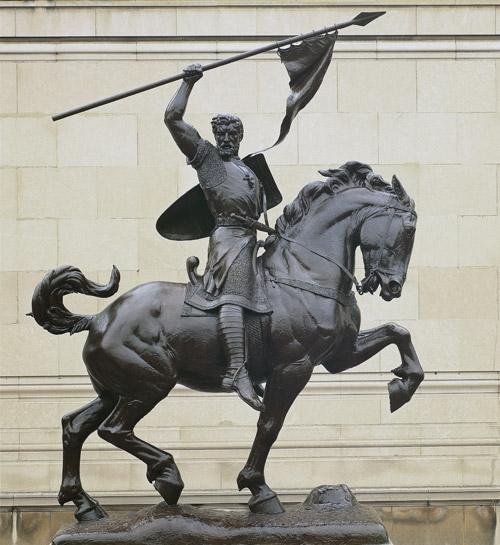
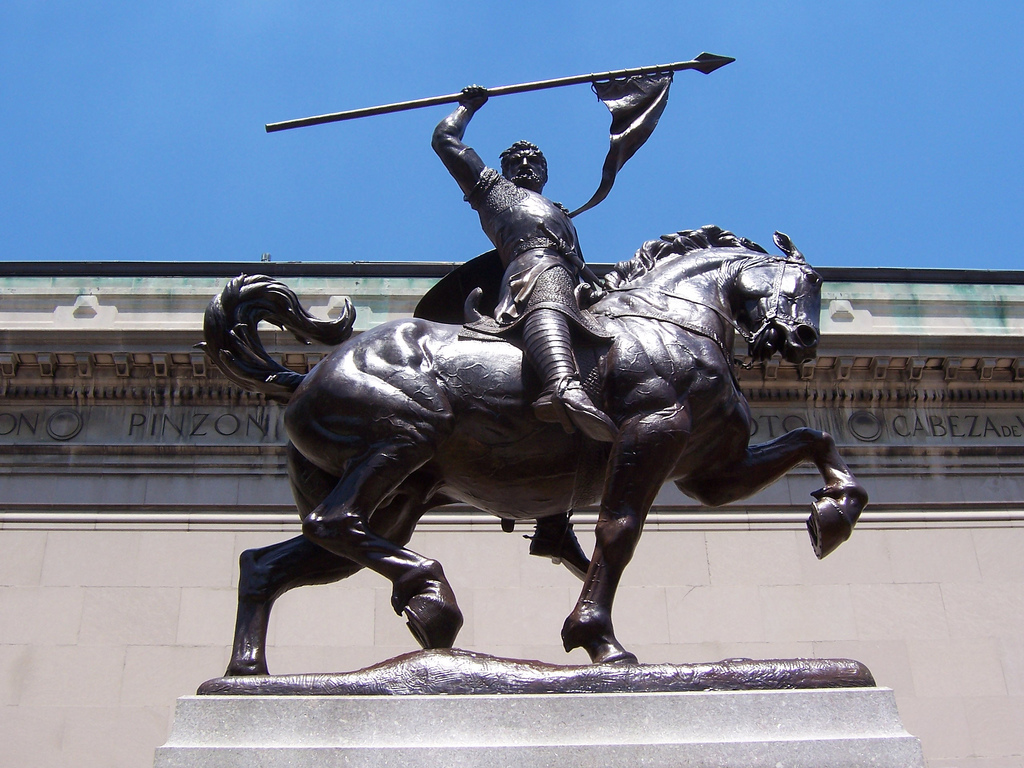
‘El Cid Campeador’ [1927] by Anna Hyatt Huntington, Bronze statue on stone at the New York Hispanic Society of America.  Photograph courtesy of the HSA – NYC.

Please click the photographs for further detailing:

‘El Cid Campeador’ by Anna Hyatt Huntington.
Photograph courtesy of http://xtremearttourists1.blogspot.co.uk/

‘El Cid Campeador’ in New York by Huntington, pictured twice above, is a highly useful study for fledgling sculptors to investigate.  If you’re studying art I would encourage you to do so.

Anna and her husband Archer enjoyed researching fine details.  Their vision of art is based upon facts, realism and visibly tangible elements.  Regardless of the subject matter Anna was always looking to create a faithfully unique sculpture of the subject wherever possible.

The process of learning about an intended commission preceded her clay studies as an integral part of the intellectual design long before the delivery or final unveiling.  Archer was a constant source of inspiration for Anna through his own scholarly interests.

Yet, Anna was already self-sufficient from her art career prior to their marriage.  From the 1910’s Anna earned a monumental amount of money per annum – $50,000.  This would be at least $1.2 million US dollars annually – adjusted for 2017!

‘The Torch Bearers’ [1954] by Anna Hyatt Huntington, Aluminium sculpture, 6m x 6m x 6.2m. At Ciudad Universitaria in Madrid, Spain. Photograph by JL De Diego.

There are versions of this Spanish sculptural installation by Anna called ‘The Torch Bearers’ (shown above) in Havana Cuba, South Carolina, New Jersey, Virginia and one each at Bridgeport & Redding in Connecticut.

‘The Torch Bearers’ is a truly moving piece of work, part-reminiscent of Michelangelo’s near-ineffable Sistine Chapel ceiling artwork.  If you can visit any of Anna’s intricate sculptures I’m sure you will enjoy the whole experience.

Anna Hyatt Huntington’s sculptures along with the ancient ‘Artemision Bronze’ at the National Archaeological Museum in Athens Greece can only be best appreciated visiting them in person.

As friends.

N.B. In keeping with todays article theme of female artistry please check out Marie Hammer’s art, hyperlink below.  Her husband, Rusty, writes the Xtreme Art Tourist blog aforementioned.

They both love art as much as Archer and Anna Huntington.  After reading about Archer’s Hispanic museum quest from his boyhood this takes some serious doing!

Marie’s website:

http://mariesegallery.blogspot.co.uk/

Standard