“emi mi” — The Geometry of Consequence

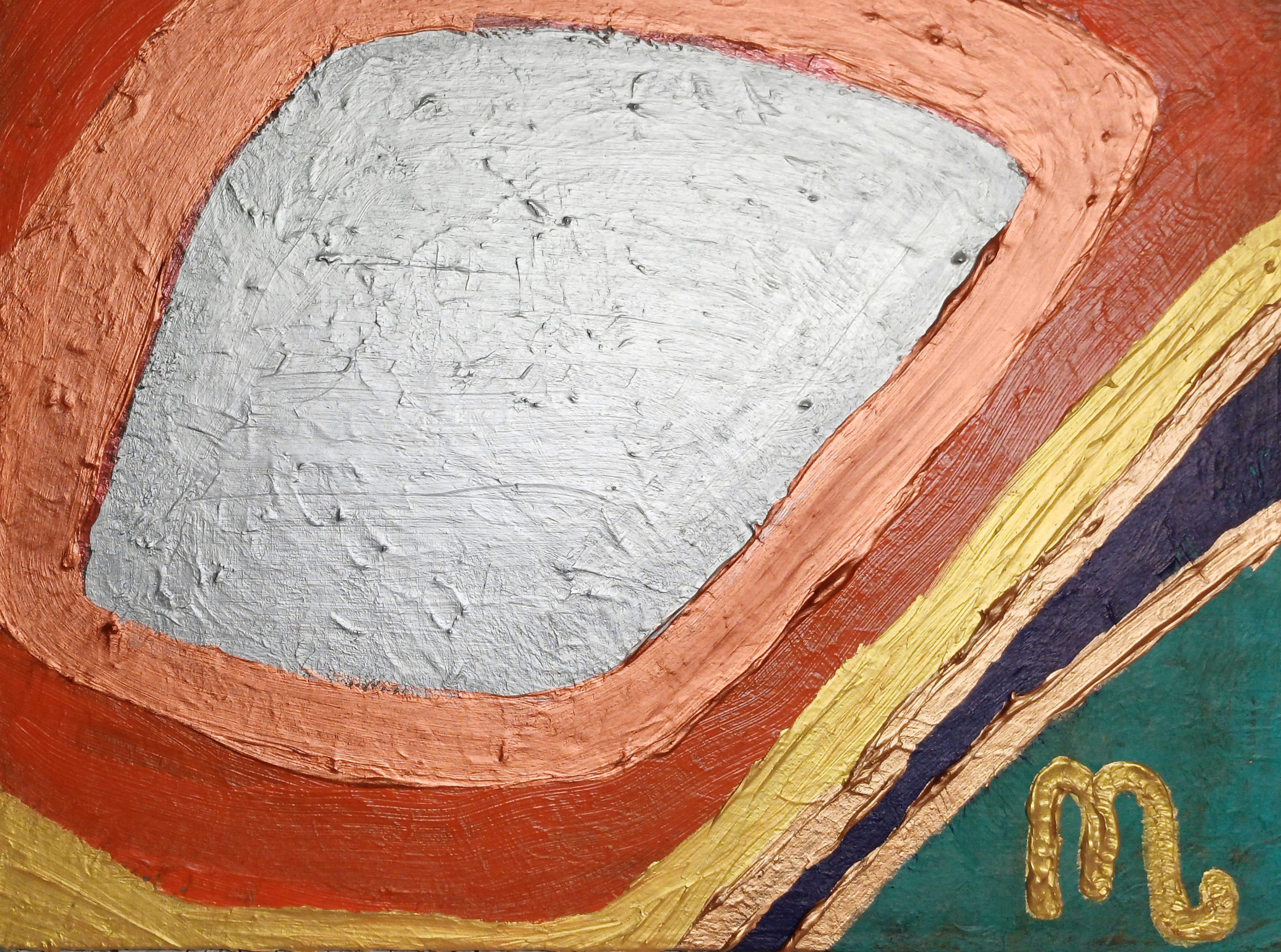
Abstract painting titled 'emi mi' featuring a central, textured silver monolith surrounded by bands of oxidised copper, gold, and violet. A stylised gold 'm' signature sits in the bottom right corner.
“emi mi” [29th May / 1st June 2025] by Matt The Unfathomable Artist, acrylic on A3 (42cm x 30cm) gesso primed 5mm wooden board, 5000 x 3716 pixels.

The Silent Sentinel

Art reflects a shared conscience and understanding.

In “emi mi” I switch from flowing gesture to firm geometry, using the cool poise of mid-century science fiction as atmosphere rather than subject.

While “The Day the Earth Stood Still” centres on Klaatu—the messenger—my focus is destructive force: Gort, the mute power that enforces the warning. This piece does not depict or reproduce any character or image from that film; the reference is conceptual.

The Abstraction of the Enforcer

An irregular silver monolith commands the field. This is not formal portraiture, rather a distillation: visor, eye, shield. I rarely embrace strict forms, yet to convey a cosmic arbiter the organic yields to rigid structure. The silver plane intrudes with order, dominating the canvas.

Oversight of Human Entropy

Though the style nods to mid-century sci-fi and modern abstraction, the story is present tense. Klaatu arrives to assess; Gort stands ready to act. Here, the silver mass is a celestial oversight of man-made harm. Surrounding bands—oxidised copper, burning gold, bruised violet—signal extraction, scorched habitats, pollution and the dull red of conflict. Hard demarcations: cold corrective logic set against heated disorder.

The Weight of the Ultimatum

Silence is the threat. This presence sees not argument or contention; it measures. Metallic impasto reflects actions. The painting is a study in accountability: by reducing the “enforcer” to a single dominant shape, it asks whether a civilisation can survive its own inventions—or face the consequence of the silent sentinel.

Who or what is the silent sentinel to you?

Is it purpose, chance or cause and effect?


Title Note:

‘emi mi’ fuses EMI (electromagnetic interference) and MI (machine intelligence) with linguistic echo of the self. Succinctly referencing “Mi” iconography as a superscript while the lower-right “M” signature is dually stylised as the human presence to whom the geometric form inclines for direction.

Standard

Bloom of Works

“Rosé Wine Flowers” [24th November 2024] by Matt The Unfathomable Artist, abstract acrylic painting on A3 250gsm mixed media paper, 4000 x 2914 pixels.

For readers who haven’t seen my pre-published social media here is a commentary for the artwork above in bold and italics:

“Rosé Wine Flowers” began with splatting a fan brush all over the canvas. Much fun to be honest. I then brushed in abstract shapes impasto style. The copper creates a wonderful contrast to the canvas which I have included in the photography for you to enjoy.

I have seen a ‘soldier’, ‘Beethoven’ or perhaps a ‘scientific genius’ in the abstract shapes. 100% pure chance. The vermilion hue red I added to harmonise the painting whilst also experimenting with compositional ideas.

From this lattermost freestyling I derived the working title “Rosé Wine Flowers” since afterwards it immediately reminded me of an artist’s work I viewed in a gallery some time ago in 2008.

An artist style I could recollect some sixteen years or so later. Her expertise is floral depictions. I felt my cadmium-red brush lines inadvertently emulated her floating, dreamy canvas quality.

Cadmium-red overpainting transformed this painting, providing definition with structure. A place for your eyes to wander.

‘The Beethoven’ as I shall call the mid-lower chance portrait is purely a bonus.

Standard

‘Creative Mind’ – oil on canvas

‘Creative Mind’ [completed Summer/Autumn 2012] by Matt The Unfathomable Artist, Oil on canvas, 36ins x 28ins.  Please note the lower right artist’s signature is not shown in this photograph.

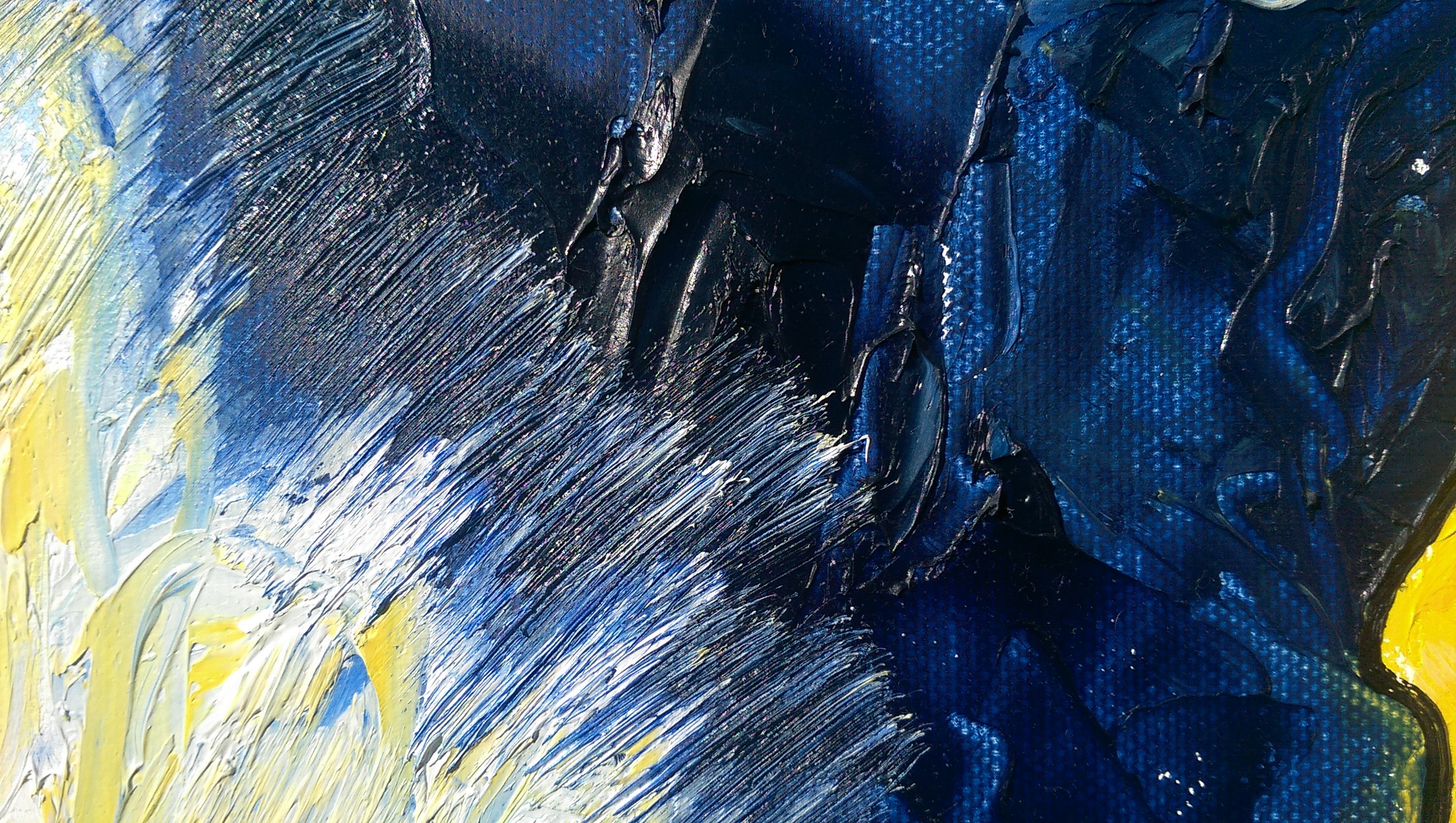
Detailed photography [01] of ‘Creative Mind’ [completed Summer/Autumn 2012] by Matt The Unfathomable Artist, Oil on canvas, 36ins x 28ins.

Detailed photography [02] of ‘Creative Mind’ [completed Summer/Autumn 2012] by Matt The Unfathomable Artist, Oil on canvas, 36ins x 28ins.

Detailed photography [03] of ‘Creative Mind’ [completed Summer/Autumn 2012] by Matt The Unfathomable Artist, Oil on canvas, 36ins x 28ins.

Detailed photography [04] of ‘Creative Mind’ [completed Summer/Autumn 2012] by Matt The Unfathomable Artist, Oil on canvas, 36ins x 28ins.

Detailed photography [05] of ‘Creative Mind’ [completed Summer/Autumn 2012] by Matt The Unfathomable Artist, Oil on canvas, 36ins x 28ins.

I hope you love my oil painting artwork ‘Creative Mind’.

Thank you

Matt The Unfathomable Artist

Standard

Jackson Pollock Wows

No. 5 (1948) by Jackson Pollock. 243.8 x 121.9 cm (8ft by 4ft)

No. 5 (1948) by Jackson Pollock.
243.8 x 121.9 cm (8ft by 4ft)

No.5 completed in 1948 is without doubt the most famous abstract painting ever.  Produced by dripping paint onto the canvas during an ordered creative art process.  No. 5 has a beauty all of its own.

Pollock was working at a time when the whole abstract art movement was positively vibrant with pace and ascendency.  If you could hop into H.G. Wells “Time Machine” and travel back to Pollock’s art era you would see the equalling influence of leading abstract painters during his life.

Every artist has their own style and constructive technique.  What demonstrably impressed me about Pollock is his professionalism.  He is meticulous, innovative and inspirational.  Clients often expressed their appreciation for his work with profound eloquence describing the beauty of his art as a rapture or a deeply spiritual experience to them.

Jackson enjoyed layers to add depth.  He understood that dissemination can be beautiful if it’s ordered and fashioned in an exciting way.  This expertise that color and structure can be strongly emotive is why he is a Master of the modern art era.

An Abstract giant where there is little or no perceptible form to discern except that which we perceive as feeling within.

What makes popular?  Who holds the secret?  Why does something non-living have continuing value both monetarily and as a connection to the human experience?  Perhaps the answer is the very question.  Out from a non-living arty contrivance we see the personality on the canvas, the fiberboard, the paper or the multitude of ‘watercoloured skies’.

Can we really be objective about art?

Standard