Empathic Depictions by Jean-Michel Basquiat

Untitled known as 'Two Heads on Gold', 1982. Acrylic and oil paintstick on canvas [80 × 125 in 203.2 × 317.5 cm]

Untitled ‘Two Heads on Gold’, 1982 by Jean-Michel Basquiat
Acrylic and oil paintstick on canvas
80 × 125 in- 203.2 × 317.5 cm

Today I finished watching the latter half of a docu-movie entitled Jean-Michel Basquiat: The Radiant Child.

Let me please ramp up some intellectual thoughts for your consideration.  Ok, well up until several weeks ago I didn’t know that Charles Bird King’s father was killed by a native American.  This would not be poignantly significant except that Charles Bird King is almost singularly remembered as one of the greatest historical portrait artists of native American culture in a truly positive light.  Dignifying the perspective of native Americans in his day and beyond to our time.

The question to ask from this docu-movie in my opinion is – How did Basquiat die at 27 years of age?  Obviously his lifestyle choice was conducive to this.  He was sucked up into a decadent torrent, seemingly casting himself off in an instant.

Can anyone here expect to cast a pebble into the sea only to find that same pebble rise to the surface of the waters and roll back towards you?  What you actually do is skim the pebble upon the surface many times to see it skipping along the smoothness of waves.

I’m deeply moved by this film because I see almost precisely the same sensitivity and fragility that Van Gogh no doubt possessed during his own lifetime.  37 years and 27 years is merely glancing at the surface of what life has to offer.

At this point I would mention that perhaps watching Pina (preferably in 3D) by Wim Wenders is also a strongly emotive film experience.  That is, if you would like to tap into your deep inner sensibilities for an hour or two.  Personally speaking I do sincerely become immersed in a range of emotions during these arty indulgences.

Back on track to Jean-Michel Basquiat.  Firstly a superior artist to any reference of what we might consider good or acceptable art in quality.  His drawing in a child-like manner explains how he felt as a person in this highly competitive commercial world.  Cartoonistic, raw and excitable in style.  Abrupt, often complex and bold.  Stark and beautifully complimentary.  Largely attractive colour contrasted arrangements.
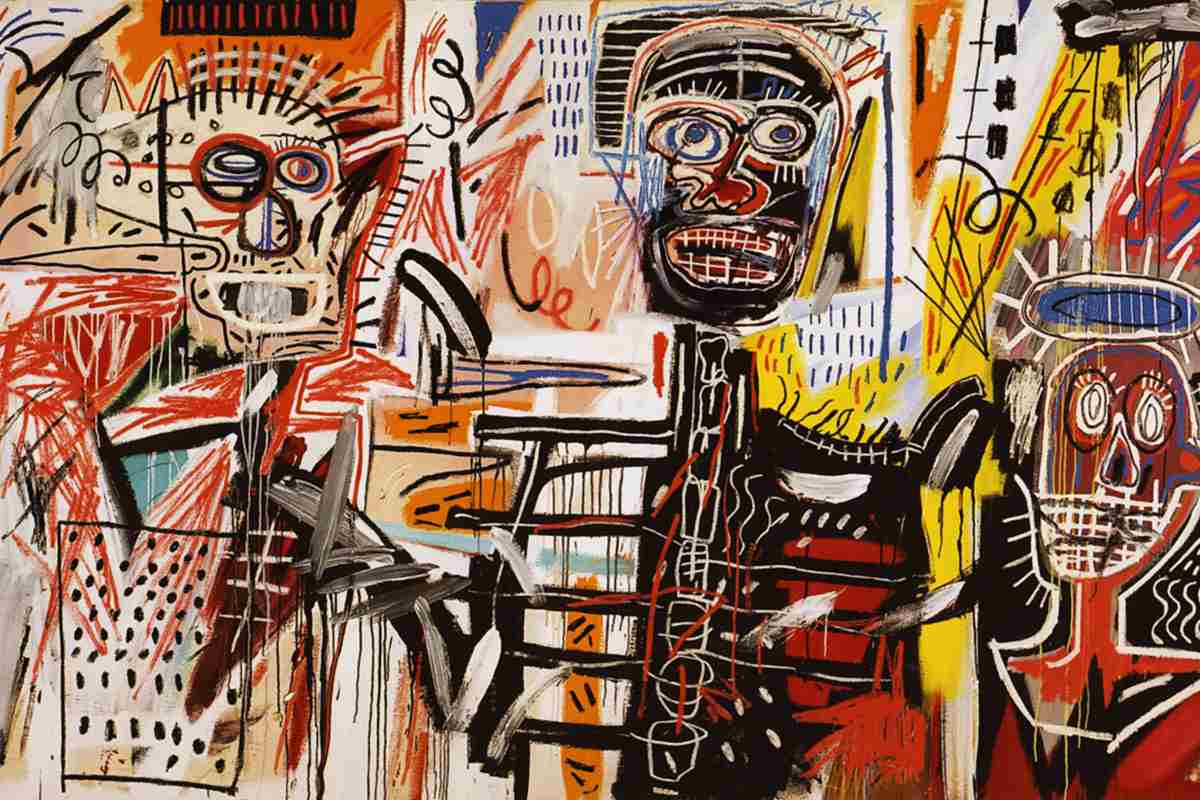
Philistines – 1982. Acrylic, crayon on canvas, 183 x 312.5cm.

Philistines – 1982 by Jean-Michel Basquiat
Acrylic, crayon on canvas, 183 x 312.5cm

Is Jean-Michel Basquiat explaining some of his own life experiences in his painting above?  I would strongly accept this hypothesis.
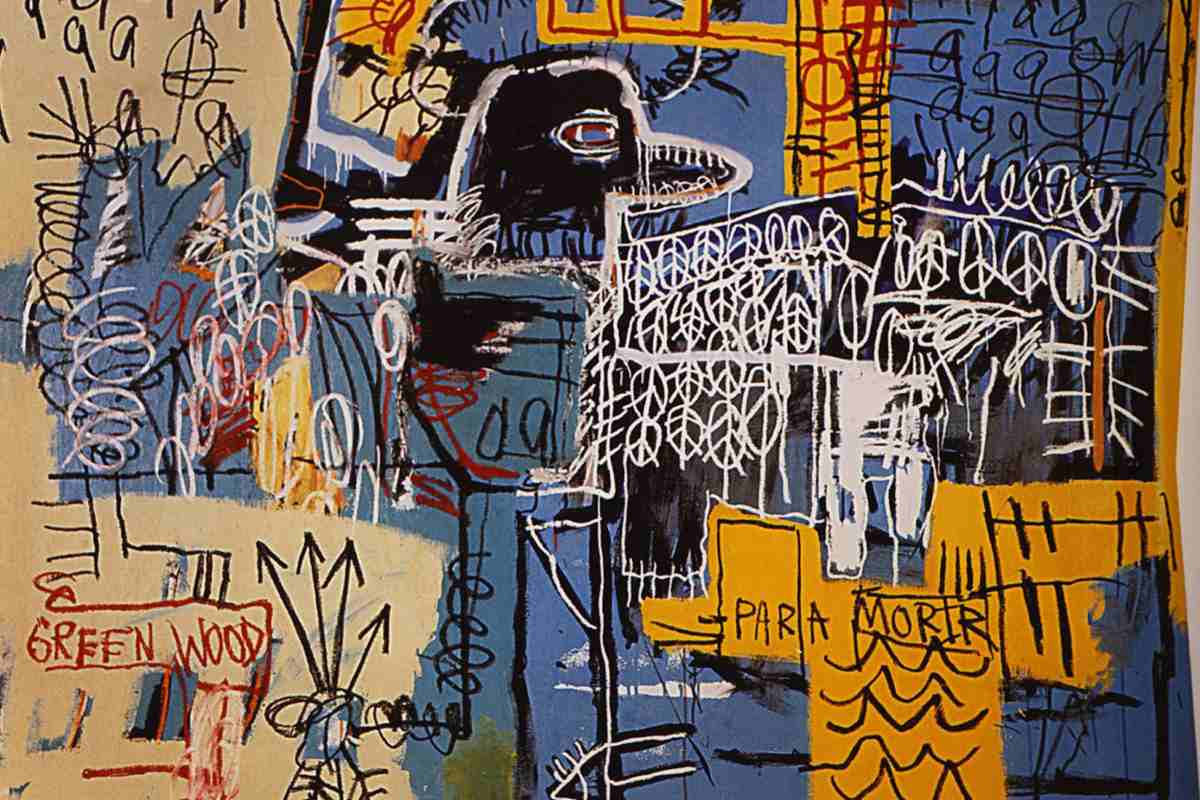
Bird on Money, 1981 by Jean-Michel Basquiat. Acrylic, crayon on canvas - 167.5 x 228.5cm

Bird on Money, 1981 by Jean-Michel Basquiat.
Acrylic, crayon on canvas – 167.5 x 228.5cm

Come on surely we would all like to own a Basquiat?  Colourful and interesting doesn’t even begin to describe a Basquiat.  His influence in artists like Banksy is almost a given.  Basquiat clearly dignifies many artists within his paintings so I think its posthumous reward his art is still living and breathing today.  Speaking street and high brow intellectualism as one.

Del Monte, c1984-1985 by Jean-Michel Basquiat and Andy Warhol. Synthetic polymer paint & silkscreen ink on canvas. 76 x 88 in. (193 x 223.5 cm)

Del Monte, c1984-1985 by Jean-Michel Basquiat and Andy Warhol
Synthetic polymer paint & silkscreen ink on canvas
76 x 88 in. (193 x 223.5 cm)

I’ve included this latter painting above to add controversy to the whole art valuation debate.  What is a piece of art worth?  This painting sold for $1,082,500.  Unusually Jean-Michel Basquiat chose not to use visible words or letters in this artwork.  The branding work is synonymous with Andy Warhol’s style.  An art collector would pay this sum purely based on the strong friendship that Andy Warhol and Jean-Michel Basquiat had or perhaps because JMB is a genius for unspoken commentary?

Art is each their own personal feeling.  But I tell you something, when I saw the slave ship briefly referenced in one of Jean-Michel Basquiat’s paintings during the docu-movie aforementioned, well, sometimes it takes time to see what an artist is saying or feeling on many levels.

Personally I think this is Basquiat referencing his savvy worldly acumen and woefully addictive tendencies with honest sentimentality.  I would be surprised if the brilliance of his style does not find influence in my own future artworks ‘through a new mind’ in some way.  I certainly hope so because I loved the man himself.  A great pity he is no longer with us as a person and masterful artist.

Standard

Momentary Weakness – A Poem

“Momentary weakness is the passing of the night, the full Moon that rides quietly by, it’s the Swans for gliding forever high, on the waves made by our Sun’s rapturous roaring flight, in a mustering up of energy ready for the invisible fight, a gathering of thoughts to win out with last breaths might, as I’ve said before ‘You cannot contain my spirit’ quite, when with all I stand unequalled in this mind, that is ever thirsting for the Light.”

Words for you to picture.

Matt, The Unfathomable Artist – Copyright © 24th May 2015

Standard

Songwriting Mood With Added Swings, Dali-cious

Inspiration is often like the dances of butterflies.  Pretty and irrevocably beautiful.  Whilst I’m eager to paint soon, creating new song ideas and musical compositions has been lots of fun.

Most songwriters enjoy various layers of thought to their songs and I’m definitely no exception.  As a boy of three years of age I was, I’m told, a fan of Abba and Queen’s ‘Bohemian Rhapsody’.  I know this to be true.

Working out everything with reference to the latter lyrics was extremely satisfying, especially when my thoughts were rightly confirmed quite some time afterwards.

I recall a famous guitarist from another rock band stating that there was no way their lead singer could possibly have much meaningful sense or reason to some of the lyrics he had jotted in a mere matter of minutes.

I dissect whatever seems reasonable to gain an understanding of individual people.  Really though, can anyone know you better than yourself?

The strangest new chorus came to my mind the other day:

‘Have you seen the Cannibal?
Lurkin’ wanton inside your skull,
It’s kind of grey and alien!
Feedin’ on bloods limitation

Don’t get caught, don’t get scared
Cos when its hungry it don’t care
It’ll-sweep-you-off-the-floor, with.. your.. bones,
Its gaze turns your body putrefied Auld,
Like Seventy Nine to the Power of Ten’

Matt, The Unfathomable Artist – Copyright © 10th April 2015

Standard

Super Icon

Having unwrapped the cellophane from a new canvas it didn’t take long for me to wreck the composition because I’m finding the subject material wondrously challenging.

I promise you that even Monet with all his effortless talent needed patience to get exactly what he wanted.

Skill takes time.

I appreciate that all artists have personal epiphani and epilogues of varying distance and depths.  Whenever a personal epiphany is with me I work with tremendous focus.

Painting is a feeling.  My heart is with the art.

I do wish to write things at this moment.  Share my feelings in the vernacular.  Super Icon is a song I wrote in 2006.  I regularly write lyrics, sayings, short stories and poems year on year.  It’s all the thoughts of me, so to speak.

Every song I’ve wrote has a clearly defined melody.  I write lyrics to melodies and melodies to lyrics dependent upon whether it’s the musical or lyrical inspiration arriving first.

Here is Super Icon:

Super Icon 

Oh please do up your lace

Silk worms doin’ overtime

Stallions in a filly race

All I want laid to wait

Chorus 

“Got a new super icon 

You can’t have or buy one 

Looks so nice on my mantelpiece 

Seen it close up megapixel 

Oh a super user icon” 

Got a flyin’ machine

Landin’ strip in the cockpit

Seen it dippin’ splendidly

Engines blowin’ gracefully

Chorus 

“Got a new super icon 

You can’t have or buy one 

Looks so nice on my mantelpiece 

Seen it close up megapixel 

Oh a super user icon” 

Seen one posing double view

Inter-plan-e-tary

Flowers in a vase and dare me

What you wantin’ scary

Linkin’ arms and shakin’

Euphoric body breakin’

Chorus 

“Got a new super icon 

You can’t have or buy one 

Looks so nice on my mantelpiece 

Seen it close up megapixel 

Oh a super user icon” 

Super user icon

Super user icon

You can’t have or buy one

Love my super icon

Super user icon

Super user icon

Super user icon (to fade)

Matt The Unfathomable Artist – Copyright © 23rd April 2006

Standard

Art in the Making – Creative Mind, Human Heart

Quite literally behind my oil painting entitled ‘Human Heart’ you can see the concept and pattern begin to form.

humanheartinprogressweb

Earlier photo of ‘Human Heart’ whilst a work in progress.The physical idea of the heart shown centrally in the photograph of my artwork above was overpainted.

The ghostly apparition eventually appeared in the place of the physical heart originally envisaged.

Linseed oil was mixed extensively producing a sort of treacle effect.

Here is the completed ‘Human Heart’ oil painting:

'Human Heart', oil painting on canvas, 36 inches wide by 28 inches high, completed April 2013.

‘Human Heart’ – oil painting on canvas, 36 inches wide by 28 inches high, completed April 2013.

Texture underlies ‘Human Heart’ and is readily demonstrated in the background detail particularly at the top left.  An eclectic use of blending, searching and soulfulness.

A contrast of blue-grey, yellow-red tones.

Again, to show the creative process of art making please kindly see an earlier photograph of ‘Creative Mind’ below and note the subtle differences upon its completion:

CreativeMindEarlier

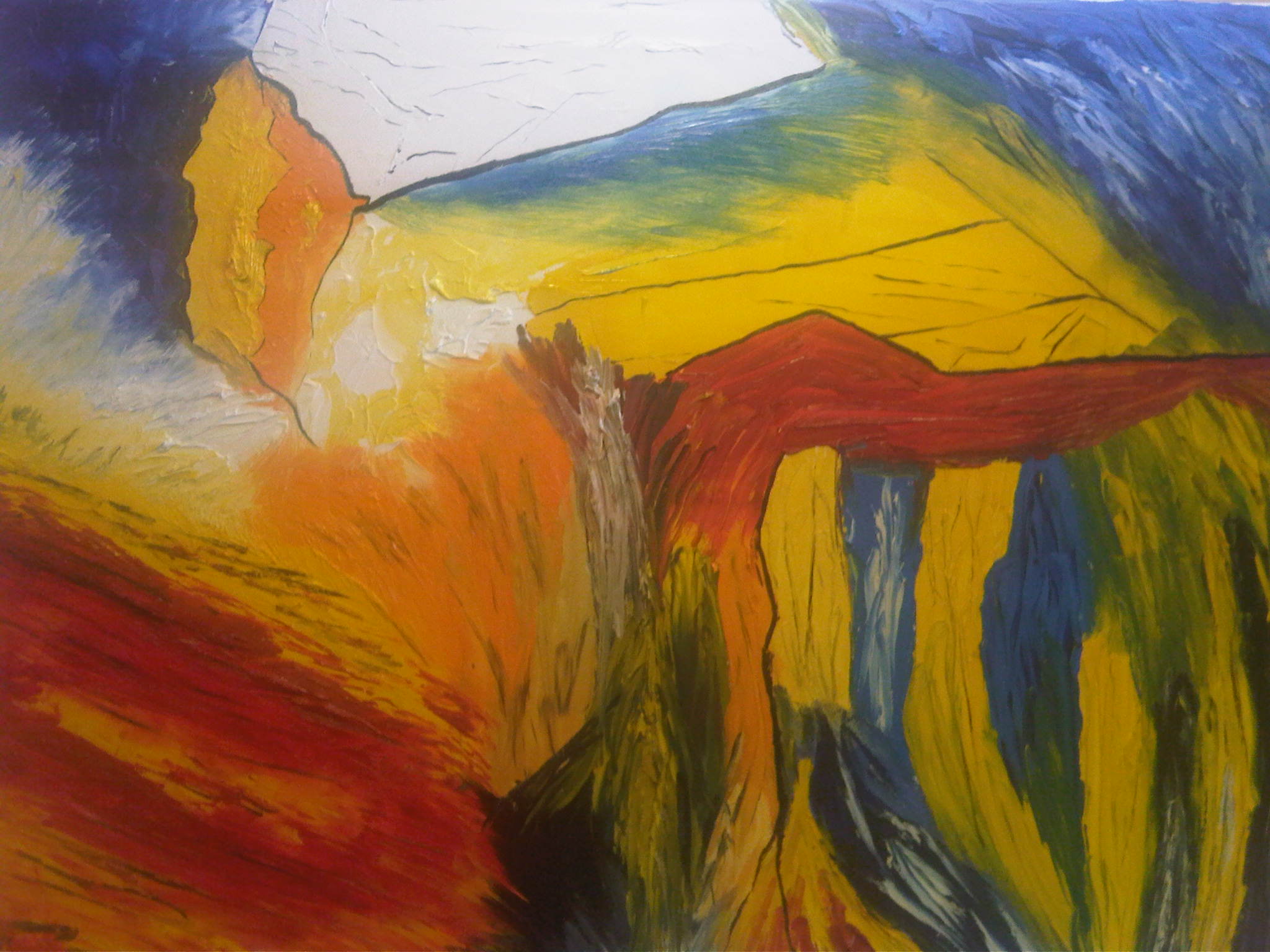
The canvas was divided into the evident shapes above.  This has deeper abstract meaning to me personally.  The artwork is thoroughly definitive.

White-yellow fan brush work, also top left, is just about the only brushwork throughout the entire piece. This compliments the unwittingly ‘cubist’ blue uppermost top-left.  Cubist detail shines radiantly in the photograph below.

Please note that two palette knives dominate the artistic construction from beginning to end aside from the fan brush work aforementioned.

I etch the palette knife edge point at the lower-centre section of the artwork.  A succinct thank you to Vincent Van Gogh.

The greyish allegory to brain matter is folded and fluted with the palette knife at the top of the artwork using a multitude of carefully mixed colours.  Appropriate of intellect considering the way our brains look in the physical sense with furrows, folds and swirls.

The outworking of my various artistic styles can be seen in ‘Creative Mind’ along with the volcano-like tempest and the mid-right upper central ‘haze’.

Completed painting of ‘Creative Mind’ immediately below.

(the lower right signature digitally altered in purposed obfuscation):

'Creative Mind' - Oil painting on canvas, 36 inches wide by 28 inches high, completed Autumn 2012.

‘Creative Mind’ – oil painting on canvas, 36 inches wide by 28 inches high, completed Autumn 2012.

My long palette knife took over in bewilderment.  Like hands holding onto a tornado, consumed in the moment.

With art-making sometimes the fruit can ripen oh so quickly.  Sweet coconut milk quenches my thirst.  Succulent figs become silent speeches.  Peaches pressed gently to produce delicious oil.  Wholeheartedly exploring a new depth.

Swan follows swan as ineffably as the one that guides its flight.

Standard

Arcimboldo Assimilated

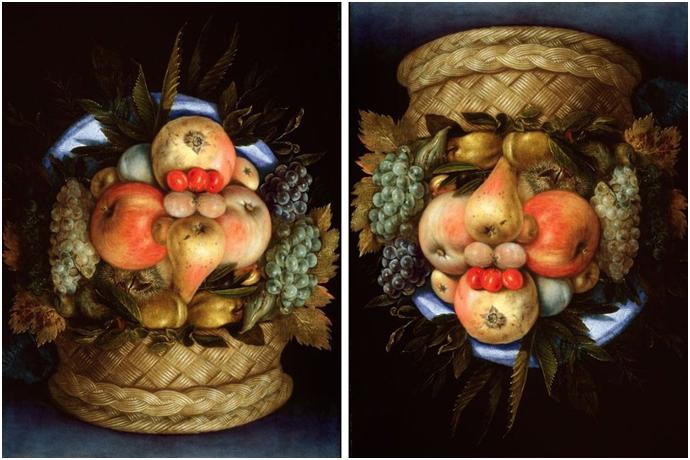
Pictured immediately below is a delicious basket of fruit with apples, grapes and pears ready for eating by Italian past Master Guiseppe Arcimboldo.

Auctioneers entitled the painting in sale lots as ‘A Reversible Anthropomorphic Portrait of a Man Composed of Fruit’.  It sold for $104,000 in 1999 and again a year later for $1.4 million through Sotheby’s.

Great art can be profitable and pleasurable to own.

The National Gallery of Art, The British Museum and New York Botanical Gardens have all paid homage to Guiseppe Arcimboldo in recent years.  Publicized acquisitions, exhibitions and events.

Arcimboldo like many Milanese artists was heavily influenced by Leonardo Da Vinci.  Whilst naturalistic drawings have been with us for millenia, artists like Da Vinci had begun to popularize nature in scientific terms of proportion, accuracy and physiology.

Da Vinci was by no means the first but we see a positive interest of intermingling man or woman with nature throughout Arcimboldo’s paintings.  This likewise influenced people to see their relationship with the natural world in a less religiously defined manner.  Not so frightening or mysterious to their superstitious sensibilities.

Did old world paintings contribute to a shift in how people viewed the mystery of life and our place in a mind-boggling Universe?  It would be fruitless to think otherwise.  Fruity wordplay huh.

The Unfathomable Artist poses amusingly in his mirror, raises his eyebrows up and smiles cheekily to himself.

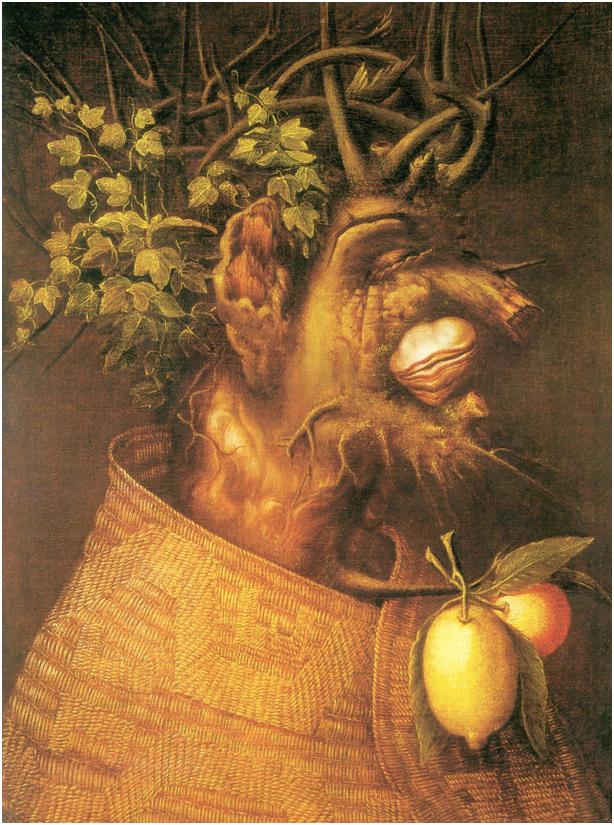
Speaking in musical terms we all appreciate that Antonio Vivaldi is famous for ‘The Four Seasons’.  Yet so too is Arcimboldo from a prior era.  Please take a look at ‘Winter: An anthropomorphic portrait of a man’ shown below:

Arcimboldo painted the seasons avidly. Perfecting and experimenting with compositions as all great artists do.  Looking at Winter version 3 above with lemons sprouting from the caricature’s neck one cannot help notice Guiseppe’s highly definitive textural style.  Equalled by art greats yet impossible to surpass.  Perfect is fit for purpose.  Rarely is perfection of itself.

Arcimboldo is to Wicker Baskets as Van Gogh is to Sunflowers.  Signed, sealed and delivered.  Owned.

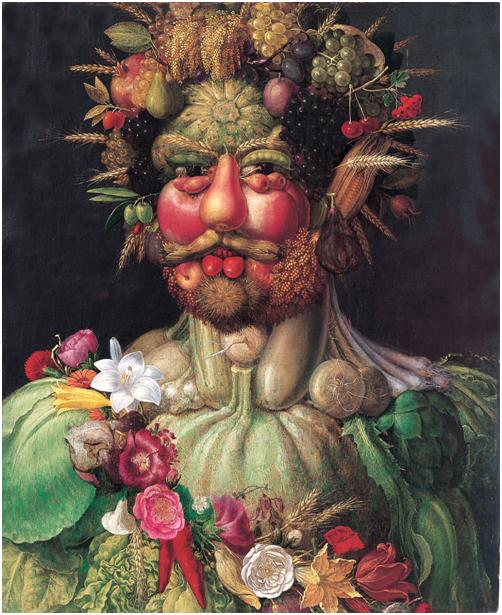
Simile, reversible and object-orientated portraiture became his undoubted speciality from the 1560’s onwards especially following his appointment by Ferdinand I in 1562.

One of his most famous paintings, ‘Vertumnus’, painted for Rudolf II ‘Holy Roman Emperor’ is based on the Roman god of the seasons.  Shown below colourfully resplendent and might I say quite flattering when compared with some of his earlier portraits.

Rudolf II must have possessed a good sense of umor ad sanctimoniam affectans and respected Arcimboldo greatly to happily receive such a brilliant masterpiece.  It also shows the influential gravitas that well known paint artists held amongst royalty, aristocracy and the wealthy.  Historical diplomatic assignments by Sir Peter Paul Rubens dramatically attests.

Intellect, creativity and sensitivity.  We all have these qualities.

Portrait paint artists interact personably with people to fill a canvas.  What we see is what you get.  Honesty will always produce the best portrait in my opinion.  Every great portrait artist across any medium knows things about you whilst busily working away.

Oils become creative fruit juices swirling around our minds eager for the appropriate brush.

‘Vertumnus’ 1590/1.

Standard

Egyptian Art in Dubai

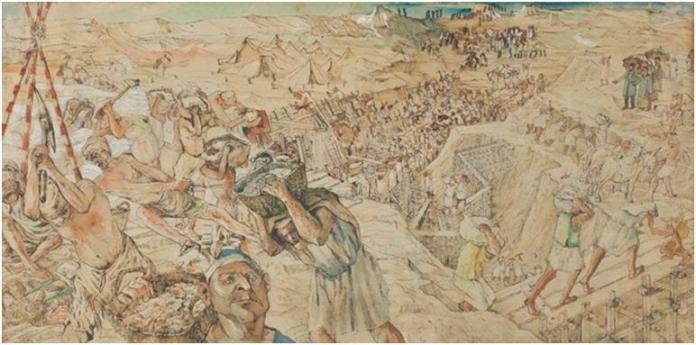
I would like to review ‘Construction of the Suez Canal’ by Abdul Hadi El-Gazzar.  It was acquired for $1.02m through Christie’s Dubai.  A new auction record for the artist.

Today my interest is in discussing this artwork, its historical reverberation and artistic value.

Quite some time ago I remember reading a specific story about a group of ancient Egyptian workers at Deir el Medina under Ramses III in the 12th Century BCE.

It intrigued me greatly.  The workers threw down their tools in protest due to a woeful lack of rations and peacefully complained to their Chief of Police.  Their complaint duly noted and directly quoted from an unedited English translation reads:

“The prospect of hunger and thirst has driven us to this; there is no clothing, there is no , there is no fish, there are no vegetables. Send to Pharaoh, our good lord, about it, and send to the vizier, our superior, that we may be supplied with provisions.”

Looking at El-Gazzar’s painting, shown above, we see the struggle of hard work.  An overseeing. Order. Logical procession. Monotony. Tented dwellings, perhaps for the workers.  A complex scene with varying angles and perspectives for the artist to deal with artistically and consider.

Sesostris, the Persian King Darius I, Ptoemy II and Napoleon Bonaparte have all been linked in historicity with the Suez Canal and the ancient waterways interconnecting the Red Sea and Mediterranean.

A flowing of water that spans some 4,000 years between these men respectively.

I cannot help wondering if El-Gazzar inadvertently placed himself in his own painting.  Overseeing.

Did you know that Rembrandt evolved and refined his art signature?  Will I use the same initialled signature my art teacher from school remarked upon favourably or will an artist grow and light upon a recognisable identity in good time.  My apologies, I digress momentarily.  Thoughts are sometimes like the dancing of butterflies.

Some painters are positively narcissistic, and it speaks much of their personal boldness and extrovert nature.  I feel El-Gazzar is somewhat subtle in his commentary within this painting.  Although he is exquisitely bold in most of his other artworks.

Construction of the Suez Canal is honest, warm and empathic.  An historical masterpiece.  El-Gazzar is a highly skilful painter, an artisan from ancient generations, happily gaining modern inspiration from Dali and Picasso with masterful creativity in his own right.

– Matt, The Unfathomable Artist

Standard

Art Dubai on March 18 – 21, 2015

Art Dubai Announces Dates For its Ninth Edition.

This Blog is brought to you by The Unfathomable Artist to highlight a Press Release from Art Dubai for their forthcoming Art Fair taking place in 2015.

Further details, including gallery pictures and Visitor information to Madinat Jumeirah can be found here:  http://artdubai.ae/.

A very relaxing and entertaining video from a previous Art Dubai fair can be viewed here:  http://vimeo.com/58004478.

Art Dubai 2015 will take place in the third week of March alongside a plethora of art, design and cultural events across the UAE and beyond.

Art Dubai, the leading international art fair in the Middle East and South Asia, announced today that its ninth edition will take place March 18 – 21, 2015, at Madinat Jumeirah in Dubai, United Arab Emirates.

Held under the patronage of His Highness Sheikh Mohammed bin Rashid Al Maktoum, Vice President and Prime Minister of the UAE and Ruler of Dubai, Art Dubai has become a cornerstone of the region’s booming contemporary art scene, both reflecting and acting as a catalyst in its extraordinary international growth over the past decade.

Art Dubai is recognised as one of the most globalised of meeting points in the art world today; the fair places an emphasis on maintaining an intimate, human scale while foregrounding quality and diversity.  The fair’s 85 galleries hail from 34 countries, and together present the work of around 500 artists.

Carefully selected, curated and presented through three distinct programmes – Contemporary, Modern and Marker – the galleries range from world – renowned dealers to upcoming artspaces.

In March 2014, 25,500 visitors attended the eighth edition of Art Dubai, including 70 museum groups and more than 400 curators and institutional representatives, confirming Art Dubai’s role as the meeting point in the Middle East and South Asia, and the global fair of choice for the art world.

The 2015 edition of the fair will run alongside Design Days Dubai – the world’s most diverse fair dedicated to limited collectible design – plus a myriad of other art – related events, exhibitions and cultural happenings in the UAE and across the region.

Next year’s Art Dubai will also coincide with Sharjah Biennial; the 12th edition of the renowned biennial, directed by Sheikha Hoor Al Qasimi and curated by Eungie Joo, also opens in March 2015.

“Building on the success of a phenomenal Art Dubai 2014, we’re thrilled to be working with our partners, galleries, artists, patrons and colleagues to present the ninth edition of the fair in March 2015,” said Antonia Carver, Fair Director, Art Dubai.

“Art Dubai has carved out a unique place for itself in an increasingly crowded artworld calendar and spring 2015 will be a particular time of celebration, given the strength of the programming at the fair and throughout the UAE and beyond.”

Standard

The Qingming Festival Masterpiece

An immensely historical painting popularly translated into English as “Along The River During the Qingming Festival” pre-dates Claude Monet’s “Garden of the Princess” by more than seven centuries.

The latter was painted in 1867 whilst the ancient Chinese cityscape was painted during the 12th Century by Zhang Zeduan – if we choose to use the Gregorian calendar as a reference point.

Both paintings are truly beautiful works of art.  They provide us with a busy cityscape using a panoramic view referencing capital cities during the time of their creation.  Each painting gifts us with a window into the lives, the ergonomic structures and customs of the people we see.

Monet is seated by permission to focus on the Quai de Louvre and Left Bank in Paris.  Zhang Zeduan is likewise granted to carry out his important artistic commission centuries earlier.

The man is asked to stand at a gate to carry out his work by specific request.  Monet paints from a balcony of the Louvre itself overlooking the scene below.  Intriguing artistic similarities.  Immediately Monet’s painting sprung to my mind when I studied the original Qingming Festival painting from the 12th Century.

Edouard Manet and Renoir too.  Indeed, it’s true that Monet admired Oriental art although his style is clearly European.  All great artists draw inspiration from past and present Masters.  Chinese Master artist Qi Baishi is notably humble in his praise of his favourite Chinese painters.

Bianjing now modern Kaifeng in China was the capital of the Northern Song Dynasty (960 – 1127) some thousand years after the Romans had begun establishing Londinium as the new capital of Brittannia.  In doing so the Romans replaced the settlement at Camulodunum for what we now know as London over Colchester in England respectively.

The original Chinese painting by Zhang Zeduan has extraordinary value wrapped up in its scrolls through its past ownership, cultural influence and endearment to Chinese art throughout the proceeding centuries.  A reverence that has inspired newly stylised remakes of the original for important occasions since.

Among these fine art remakes is an expert version presented to Emperor Qianlong in 1737.  The remake is updated only to reflect 18th century culture whilst remaining faithful in composition to the original.

Convergence, divergence and intransigence is intrinsically valuable to the ongoing cultural heritage of World Art.

Let us please take a considered look at “Along The River During the Qingming Festival”.  Respectfully appreciating that a language may be translated in various ways.  For a certainty, choosing a popular title for an artwork is wise.  Zhang Zeduan excels completely in his use of movement, detail, structuring and artistry.

Along the River during the Qingming Festival

The original painted scroll above measures five and a quarter metres across and ten inches high so it is difficult to imagine its impressive visual scale.  Especially as most Readers will view this image using a modest electronic device.

A large scale animated digital screen artwork has been produced incorporating the original and displayed in the China Pavilion at the Shanghai Expo 2010. 

This can be viewed by clicking here:  http://www.youtube.com/watch?feature=player_embedded&v=-AVzwui5-5w and for a closer view here: http://www.youtube.com/watch?v=SbzQ-JPlc9g

The animation is astonishingly rendered and helps to capture the affection in which the original painting is held.

I love both these paintings.  Zeduan painted fashionably of his day according to Chinese artistic style and tradition.  We see this Chinese style consistently throughout the following centuries up to and beyond Monet.  Beloved themes embraced like fruit bowls upon tables.

Just as Monet himself contributed to modern Impressionistic Art, Zeduan has greatly influenced Asia’s contemporary artists.  It’s wonderful to see artists around the world gaining inspiration from world art.

I have seen the influence of artists like Qi Baishi in the artistic style of living painters on the other side of the globe.  Professional Artists whose excellent work I’ve viewed up close and personal in art galleries.

I would like to include Monet’s “Garden of the Princess” in this Blog since we have discussed this painting also.

Here it is:

Garden of the Princess by Claude Monet

Garden of the Princess by Claude Monet

It has been a joy to write my Blog once again.

Matt The Unfathomable Artist

Standard

Titian – A Commanding Master

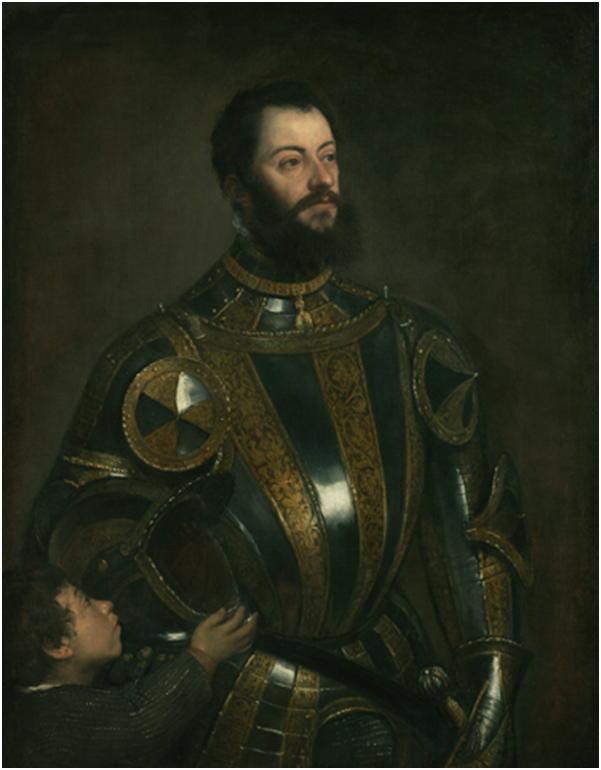
“Portrait of Alfonso d’Avalos, Marquis of Vasto in Armor with a Page” was acquired for $70m in 2003 by the Getty’s for their beautiful Getty Museum and Villa. A single painting valued at $96.57m today if we allow only for inflation. Please take a look at d’Avalos portrait here:

Painted by Tiziano or more widely known as Titian in English, this unequivocally represents his powers of fine portrait excellence. Always commanding a dignified presence for his subjects, mastery of light and exquisite detailing of textures. Titian’s ability to mirror textures is so awe-inspiring that I am quick to place him amongst my favourite past Masters even before we talk about his natural artistic flair.

Interestingly Titian shares the 16th Century world of art with yet another famous Italian artist of favoured significance to me. I will name unsaid artist in my Blog at a future convenient time. Certainly they are both commensurate textural geniuses applauded for their fine art paint work. I often marvel at the painting time their work required for this level of miniscule brush work.

Most accomplished past Masters like Titian retained skilled understudies to happily assist in their workshops. Art students eager to learn the art trade from their famed tutors. Titian himself hailed from the Venetian school system years prior. A great apprentice in the making. Past Masters commissions could include travel by ships that regularly graced the seas with the strength of the wind in order to visit clients through amenable oceans.

Returning to the portrait for the purpose of my Blog – instantly we see solid substance and grandeur in this d’Avalos pose. The inclusion of a page boy enforces the idea that Alfonso d’Avalos is a physically mighty man in stature held in high military regard. His armour is painted strong in every sense with the metal reflecting white light in a robust manner and with remarkable perceptible depth.

His facial expression gives me the idea that he is looking toward a future battle in distant lands. Concentrated awareness is in his eyes. A glimpse into his mind. A mind fixed upon ensuring he will provide Tiziano with the precise way that he would like to be known and remembered in this portrait.

From notable Spanish-Italian origin Alfonso d’Avalos was made Knight of the Order of the Golden Fleece in 1531. His titles included 1st Prince of Francavilla, 2nd Marquis de Vasto, Marquis di Pescara and General & Governor of Milan. In 1538 he served as Ambassador to Spain and commanded the Imperial Army during the Italian War of 1542.


“Titian has therefore produced a portrait of considerable importance to Spanish-Italian history. The workmanship of which is at least equal to other leading art compatriots of his day. Furthermore it provides us with an insight into the function of leading portrait artists as established pictorial historians.”


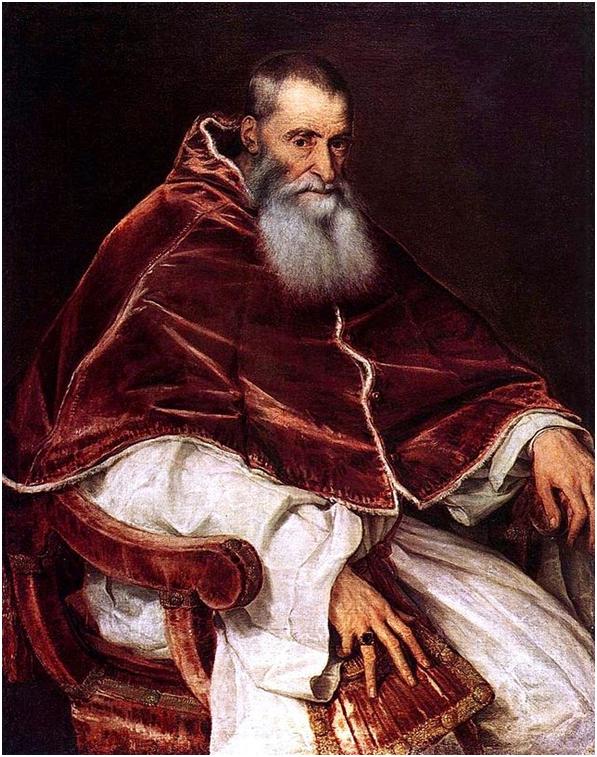
Please also take a look at his portrait of Pope Paul III (1543) below to further see why Titian’s work is highly prized by wealthy collectors, Art Galleries and Museums:

The palette contrast between these two paintings shows that Titian intelligently chose specific colour schemes to highlight the purposeful reasoning behind each portrait. Be it solemn, serious or joyful in its portrayal.

I myself happily study Titian and his work and hope you have enjoyed this blog article.

– Matt, The Unfathomable Artist

Standard