

‘A Woman And A Girl Driving’ [1881] by Mary Stevenson Cassatt, Oil on canvas, 35 5/16 × 51 3/8 inches (89.7 × 130.5 cm).
# Interesting fact – Do you know the names of any horse carriages by their constructed style and purpose?
Okay, well here is the name of some popular carriages during the latter 19th Century including a few modernly represented carriages too:
Araba, Barouche, Berlin, Brougham, Cabriolet, Curricle, Dog-cart, Dray, Gig, Hackney, Hansom, Landau, Mail coach, Omnibus, Phaeton, Road wagon, Rockaway, Runabout, Stage coach, Surrey, Tonga, Van coach, Victoria, Volante, Waggon and Wagonette.
To be honest I only knew fourteen of these carriage names.
In her painting we see the lesser detailed fauna of the Bois de Boulogne. A heavily cropped composition of horse and carriage to showcase the occupants. The steadied seating of young Odile and Lydia’s concentration to drive carefully whilst holding horse-drawn reins.
Yes, a woman actually driving in the late nineteenth century. Although now it’s the early 21st Century and we should all be hovering about on magically carpeted skateboards pretending its 1985.
Flux capacitor fully charged, of course.
– “Times are a changin’ like the dog and it’s tail.” – chimed the Coachy, who had clearly seen the various where-with-alls of the known ages come and go.
Purraps ye olde Coachy is proper ‘edless and has seen ye time and times thee only throws a stick at?
Hey, I wonder if ole’ Coachy knows Charon, the ferryman? They’d get along swimmingly together.
Lydia looks responsible. The groom is contemplating bachelor life passing by. I have to laugh that Cassatt has wondrously captured the man with all his intrepid apprehension. Although posing in a horse drawn carriage for goodness knows how long must be quite challenging.
Beautiful too.
I do love her painting.

‘Sara Wearing A Bonnet’ by Mary Stevenson Cassatt.
‘Sara Wearing A Bonnet’ by Mary Stevenson Cassatt is a masterpiece.
Sara’s origin is currently a mystery to me.
Cassatt sketched and painted Sara around fifty times from circa 1900/1 through to, at least, 1907. Cassatt’s determined efforts to replicate same subject person’s in different compositions was likely influenced upon seeing works by Peter Paul Rubens and Antonio Allegri da Correggio.
Mary is exceptionally thorough in her artistic training and study of past Masters.
What intensity do you need to enjoy composing the same person fifty times? Look at Sara, she is divinely beautiful at such a delicate young age. It’s a testament to Mary Cassatt that she also finds Sara’s inner qualities of grace, patience and charm time and again in her compositions.
Sara has an incredible sense of purity that radiates through her adorable complexion. Personally I think Mary viewed her expression so perfectly painted here that she hastily put down her brushes.
The artwork is just so.
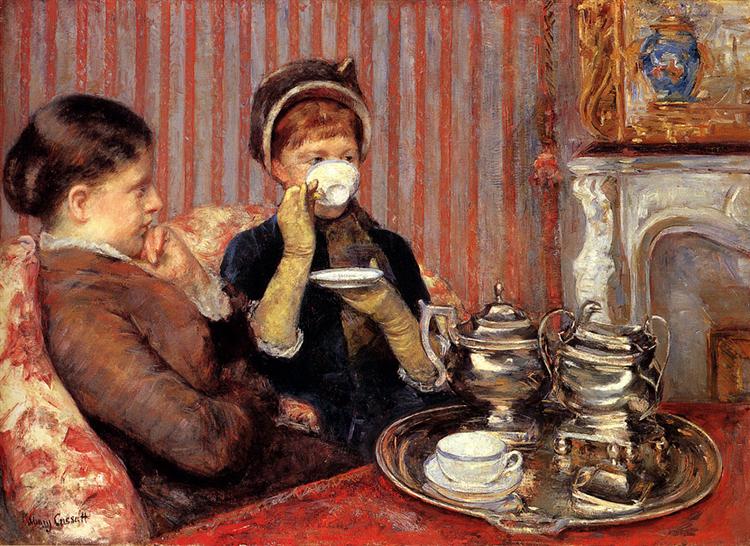
‘The Tea’ by Mary Stevenson Cassatt [c1880-81], Oil on canvas, 64.77 cm x 92.07 cm (25 1/2 ins x 36 1/4 ins).
‘The Tea’ by Mary Stevenson Cassatt, shown above, is a true delight to behold. To our left Lydia Cassatt, the aforementioned carriage driver, appears deep in thought. Hair shining, superbly posed, revealing her personality to us in a new way – a friendly looking lady.
The tea drinker, cup to lips, is dainty and prim. We are able to glean her nature in this fleeting movement to sup, along with the pretty societal decorum of her era.
The tea service belonged to Mary Stevenson, the Cassatt’s Grandmother whom Mary herself is named after. Likely the tea service is expensive as this was made specifically for their Grandmother. Therefore in this painting we have direct connections to the artist’s family heritage. Notwithstanding that the silverware itself is beautifully envisaged for us by Mary.
Honest portrait replication is where Mary Cassatt’s art excels. Without question this is her primary objective in portraiture, irrespective of the background. Mary understood exactly what the fashionable art market wanted. ‘The Tea’ painting shown here was included in two Impressionist Exhibitions, 1880 and ’81.
Close, trusted friend to Degas [‘The Edgar Degas Art Ballet’ link here]. Personal friend and colleague to French artist Berthe Marie Pauline Morisot [Wikipedia link here], whose artworks featured in one of my past blog articles A Woman’s Perspective by Berthe Morisot [link here].
Mary Cassatt was also lifelong friend to the exceedingly wealthy Louisine Waldron Elder Havemeyer, who was instrumental to the Early 1900’s Suffrage Movement . Louisine herself was a high profile art collector and an active feminist. Proven through the pages of a book entitled ‘Sixteen to Sixty: Memoirs of a Collector’ by Louisine W. Havemeyer.
Women of the early 1900’s were not all shy, retiring types.
However, I’d like to mention that whilst Mary Cassatt was certainly unafraid to voice her opinions, she did respect the global business of art. Her friendships show Mary to be pleasantly malleable and eager to accept positive career direction, regardless of gender.
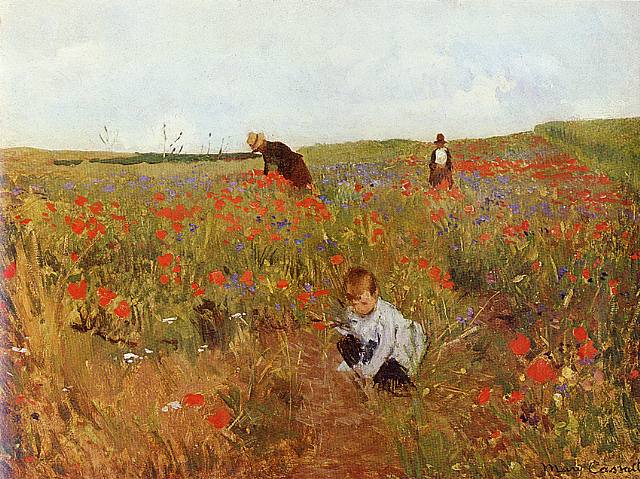
‘Picking Flowers In A Field’ by Mary Stevenson Cassatt [1875], Oil on panel, height 26.6 cm (10.4 ins) x width 34.3 cm (13.5 ins).
The Age of Innocence.
!['By The Water' [1879] by Berthe Morisot - Watercolor - cm x cm](https://theunfathomableartist.co.uk/wp-content/uploads/2016/07/morisot1.jpg)
![Newark Museum (United States - Newark, New Jersey) Dates: 1875 Artist age: Approximately 34 years old. 'English Landscape' [1875] by Berthe Morisot - 43 cm (h) x 64.8 cm (w) - oil on canvas - Displayed at Newark Museum.](https://theunfathomableartist.co.uk/wp-content/uploads/2016/07/morisot2.jpg)
 – oil on canvas – Displayed at Newark Museum.
!['Girl Carrying A Basket' [1891] by Berthe Morisot; pastel on paper; Musee Marmottan Monet - Paris France](https://theunfathomableartist.co.uk/wp-content/uploads/2016/08/girl-carrying-a-basket.jpg)
!['Peasant Girl' [1890] by Berthe Morisot; red chalk with stumping on light brown paper; 20 3/8 in × 17 5/8 in](https://theunfathomableartist.co.uk/wp-content/uploads/2016/08/aalarger.jpg)
 The Unfathomable Artist