Mary Cassatt Mixes Media

‘A Woman And A Girl Driving’ [1881] by Mary Stevenson Cassatt, Oil on canvas, 35 5/16 × 51 3/8 inches (89.7 × 130.5 cm).

Featured here in the painting entitled ‘A Woman And A Girl Driving’ [1881] by Mary Stevenson Cassatt we have the bracing posture of Odile Fèvre, niece to artist Edgar Degas.  The lady is Lydia the artist’s sister with the groom riding along facing the rear and sitting behind our two main subjects.

# Interesting fact – Do you know the names of any horse carriages by their constructed style and purpose?

Okay, well here is the name of some popular carriages during the latter 19th Century including a few modernly represented carriages too:

Araba, Barouche, Berlin, Brougham, Cabriolet, Curricle, Dog-cart, Dray, Gig, Hackney, Hansom, Landau, Mail coach, Omnibus, Phaeton, Road wagon, Rockaway, Runabout, Stage coach, Surrey, Tonga, Van coach, Victoria, Volante, Waggon and Wagonette.

To be honest I only knew fourteen of these carriage names.

In her painting we see the lesser detailed fauna of the Bois de Boulogne.  A heavily cropped composition of horse and carriage to showcase the occupants.  The steadied seating of young Odile and Lydia’s concentration to drive carefully whilst holding horse-drawn reins.

Yes, a woman actually driving in the late nineteenth century.  Although now it’s the early 21st Century and we should all be hovering about on magically carpeted skateboards pretending its 1985.

Flux capacitor fully charged, of course.

– “Times are a changin’ like the dog and it’s tail.” – chimed the Coachy, who had clearly seen the various where-with-alls of the known ages come and go.

Purraps ye olde Coachy is proper ‘edless and has seen ye time and times thee only throws a stick at?

Hey, I wonder if ole’ Coachy knows Charon, the ferryman?  They’d get along swimmingly together.

Lydia looks responsible.  The groom is contemplating bachelor life passing by.  I have to laugh that Cassatt has wondrously captured the man with all his intrepid apprehension.  Although posing in a horse drawn carriage for goodness knows how long must be quite challenging.

Beautiful too.

I do love her painting.

‘Sara Wearing A Bonnet’ by Mary Stevenson Cassatt.

‘Sara Wearing A Bonnet’ by Mary Stevenson Cassatt is a masterpiece.

Sara’s origin is currently a mystery to me.

Cassatt sketched and painted Sara around fifty times from circa 1900/1 through to, at least, 1907.  Cassatt’s determined efforts to replicate same subject person’s in different compositions was likely influenced upon seeing works by Peter Paul Rubens and Antonio Allegri da Correggio.

Mary is exceptionally thorough in her artistic training and study of past Masters.

What intensity do you need to enjoy composing the same person fifty times?  Look at Sara, she is divinely beautiful at such a delicate young age.  It’s a testament to Mary Cassatt that she also finds Sara’s inner qualities of grace, patience and charm time and again in her compositions.

Sara has an incredible sense of purity that radiates through her adorable complexion.  Personally I think Mary viewed her expression so perfectly painted here that she hastily put down her brushes.

The artwork is just so.
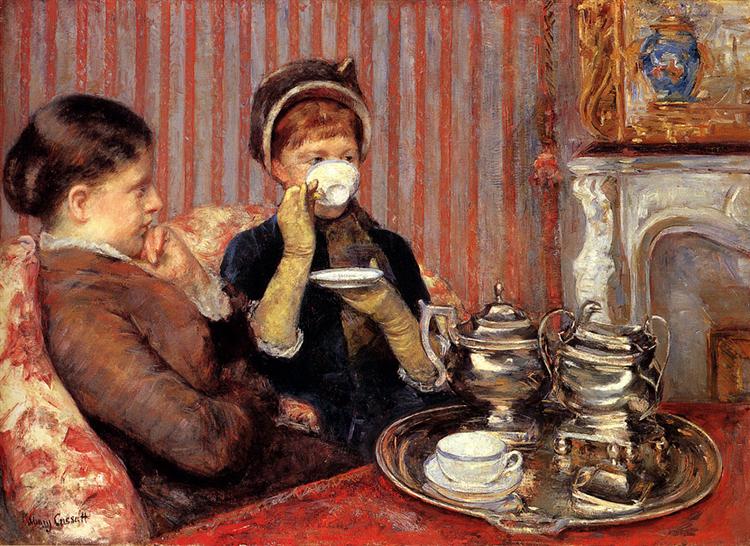
‘The Tea’ by Mary Stevenson Cassatt [c1880-81], Oil on canvas, 64.77 cm x 92.07 cm (25 1/2 ins x 36 1/4 ins).

Anyone for tea?

‘The Tea’ by Mary Stevenson Cassatt, shown above, is a true delight to behold.  To our left Lydia Cassatt, the aforementioned carriage driver, appears deep in thought.  Hair shining, superbly posed, revealing her personality to us in a new way – a friendly looking lady.

The tea drinker, cup to lips, is dainty and prim.  We are able to glean her nature in this fleeting movement to sup, along with the pretty societal decorum of her era.

The tea service belonged to Mary Stevenson, the Cassatt’s Grandmother whom Mary herself is named after.  Likely the tea service is expensive as this was made specifically for their Grandmother.  Therefore in this painting we have direct connections to the artist’s family heritage.  Notwithstanding that the silverware itself is beautifully envisaged for us by Mary.

Honest portrait replication is where Mary Cassatt’s art excels.  Without question this is her primary objective in portraiture, irrespective of the background.  Mary understood exactly what the fashionable art market wanted.  ‘The Tea’ painting shown here was included in two Impressionist Exhibitions, 1880 and ’81.

Close, trusted friend to Degas [‘The Edgar Degas Art Ballet’ link here].  Personal friend and colleague to French artist Berthe Marie Pauline Morisot [Wikipedia link here], whose artworks featured in one of my past blog articles A Woman’s Perspective by Berthe Morisot [link here].

Mary Cassatt was also lifelong friend to the exceedingly wealthy Louisine Waldron Elder Havemeyer, who was instrumental to the Early 1900’s Suffrage Movement .  Louisine herself was a high profile art collector and an active feminist.  Proven through the pages of a book entitled ‘Sixteen to Sixty: Memoirs of a Collector’ by Louisine W. Havemeyer.

Women of the early 1900’s were not all shy, retiring types.

However, I’d like to mention that whilst Mary Cassatt was certainly unafraid to voice her opinions, she did respect the global business of art.  Her friendships show Mary to be pleasantly malleable and eager to accept positive career direction, regardless of gender.
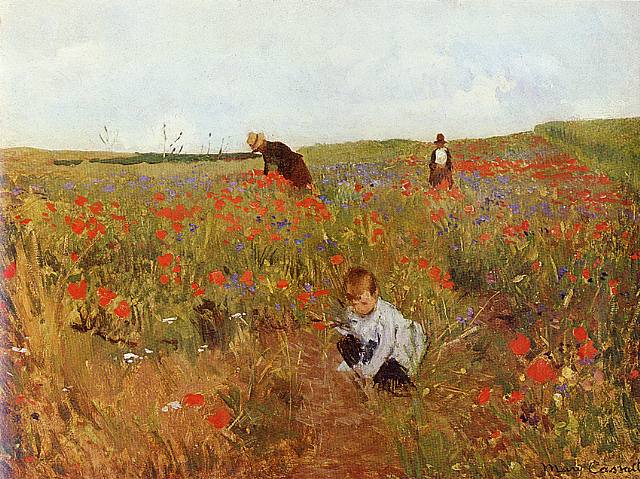
‘Picking Flowers In A Field’ by Mary Stevenson Cassatt [1875], Oil on panel, height 26.6 cm (10.4 ins) x width 34.3 cm (13.5 ins).

If I owned ‘Picking Flowers In A Field’ vibrantly alive above by Mary Stevenson Cassatt it would never leave my possession.

The Age of Innocence.

Standard

The Edgar Degas Art Ballet

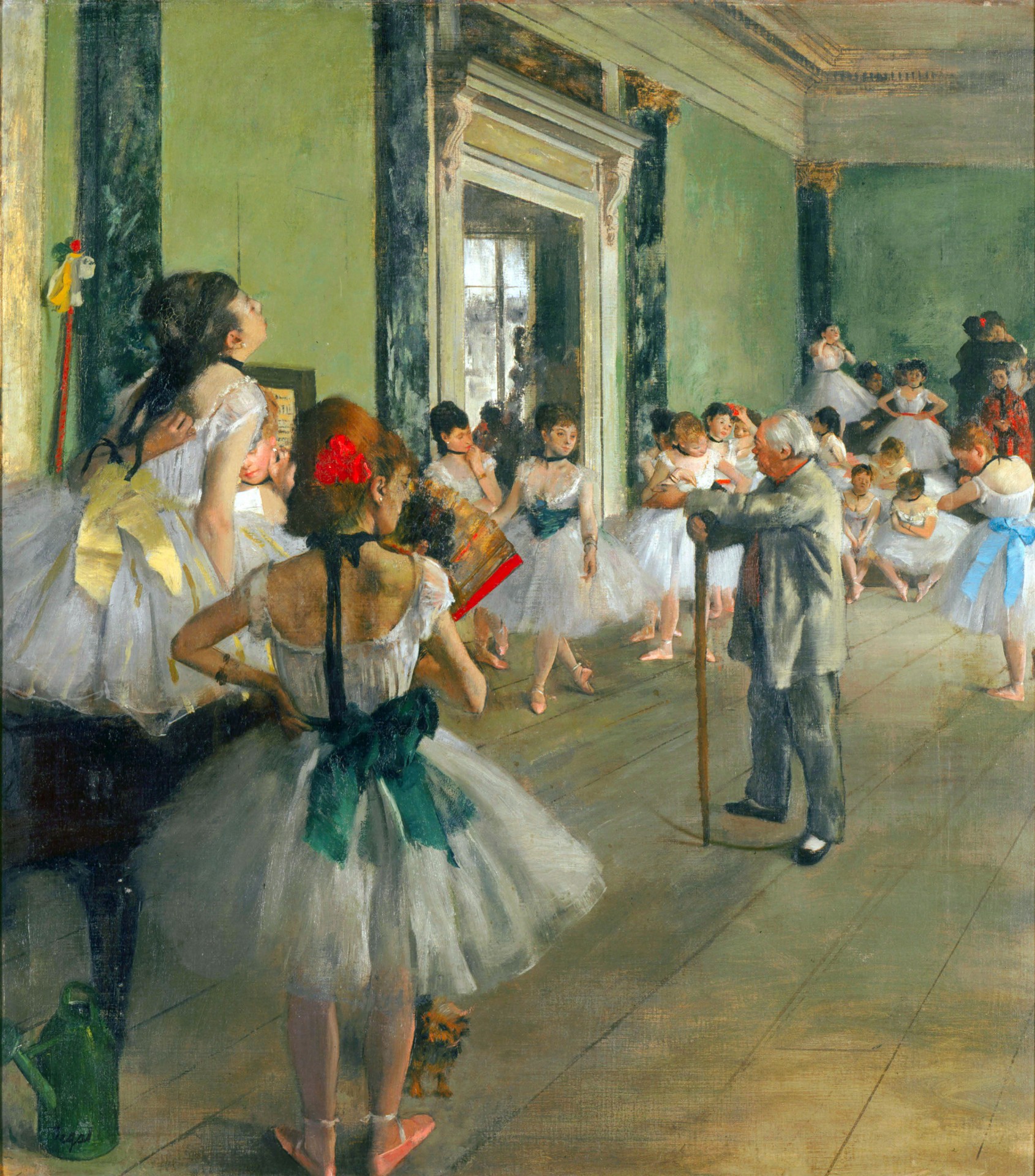
'The Ballet Class' [c1871-1874) by Edgar Degas (b1834-d1917), Oil on canvas, (H) 85 cm; (W) 75 cm

‘The Ballet Class’ [c1871-1874) by Edgar Degas (b1834-d1917), Oil on canvas, (H) 85 cm; (W) 75 cm

Edgar Degas born Hilaire-Germain-Edgar De Gas, 19 July 1834 – 27 September 1917 was a French artist famous for his paintings, sculptures, prints, and drawings. He is especially identified with the subject of dance; more than half of his works depict dancers.”

Opening quotation courtesy of Wikipedia.

Ballet dancers feature extensively by Degas.  Having seen Degas’ work for myself I can irrefutably attest to his awe-inspiring magnificence.  Please let me be clear, I’m talking about breathtaking quality.

The kind of art works that cause me to wonder-at.. much like a child seeing their first puppy.

‘Rover’ a Manchester Terrier popped his adorable puppy head out from our Dad’s coat jacket.  I was about nine years old.  If you had known our first family dog you would have to say his name was perfectly accurate.  Pretty much everyone within our neighbourhood knew him.  Even the butcher ten minutes walk away at the local shops!  Rover had been known to sit outside looking through the window, waiting.

A nearby family watched him enter their open-gated garden, take their large sheepdogs juicy bone from under its nose and leave like the SAS as if nothing had ever happened.  We only knew because they told us – astounded at his sheer audacity!  Rover once got locked in a neighbours garage, barking for a couple of hours to be let out.  They thought it was a neighbours dog, well it was, ours one road and cul-de-sac away.

As children we’d play with our friends and so the opportunity eventually arose for him to craftily sneak off to do ‘Rover’ business.  One of the funniest things was seeing him regularly ‘jogging’ in front of us, tongue-out looking back at us.  Wouldn’t mind except that we were at full speed on our pedal bikes!

Rover – “an animal which ranges over a wide area.”

Degas had a keen interest in gracefulness and the beauty of depicting honesty in his paintings.

‘The Ballet Class’ shown above has an excellent sense of perspective, order and formal instruction as its theme.  The dancers waist bows are multi-coloured with intentional shine or matte finish.  Floorboards and walls would be painted first ready for his complex ensemble of dancers in their individual postures.

Foreground-left, a girl is uncomfortable and fidgety.  Adding to the sense of flexibility and concentration required for intricate ballet moves.  Degas paints intellectual ideas.  Is this the young girl that attends classes for a few weeks then decides it’s not for her?

Her mother might say –  ‘You loved ballet and we brought you all these lovely clothes boutique et al.’

Their ballet teacher is rigid and strictly characterised in polar contrast to the dancers.  We need to ask – was this momentarily observed by Degas or a structured composition by design?

Likely both.

In 2004 I saw an impossible sight of human perception.  I spoke of this phenomenon to a rare few and made especially careful note.  In 2004 I stood by a paint artist working ‘plein air’ in Rhodes not far from the port itself.  Hidden deep was he, peaceful amongst an ‘orchard’ of trees and deep red flowers.  Likely the red hibiscus.

Speaking with the artist whilst he contrived artily of that gorgeous flower, painting also precisely of certain delicate observations.  His brush movements definitive and skilled.

Whosoever can paint as definitely as Edgar Degas deserves to be earnestly proud.  A Realist of his period and highly capable of masterful Impressionist work.

'Achille De Gas' in the Uniform of a Cadet (1856/1857) by Edgar Degas, Oil on canvas, 64.5 cm x 46.2 cm (25 3/8 in x 18 3/16 in)

‘Achille De Gas’ in the Uniform of a Cadet (1856/1857) by Edgar Degas, Oil on canvas, 64.5 cm x 46.2 cm (25 3/8 in x 18 3/16 in)

Achille Degas is his brother.  Posing here relaxed, casual and at ease in his Cadet uniform.

Photographs of paintings allow us glimpses.  Please trust me when I say that having seen ‘The Beggar Woman’ by Edgar Degas for myself that his work defies belief.  Paint has its own texture within oils.  The substance real and magical of properties through the cunning art of visual illusion.

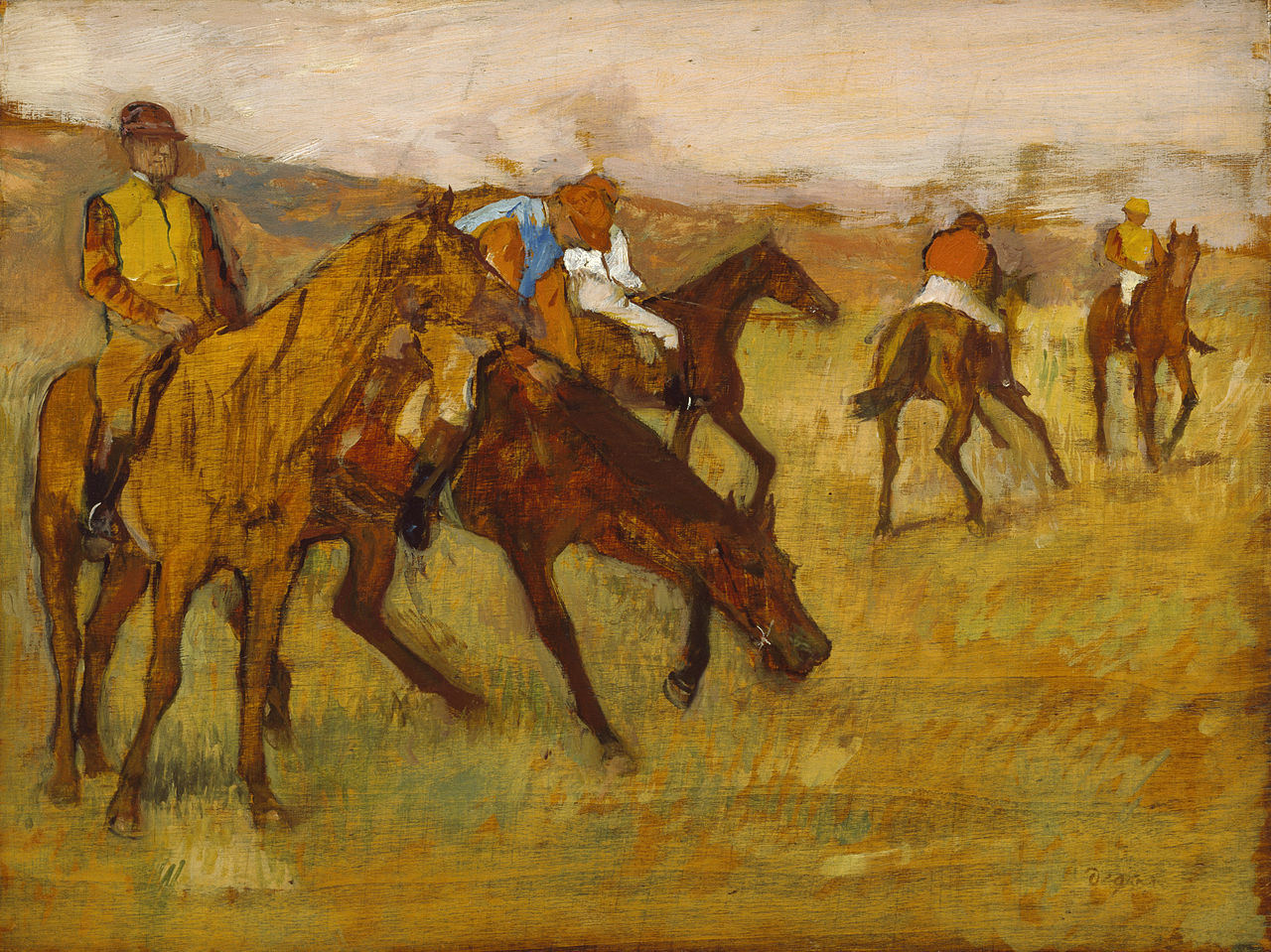
'Before The Race' by Edgar Degas, Oil on panel, (H) 26.4 cm (10.4 in). (W) 34.9 cm (13.7 in)

‘Before The Race’ (1882-1884) by Edgar Degas, Oil on panel, (H) 26.4 cm (10.4 in). (W) 34.9 cm (13.7 in)

Degas produced numerous compositions of horses and their riders.  I chose to include an Impressionist oil painting for this article.  The bowing horse is particularly alive to me.  Living.  Breathing.

That the painting is some 132 years old does not prevent me from wanting to know what on earth he is thinking bucking like this with his rider.  The far-left horse could be viewing the finish line already!  Or perhaps waiting for a gentle squeeze of knees and heels for the cantering.

The chromatic symmetry is a work of art all of its own.  Burnt umbers, oranges and yellows.  It allows for variety as an artist.  Sometimes its good to exclaim ‘What does my sky matter when the foreground subjects become our EVERYTHING.’

Diversity is depth of feelings.

'After The Bath, Woman Drying Her Neck' (1898) by Edgar Degas, (W) 25.59 in x (H) 24.41 in

‘After The Bath, Woman Drying Her Neck’ (1898) by Edgar Degas,
(W) 25.59 in x (H) 24.41 in

The most exciting thing about nude painting?

Naked trust.  Every single time.

Standard

Darren Baker Prime Real Estate

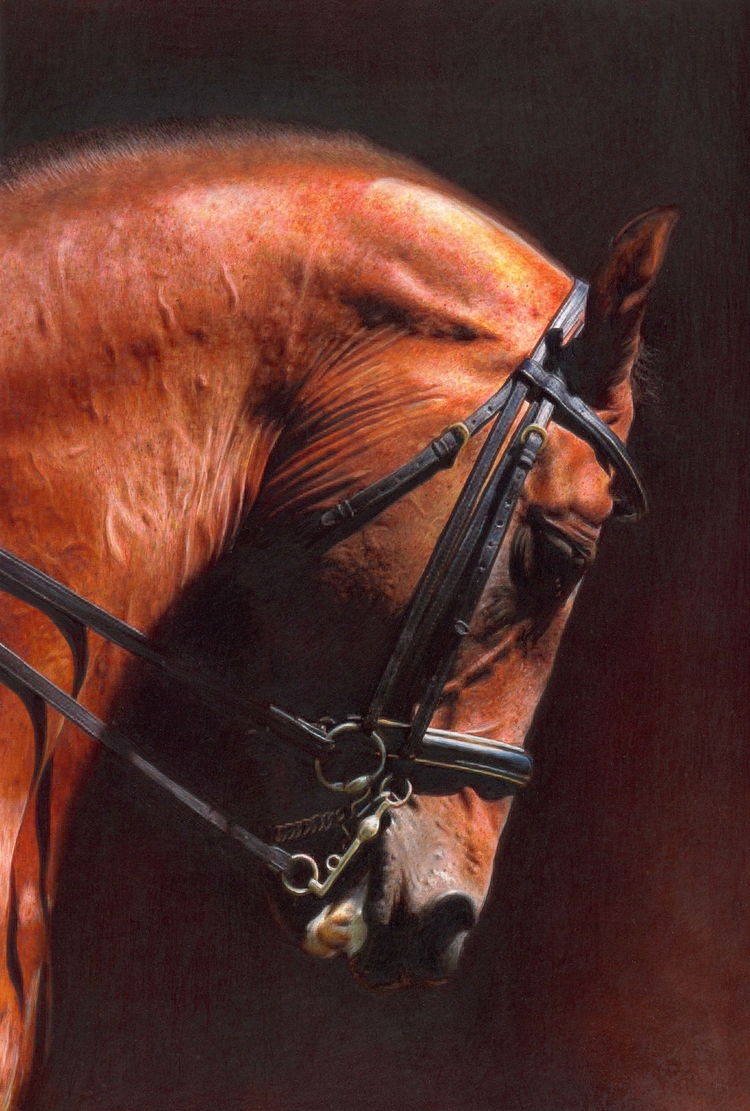
'Classical Horse' on canvas by Darren Baker, 36 in x 48 in

‘Classical Horse’ on canvas by Darren Baker, 36 in x 48 in

I wonder how especially delighted Equestrian art admirers would be for the opportunity of British artists Darren Baker and Sally Lancaster to produce an Art Exhibition together?

'Champagne' by Darren Baker, Oil on canvas, 28 cm x 40 cm

‘Champagne’ by Darren Baker, Oil on canvas, 28 cm x 40 cm

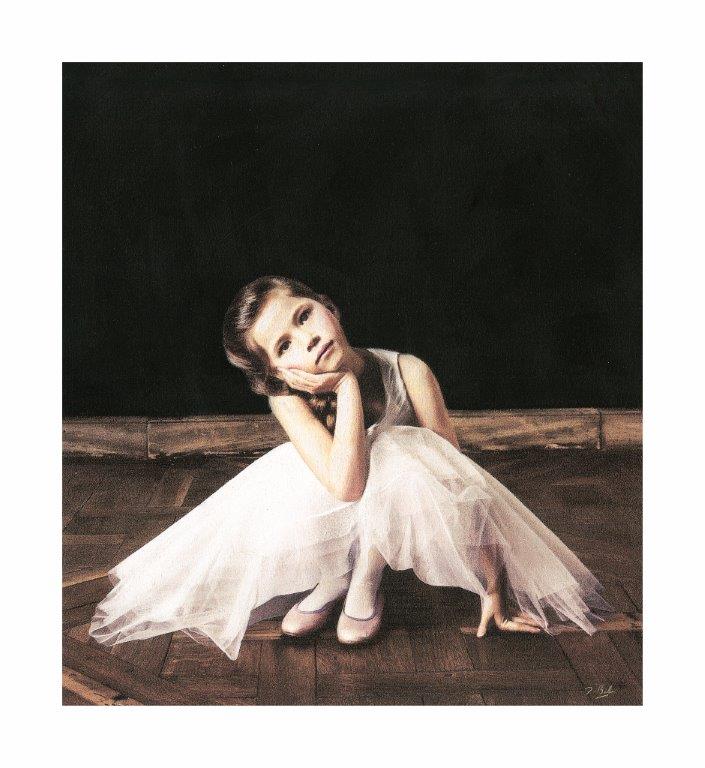
Ah, the Result.  Just look at our ‘Sweet Ballerina’ shown below, waiting patiently.

'Sweet Ballerina' by Darren Baker, 23 cm by 20 cm

‘Sweet Ballerina’ by Darren Baker, 23 cm by 20 cm (image shown with white border)

My favourite artists evoke an extraordinary sense of admiration.  Power of artistic quality.  Flair for vivid imagination.  Incredulous symbology.  Compositional genius.  Weightiness of message.

Darren Baker pushes the boundaries of hyperrealism straight up into the stratosphere.

Having actually experienced an olfactory moment whilst looking at an image of onions Darren Baker had painted is certainly profound.

Suddenly whilst writing this piece the artist John W Waterhouse has leapt into my mind.  The weightiness of Darren Baker’s technique allows comparison.  To appreciate my thinking further please read:

https://theunfathomableartist.wordpress.com/2014/08/21/john-w-waterhouse-the-lady-of-shalott/

And then we return to Darren Baker.

What makes my ‘olfactory moment’ intriguing is that I have anosmia.  Long attributed by myself as occurring from about 7 years of age.  Regrettably my olfactory sense is therefore extremely finite.  Only strong chemical smells can cause me to briefly capture the fleeting note of an aroma.

Vinegar and onions for instance.

Darren has either purposed to accomplish this olfactory wonder and/or his Realist crafting is so highly tuned that the subject detailing causes complimentary senses to become involved.  An artistic crafting of visual-memory triggers linked to additional senses other than sight and touch is certainly a commendable talking point.

Yet I speak from personal experience.  Perception being the culmination of all cognitive reasoning gathered together at the blink of an eye.  The sixth sense if you will.  Intuition.

Darren Baker is already demonstrating his capability at creating art that includes the sense of touch relative to the people, subjects or objects on view.  By sight.

Encourage and be encouraged.

Having felt the power of horses and the gracefulness of dancers myself.

To conjure a sense without the sense itself is a sheer feat of hand-to-brush-to-canvas wizardry.  Entirely at the forefront of Realist painting is the believability of depth and touch.  Highly delineated imagery presented conceivably.

Would it be correct to explain Realist art viewing as first ‘touching as if with one’s eyes?’.

Like the bonfire I did not turn aside from gazing towards in close proximity at 7 years of age.  The alluring art I could see dancing as fire-crackling mercilessly against a mountain of wood.  Interestingly at this same age I gazed surreally upon a low slung Sun in the sky, pausing whilst playing with friends.  Pondering its defiant blazing absurdity.

I find the whole idea that Darren has engineered onions and vinegar into compositional art recipes fascinating.  Look at the popularity of cookery shows we see in the televised media.

We love our international food heritage.

Few can hold their work up to the light with the Michelin Stars quality of excellence that Darren Baker boasts modestly through his paintings and eclectically acclaimed client list.

'Venice' by Darren Baker, pastel, 20cm x 25 cm

‘Venice’ by Darren Baker, pastel, 20 cm x 25 cm

Darren Baker’s work is unquestionably hyperrealist in quality.  The depth of field within ‘Venice’ shown above is a Smörgåsbord of places to explore with our eyes.  Reach out to touch your own, personal.  Painting.  Someone who cares for their art.

Realist painters often draw out the extraordinary from the seemingly ordinary.  In 50 years time Darren Baker will have future generations writing and commenting about his work.

The super-impressive charm of paintings such as ‘Herb Garden’ and ‘Breakfast Tea’ first caught my attention and proclamation of awe.  Successful commissions for Her Majesty Queen Elizabeth II, the Bahrain Royal Family and a recently opened Darren Baker Gallery in London 2014 speak volumes.  His exemplary talent and ultra-professionalism garnishing favourable influence.

Quite rightly the work of Edgar Degas follows in my next post.

Standard