
Norwegian painter Edvard Munch produced one of the most recognizable paintings of all time, “The Scream”.
Here it is:
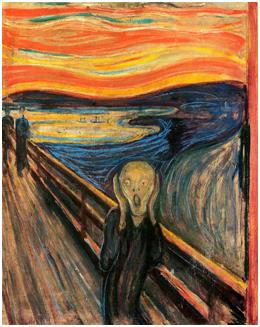
Munch created four paintings of which this is the 1893 oil, tempera and pastel version. The fourth [pastel] version not shown here was purchased from Sotheby’s on 2nd May 2012 for $119,922,600 and shows one of the background male figures stooped over the walkway railing.
Firstly, let’s read what Munch has to say about his own artwork in a poem:
“I was walking along the road with two friends – the sun was setting – suddenly the sky turned blood red – I paused, feeling exhausted, and leaned on the fence – there was blood and tongues of fire above the blue-black fjord and the city – my friends walked on, and I stood there trembling with anxiety – and I sensed an infinite scream passing through nature.”
Evocative words indeed. Munch is entirely consumed with the experience. He explains that he is the only person amongst his friends who is affected by what he sees. It is reminiscent of persons such as Michel de Nostredame the apothecary, reputed to be a seer of his time and beyond. I am not at all suggesting Munch had visionary abilities, but rather a strong emotional affectation to certain situations around him.
As one example of seeing in unusual ways if you could ask a few ancient Greeks how they perceived the sky you might be surprised at how they would answer you. Any reader interested in this particularly with a view to art might like to read about David Hockney who indeed has synesthesia.
Yet I do not believe Munch had synesthesia. What I do believe is that Munch was immensely sensitive to the world around him like Nostradamus aforementioned. Furthermore it cannot be denied there is an ominous religious undertone to the wording in his poem as it is clearly biblical in construction. I think this is highly valuable insight into Munch’ mind and interconnects beautifully to “The Scream” as a great work of art.
In discussing the famous painting I have pictured I hope you agree that the prominent figure in the foreground has the most ghostly distorted appearance. Again, this is indicative of Munch’ vivid imagination from his childhood and a fondness for macabre storytelling. A window into Munch and his mind.
It is also without question a self portrait when viewed in light of his poem.
The colours are garish and almost abstract so that if we looked at this sky in a different setting we could perceive the sky as something else. The fact our brains know it is representing the sky enhances Munch’ feelings about the ‘clouds turning blood red’ which was the description in his diary of 1892 prior to creating “The Scream” series of paintings and artfully constructing the poem.
The best question I ask us to ponder is whether this is a personal scream of himself or for humanity? Dear Readers you will have your own conclusions. Please allow me to say what I think. Somewhat both I think. Although I’m imagining that Munch is referring to a specific event or situation that I do not know as I write this blog.
What we can see is that he draws some stability around himself with his friends as a grounding. Whilst also feeling completely out of sorts and alone.
There is a chaotic tone to the background details in a flowing lavaic way. Correctly of lava. Its formation is non-descript by nature just as Munch describes himself that he does not know why he felt such anxiety on that day and at that very moment. Why did he feel so wearisome? Clearly he felt helpless and a scream was all that was left in him on that day to explain his feelings.
The physical bearance upon himself is why I have likened this to Nostradamus for sensitivity. A whole body affect, separate. Distinct.
I have to say that the figure itself seems to take the appearance of a flickering flame or a reflection in water. I see this as Munch becoming part of the painting. Feeling as the sky feels or attributing a sympathy along with it.
It is surely one of the most memorable paintings we will ever see.
 The Unfathomable Artist