type: The Unfathomable… Artist – Electronic Version

‘type: The Unfathomable… Artist – Electronic Version’ [18th August 2020] – by Matt The Unfathomable Artist, dip nib pen using original iron gall ink recipe on A3 [180 gsm] Artist’s paper.

type: The Unfathomable… Artist – Electronic Version‘ is Basquiat inspired.

I would like to quote my own personal commentary regarding this new iron gall ink piece:

“Intellectually i’m really happy with this artwork. Only after did i think, ‘that’s why i put the jagged lines in‘ This is my first Basquiat style piece and i can honestly write i had no prior notions to make it a Basquiat in style until it happened 🎨❤” [bold italics added for emphasis].

The jagged lines top and bottom were added on the 14th August 2020 after I’d finished the central/vertical calligraphy.  Initially without the ‘black block ink and multiple lines’ you can see in the artwork photograph above – completed through impromptu ink work.

I literally didn’t know how to proceed with this artwork from thereon.  Actually thinking I might leave it as it was, adrift of any further inspiration or ideas.

After drying the piece for a few days I began spontaneously researching electronic circuit board diagrams with avid interest.  I’m familiar, decades past, with circuit diagrams through my Dad’s former occupation as a photocopier engineer and his [second generation] electronics expertise.

Electronic magazines featuring television and Hi-Fi circuitry, repair and assembly scattered all over the house.  Diagrams with capacitors, LED’s, transistors, LCD’s, transformers etc.  Viewing circuit diagrams is always a memorable and pleasant experience to me.  I laughed when I saw a multimeter photograph yesterday.  My Dad carried one of those around with him quite often.

For me, this artwork is a connection to the ancient and modern past, encapsulated with new hope for the future.

I’d like to share with you the electronic circuit diagram symbols used in my artwork including their relative placements:

fuse [rectangular box with zigzag lines – begins diagonally underneath the word ‘type’];

Anode/Cathode Solar cell Photodiode [line into circle with inner triangle-vertical-line and two ascending diagonally right-to-left down-pointing arrows – underneath the grammatical colon and letter ‘T’];

battery multi-cell [horizontal line with vertical line, vertical single dash line, vertical single dash line longer, vertical line with horizontal line – underneath the space between the words ‘The’ and ‘Unfathomable’];

dome light [horizontally represented domed light bulb with heart light element – underneath letters ‘n, f, a, t, h’];

tri-phase protective and neutral conductor [single line with ‘triple diagonal line’ ‘diagonal line with T line’ and ‘diagonal line with black dotted circle’ intersections – underneath letters ‘m, a, b, l, e . .];

solder bridge [two adjacent lines above-below with two split circles representing the solders – underneath the word ‘type’];

balanced terminals [two adjacent lines with two open circles – underneath and between the words ‘type’ and ‘The’];

electromagnetic shielding [large rectangle, shaped by line dashes – surrounding the word Artist];

constant current source or general transformer or obscured oscillator [line with filled black circle] and also [line with black circle with imperfect unfilled circle overlapping directly below – underneath letters ‘l, e’ ] – please note this latter symbol also has an unknown electronic meaning.

Reasoning is viewer-dependent, wherever conceptual plurality applies to positive and negative space.

Standard

Artemisia Gentileschi The Baroquess

‘Judith and Her Maidservant’ by Artemisia Gentileschi, c1625-27, Oil on canvas, 184 cm (72 in) × 141.6 cm (55.7 in).

Art fans interested in Italian Baroque..

..Artemisia Gentileschi to the rescue.

In my opinion Artemisia can effortlessly flow between pre-Raphaelite, Renaissance and Baroque styles.  The latter style incorporating her most dominant structural preference.

Typically extreme contrasts between dark shading counter-referenced by strong natural or incandescent light upon subject/s revealing foreground details.

The Baroque style is often accompanied by dynamic, intense action designed to infuse a sense of pictorial awe and..

.. Controversy.

I could have happily chosen Orazio Gentileschi, her father, here: https://en.wikipedia.org/wiki/Orazio_Gentileschi to write about however I wish to balance my blog with various artists.  For further details about Artemisia Gentileschi’s life please read her Wikipedia page, here:

https://en.wikipedia.org/wiki/Artemisia_Gentileschi

The purpose of this article is to examine her artworks displayed on this page.

This original version of ‘Judith and Her Maidservant’, shown above, clearly emphasizes a female artist at the height of her ability.  A father and daughter learned of their craft.

Professional artists of their own volition.

The swaying candle flame, gripped sword at the ready, shadows exquisitely represented.  Seriously, we have never seen artistic shadow painted better.  A simple statement suffices, noting those superlative Baroque italics included.

Artemisia delivers to us a masterpiece as if with the birth pangs of effort and tumult.  It really is ‘As Good As It Gets’.

Except of course there is no romantic comedy in this painting.  A greying, lifeless severed head tells a completely different, graphically violent story.

Cardinal robe red drapery overhanging silent gestures tells of an urgent sense of concealment to their obvious caution.  Concerned expressions magnify their violent crime.

Only death now seems to be at peace following the previous painting Act scene #1 of ‘Judith Slaying Holofernes’ [c1614-20] by Artemisia Gentileschi, here https://en.wikipedia.org/wiki/Judith_Slaying_Holofernes_(Artemisia_Gentileschi)

Let thee shudder as we turn our attention to her next masterful painting chosen for this blog article:

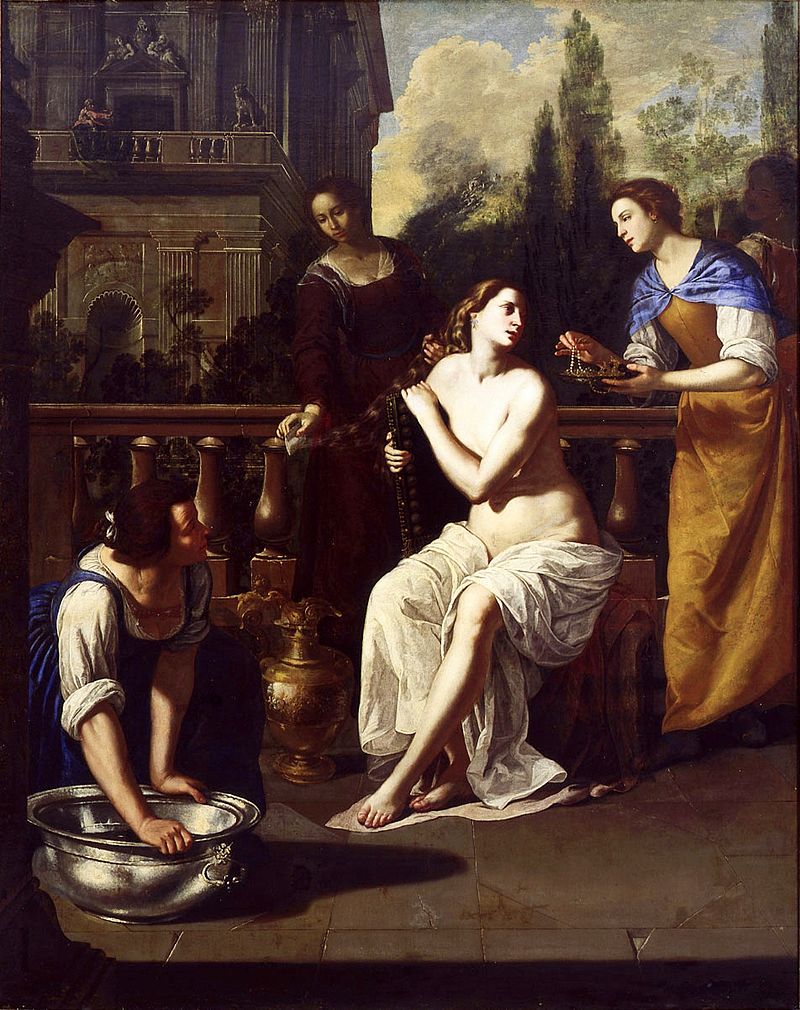
‘Bathsheba’ by Artemisia Gentileschi, c1636/7, Oil on canvas, 265.43 × 209.55 cm (104.5 × 82.5 in).

Immediately it was emotively certain for me to include an example amongst her distinctive ‘Bathsheba’ paintings, shown above.

Renaissance of composition.

For the love of goodness, please look at that silver bathing vessel.  It exudes perfect metallic strength, depth and solidity.  Should I ever paint metal like this I shall dance around a hallway with all the grace of a mountain goat cascading rocky climbs.

Glass in hand.  Celebratory.

Truthfully, Artemisia is modestly accentuating compositional skills at the very word of experts during her lifetime.  The architectural construction, also, Beyond Words.  The silks, sublime.

Everything in life has rhyme and reason.

The feminine figures foreground positively engages us as viewers.  Feigning, whilst attentive.  Could it be that the two standing attendants (maidservants) are competing with one another for Bathsheba’s favour?

Engrossed in their respective beautifying function.

Next I chose to venture a painting by Artemisia Gentileschi extolling her pre-Raphaelite competence:

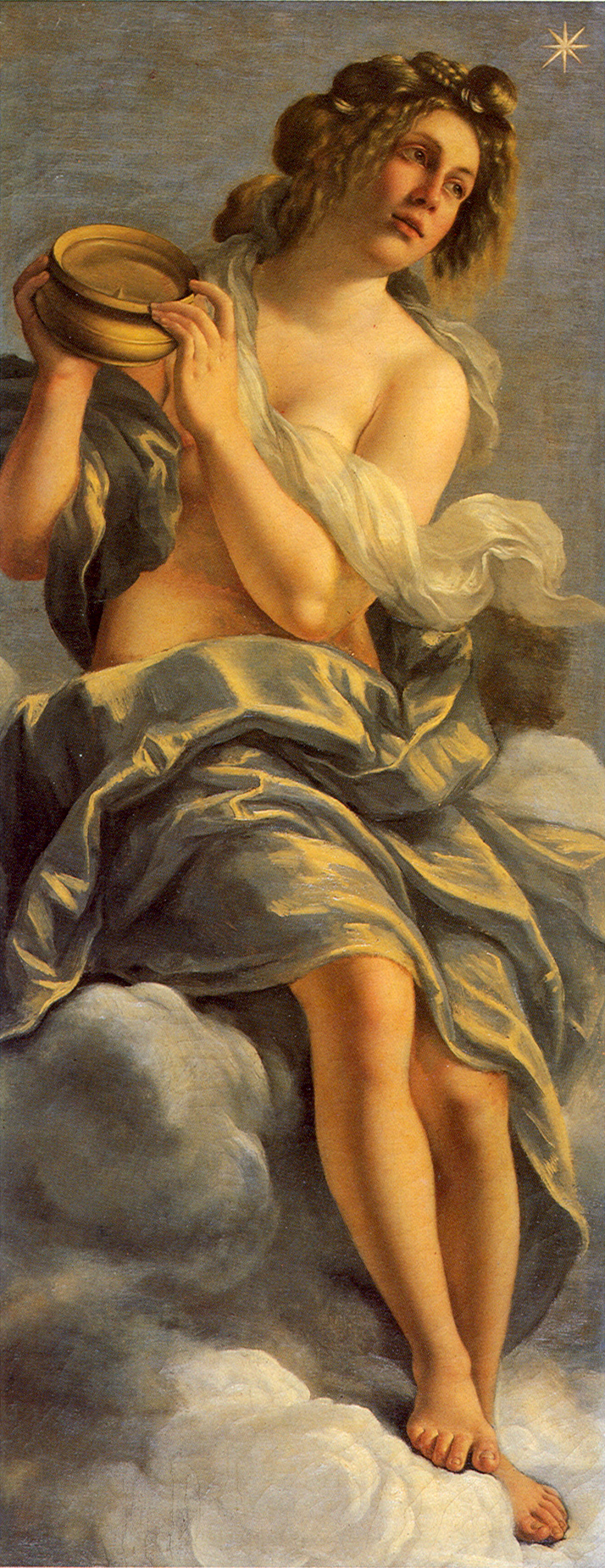
‘Allegory of Inclination’ by Artemisia Gentileschi, c1615
– 1616, ceiling canvas Casa Buonarroti, Galleria, Florence.

Heaven appears to be a firmament in this painting, ‘Allegory of Inclination’ by Artemisia Gentileschi.

Shown above.

Her dreamy-peculiar distant expression.  Sensuous handling of the subject material.  Modesty covered fleetingly as if by a soft breeze.  A bowl of revelation.  The star of Magi.  Hair tied attractively away from her face to depict important work with far-sighted vision.

Porcelain skin for chastity.  The absence of extreme shading for angelic purity.  Harmonious legs.  Withdrawn body posturing.

Artemisia Gentileschi is quite the feminist throughout her work.  I perceive her as willfully strong, confident and determined.  Respected as an equal both in society and as a female artist of her generation.

Michelangelo’s nephew, Michelangelo Buonarroti, does not surprise me with his considerable regard at choosing according to eQuality for work relating to the artistic interior decoration at Casa Buonarroti.

Artemisia delivers fine art each and every time.

‘Danaë’ by Artemisia Gentileschi, c1612, Oil paint, copper, 41.5 cm (16.3 in) × 52.5 cm (20.7 in).

Danaë ‘ shown above is an unusual composition.

This artwork, to my mind, describes two stories in one painting.  Especially with the interpolation between Danaë and various artworks of Cleopatra by Orazio and Artemisia.

Interestingly Orazio, her father [link shown earlier in this article] also uses similar gold coins falling in his $30.5 millionDanaë‘ masterpiece sold January 2016.

His ‘Danaë‘ painting here:

https://en.wikipedia.org/wiki/Dana%C3%AB_(Orazio_Gentileschi)#/media/File:Orazio_Gentileschi_-_Dana%C3%AB_and_the_Shower_of_Gold_-_2016.6_-_J._Paul_Getty_Museum.jpg

With professional art collecting all factors might be evaluated.  Historical, monetary, emotional, sentimental, proficiency, influence, provenance, creativity, artistic status and social interconnection.

That Artemisia was an industrious woman is a true testimony of her fighting spirit to achieve artistic greatness.  A spirit that urges a naturally gifted person without compromise to stand proudly with her peers.

Please note that a scholarly article is available online by Britiany Daugherty which includes inciteful research into Artemisia Gentileschi’s life and works, link here:

http://digitalcommons.unl.edu/cgi/viewcontent.cgi?article=1056&context=artstudents

Standard