Daniel Garber Teaches American Romanticism

‘Little Girl Knitting’ [1918] by Daniel Garber, Charcoal on paper, 18.25 inches x 23.25 inches.

Before I make commentary regarding the four artworks in this blog article, please let me continue my oft tradition of utilising Wikipedia pages.  You can read about the artist Daniel Garber’s career on his profile page by clicking here: Daniel Garber Wikipedia page.

‘Little Girl Knitting’ by American Impressionist painter Daniel Garber, shown above, is a charcoal monument.

Technical depth, emotive concentration, focused thoughtfulness and masterly shadow.

Defined clothing with hyper-realist skin and hair, details Tanis, the painters daughter at a determined eleven years of age.  The heavily constructed background is completely engaging whilst the patterned textural garment foreground appears almost lattice life-like.

Viewing further Garber charcoal works you will appreciate his off-the-scale pencil work.

‘Students of Painting’ [1923] by Daniel Garber, Oil on compositional board, 18 inches (h) x 21 15/16 inches (w).

‘Students of Painting’ by Daniel Garber has all the romanticism of the 1920’s art deco era.  Sort of dancing women and champagne flutes.  The full impressionistic style graces the wall with ghostly aplomb.  The pastel windowed garden contrasts the serious business of work.

Like the efforts to make movie pictures and King Kong.  I mention King Kong for its fictional story where art is entangled unto human tragedy.

Technological brute force combined with mass cultural decadence turning civilisation into the wild jungle.  The writer creates the apocalyptic city scenario envisioned of man kind(?) pitted against a prehistoric untamed gargantuan primate.

A primordial beast they cannot contain through sheer apex entitled delirium.

The beast is not Planet Earth or its earliest inhabitants.

‘Students of Painting’ likely explains the studies required before graduating to plein air techniques.  It’s also reasonable to believe there is a subtle allusion to gender equality through the left and right depiction of the students’ dominant hands.
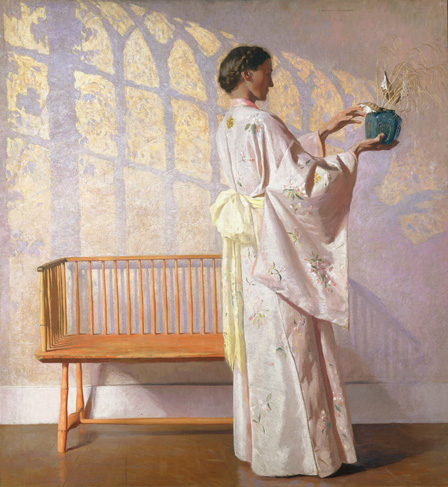
‘The Studio Wall’ [1914] by Daniel Garber, Oil on canvas, 56 inches x 52 inches.

With ‘The Studio Wall’ by Daniel Garber the artist distorts the natural light throughout pleasantly fashioned fabrics, the astonishing dappled wall ‘window frame‘ work, an earthy reflective floor and a singular piece of intricately fanciful furniture.

I think the onomatopoeian word we’re looking for to describe this painting is yummy.  Yes, I do accept cookies.

Beyond Words to be honest, albeit a thousand words is good to spring to mind.

The lady in the painting is Mary Franklin Garber, Daniel’s wife.  Mary is cousin of Anna Whelan Betts [link here to Anna Whelan Betts Wikipedia page] both of whom are artists themselves.  Mary is sister to John Franklin Garber, who himself made careful documentation and academic promotion of his late father’s work from 1958.

Further research resource regarding Daniel Garber’s work can be found here: Daniel Garber: Romantic Realist – A Teacher’s Guide published online as a collaboration between the Pennsylvania Academy of Fine Arts and the James A Michener Art Museum.
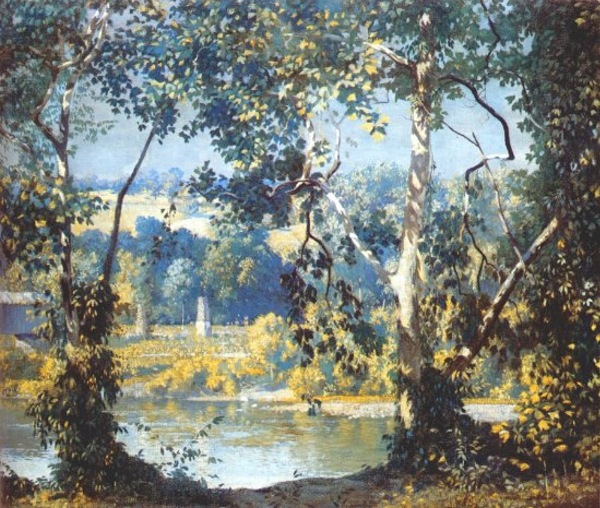
‘Fields in Jersey’ [1909] by Daniel Garber, Oil on canvas, 36 inches x 44 inches.

I’ve included ‘Fields in Jersey’ by Daniel Garber to highlight the beautiful strength of his foreground trees’ vine-like branch work.  As a complete painting there are complex shade effects to lap up, advancing depth of field changes and dreamy hues.

I want to swing on the branches like a boy eleven years of age.  What I’m actually doing is admiring the way Garber solidly painted the foreground trees.  Having perhaps worked the background trees first, then fully completing the foreground trees afterwards.

Every artist has their own way of working.

Garber’s techniques continued to be honed and passed onward through 40 years of art teaching.  Etching, printing, painting, charcoals and sketching.  Daniel’s natural talent coupled with his professional draughtsperson’s hands make for his exceptional detailing abilities.

Daniel retains the romantic feeling of Impressionism within most of his artworks, whilst clearly enjoying Realist working also as seen through works such as the ‘Little Girl Knitting’.

In concluding this article I’d like to share a YouTube video showcasing Daniel Garber‘s artworks courtesy of Learn from Masters:

Standard

Cuneiformal Art by J M W Turner

Light and Colour (Goethe’s Theory) – the Morning after the Deluge – Moses Writing the Book of Genesis‘ [1843] by Joseph Mallord William Turner, Oil on canvas, 78.5 cm × 78.5 cm (30.9 in × 30.9 in).

Today I discovered a new work of abstract art, please see the above dated 1843.

Standard

Jackson Pollock Wows

No. 5 (1948) by Jackson Pollock. 243.8 x 121.9 cm (8ft by 4ft)

No. 5 (1948) by Jackson Pollock.
243.8 x 121.9 cm (8ft by 4ft)

No.5 completed in 1948 is without doubt the most famous abstract painting ever.  Produced by dripping paint onto the canvas during an ordered creative art process.  No. 5 has a beauty all of its own.

Pollock was working at a time when the whole abstract art movement was positively vibrant with pace and ascendency.  If you could hop into H.G. Wells “Time Machine” and travel back to Pollock’s art era you would see the equalling influence of leading abstract painters during his life.

Every artist has their own style and constructive technique.  What demonstrably impressed me about Pollock is his professionalism.  He is meticulous, innovative and inspirational.  Clients often expressed their appreciation for his work with profound eloquence describing the beauty of his art as a rapture or a deeply spiritual experience to them.

Jackson enjoyed layers to add depth.  He understood that dissemination can be beautiful if it’s ordered and fashioned in an exciting way.  This expertise that color and structure can be strongly emotive is why he is a Master of the modern art era.

An Abstract giant where there is little or no perceptible form to discern except that which we perceive as feeling within.

What makes popular?  Who holds the secret?  Why does something non-living have continuing value both monetarily and as a connection to the human experience?  Perhaps the answer is the very question.  Out from a non-living arty contrivance we see the personality on the canvas, the fiberboard, the paper or the multitude of ‘watercoloured skies’.

Can we really be objective about art?

Standard

The Qingming Festival Masterpiece

An immensely historical painting popularly translated into English as “Along The River During the Qingming Festival” pre-dates Claude Monet’s “Garden of the Princess” by more than seven centuries.

The latter was painted in 1867 whilst the ancient Chinese cityscape was painted during the 12th Century by Zhang Zeduan – if we choose to use the Gregorian calendar as a reference point.

Both paintings are truly beautiful works of art.  They provide us with a busy cityscape using a panoramic view referencing capital cities during the time of their creation.  Each painting gifts us with a window into the lives, the ergonomic structures and customs of the people we see.

Monet is seated by permission to focus on the Quai de Louvre and Left Bank in Paris.  Zhang Zeduan is likewise granted to carry out his important artistic commission centuries earlier.

The man is asked to stand at a gate to carry out his work by specific request.  Monet paints from a balcony of the Louvre itself overlooking the scene below.  Intriguing artistic similarities.  Immediately Monet’s painting sprung to my mind when I studied the original Qingming Festival painting from the 12th Century.

Edouard Manet and Renoir too.  Indeed, it’s true that Monet admired Oriental art although his style is clearly European.  All great artists draw inspiration from past and present Masters.  Chinese Master artist Qi Baishi is notably humble in his praise of his favourite Chinese painters.

Bianjing now modern Kaifeng in China was the capital of the Northern Song Dynasty (960 – 1127) some thousand years after the Romans had begun establishing Londinium as the new capital of Brittannia.  In doing so the Romans replaced the settlement at Camulodunum for what we now know as London over Colchester in England respectively.

The original Chinese painting by Zhang Zeduan has extraordinary value wrapped up in its scrolls through its past ownership, cultural influence and endearment to Chinese art throughout the proceeding centuries.  A reverence that has inspired newly stylised remakes of the original for important occasions since.

Among these fine art remakes is an expert version presented to Emperor Qianlong in 1737.  The remake is updated only to reflect 18th century culture whilst remaining faithful in composition to the original.

Convergence, divergence and intransigence is intrinsically valuable to the ongoing cultural heritage of World Art.

Let us please take a considered look at “Along The River During the Qingming Festival”.  Respectfully appreciating that a language may be translated in various ways.  For a certainty, choosing a popular title for an artwork is wise.  Zhang Zeduan excels completely in his use of movement, detail, structuring and artistry.

Along the River during the Qingming Festival

The original painted scroll above measures five and a quarter metres across and ten inches high so it is difficult to imagine its impressive visual scale.  Especially as most Readers will view this image using a modest electronic device.

A large scale animated digital screen artwork has been produced incorporating the original and displayed in the China Pavilion at the Shanghai Expo 2010. 

This can be viewed by clicking here:  http://www.youtube.com/watch?feature=player_embedded&v=-AVzwui5-5w and for a closer view here: http://www.youtube.com/watch?v=SbzQ-JPlc9g

The animation is astonishingly rendered and helps to capture the affection in which the original painting is held.

I love both these paintings.  Zeduan painted fashionably of his day according to Chinese artistic style and tradition.  We see this Chinese style consistently throughout the following centuries up to and beyond Monet.  Beloved themes embraced like fruit bowls upon tables.

Just as Monet himself contributed to modern Impressionistic Art, Zeduan has greatly influenced Asia’s contemporary artists.  It’s wonderful to see artists around the world gaining inspiration from world art.

I have seen the influence of artists like Qi Baishi in the artistic style of living painters on the other side of the globe.  Professional Artists whose excellent work I’ve viewed up close and personal in art galleries.

I would like to include Monet’s “Garden of the Princess” in this Blog since we have discussed this painting also.

Here it is:

Garden of the Princess by Claude Monet

Garden of the Princess by Claude Monet

It has been a joy to write my Blog once again.

Matt The Unfathomable Artist

Standard