Élisabeth Louise Vigée Le Brun

‘Self Portrait of Élisabeth Louise Vigée Le Brun’ [1790], Oil on canvas, 100 x 81 cm

The ‘Self Portrait of Élisabeth Louise Vigée Le Brun‘ [1790] shown above is delicate, forceful and gracefully timid of pose.  The feathery handling of hair, elaborate white-cream fabrics and curious pose whilst looking to the mirror extols her professionalism.

Did you notice that this painting is actually a self portrait of Vigée Le Brun producing a working portrait?

Élisabeth married influential art dealer Jean-Baptiste Pierre Le Brun in 1776, himself born into an impressively artistic family.  His great-great uncle was Charles Le Brun – https://en.wikipedia.org/wiki/Charles_Le_Brun.

Élisabeth Vigée Le Brun herself is daughter of French portraitist Louis Vigée and sister to playwright Étienne Vigée.  Skillful art heritage assisted Élisabeth Vigée in successfully competing within aristocratically lucrative landscapes.  Eventually Élisabeth Vigée Le Brun is rewarded for her hardworking technical merit through membership to the Académie Royale de Peinture et de Sculpture in 1783.

In addition to actively seeking industry connections quality reigns supreme, dot com.

‘Portrait of a Young Woman’ [c.1797] by Élisabeth Louise Vigée Le Brun, Oil on canvas, 70.5 cm x 82.2 cm

Portrait of a Young Woman‘ [c.1797] by Élisabeth Louise Vigée Le Brun incorporates a studio posing style Élisabeth was familiar with.  Further research is required to understand the placing of arms, folded inside outer garments.

The backdrop is Renaissance in style whilst Vigée Le Brun’s work intermixes Baroque, Neoclassical and Rococo themes.  A learned expert, without question, given to intensively study her past and contemporary art Masters.

We can see a sense of movement to her subject’s hair, windswept, traversing waves set sail across the Atlantic, Pacific or Mediterranean oceans.  Her outer garments are perfectly defined and believably intricate.

Fashion, Fashion, Fashion with added Heart Eyes Emoji.

Supercool.

Portrait of Charles-Alexandre de Calonne‘ [1784] by Madame Vigée Le Brun, Oil on canvas, 155.5 x 130.3 cm

How does one begin to describe this painting by Madame Vigée Le Brun of Charles-Alexandre de Calonne?

Beyond Words.

I want to lean forward in an attempt to prevent his precariously placed paper document from falling to the ground.  Her painting so breathtakingly real it positively interacts with us as the viewer.  A calm, easy, attentive posture.  Tremendous power emanates from the subject.

Digitalised Virtual Reality – the optical illusion provoking a sensory response with body and mind.

Here is a past The Unfathomable Artist article about John W Waterhouse, therein explaining his similar ‘VR-like’ ability:

https://theunfathomableartist.wordpress.com/2014/08/21/john-w-waterhouse-the-lady-of-shalott/

‘Portrait of Madame Du Barry’ [1781] by Élisabeth Louise Vigée Le Brun, Oil on panel, 27 1/4 x 20 1/4 inches (69.2 x 51.4 cm)

I decided to include ‘Portrait of Madame Du Barry‘ for.. the.. straw.. hat.  Spoken rather slowly to imagine my awe.

Artistic painters enjoy certain textures.  A past article about woven textural specialist Guiseppe Arcimboldo illustrates my point here: https://theunfathomableartist.wordpress.com/2014/10/31/guiseppe-arcimboldo/

Madame Du Barry wore a peignoir for this particular sitting, a dressing gown.  The painting was commissioned for the Duc de Brissac, Louis Hercule Timoléon de Cossé-Brissac [https://en.wikipedia.org/wiki/Louis_Hercule_Timol%C3%A9on_de_Coss%C3%A9-Brissac] according to the artist’s ‘Souvenirs’ 1835-37.

Further information about the artist can be found by reading ‘Vigée Le Brun’ by Joseph Baillio, Katharine Baetjer, Paul Lang.

Madame Du Barry has her visual identity stored for us upon the canvas, and also digitally too.

Should we call this a UI or a Unique Identity?

Cue trailer.

Standard

Artemisia Gentileschi The Baroquess

‘Judith and Her Maidservant’ by Artemisia Gentileschi, c1625-27, Oil on canvas, 184 cm (72 in) × 141.6 cm (55.7 in).

Art fans interested in Italian Baroque..

..Artemisia Gentileschi to the rescue.

In my opinion Artemisia can effortlessly flow between pre-Raphaelite, Renaissance and Baroque styles.  The latter style incorporating her most dominant structural preference.

Typically extreme contrasts between dark shading counter-referenced by strong natural or incandescent light upon subject/s revealing foreground details.

The Baroque style is often accompanied by dynamic, intense action designed to infuse a sense of pictorial awe and..

.. Controversy.

I could have happily chosen Orazio Gentileschi, her father, here: https://en.wikipedia.org/wiki/Orazio_Gentileschi to write about however I wish to balance my blog with various artists.  For further details about Artemisia Gentileschi’s life please read her Wikipedia page, here:

https://en.wikipedia.org/wiki/Artemisia_Gentileschi

The purpose of this article is to examine her artworks displayed on this page.

This original version of ‘Judith and Her Maidservant’, shown above, clearly emphasizes a female artist at the height of her ability.  A father and daughter learned of their craft.

Professional artists of their own volition.

The swaying candle flame, gripped sword at the ready, shadows exquisitely represented.  Seriously, we have never seen artistic shadow painted better.  A simple statement suffices, noting those superlative Baroque italics included.

Artemisia delivers to us a masterpiece as if with the birth pangs of effort and tumult.  It really is ‘As Good As It Gets’.

Except of course there is no romantic comedy in this painting.  A greying, lifeless severed head tells a completely different, graphically violent story.

Cardinal robe red drapery overhanging silent gestures tells of an urgent sense of concealment to their obvious caution.  Concerned expressions magnify their violent crime.

Only death now seems to be at peace following the previous painting Act scene #1 of ‘Judith Slaying Holofernes’ [c1614-20] by Artemisia Gentileschi, here https://en.wikipedia.org/wiki/Judith_Slaying_Holofernes_(Artemisia_Gentileschi)

Let thee shudder as we turn our attention to her next masterful painting chosen for this blog article:

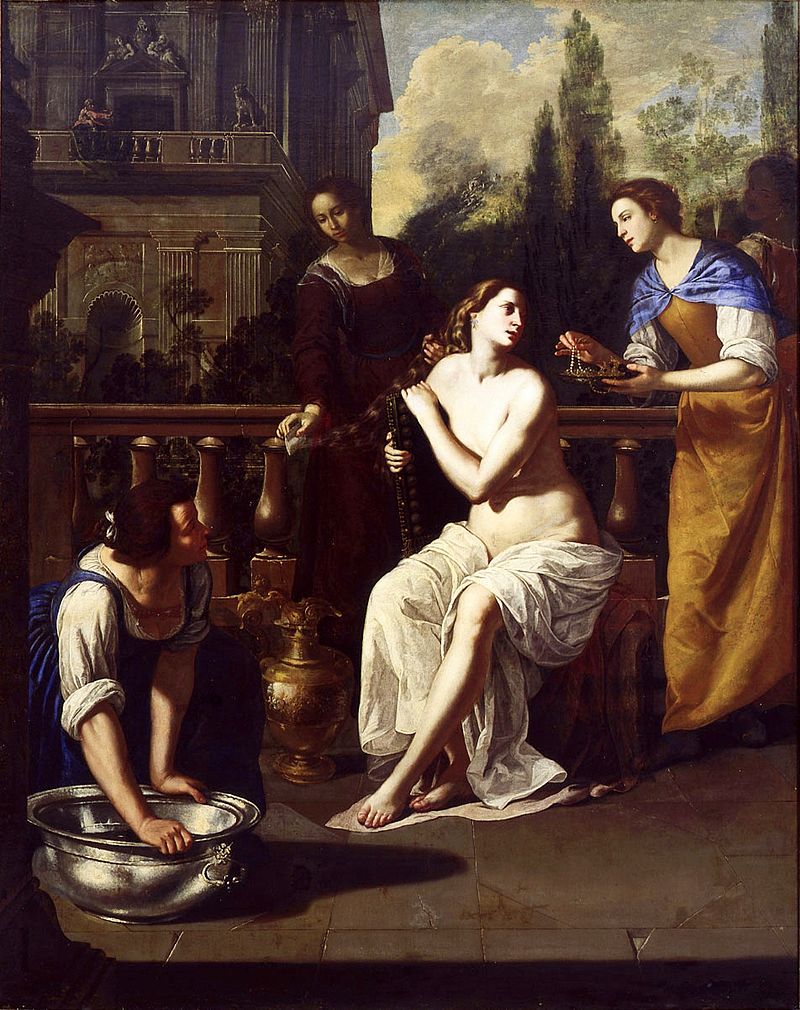
‘Bathsheba’ by Artemisia Gentileschi, c1636/7, Oil on canvas, 265.43 × 209.55 cm (104.5 × 82.5 in).

Immediately it was emotively certain for me to include an example amongst her distinctive ‘Bathsheba’ paintings, shown above.

Renaissance of composition.

For the love of goodness, please look at that silver bathing vessel.  It exudes perfect metallic strength, depth and solidity.  Should I ever paint metal like this I shall dance around a hallway with all the grace of a mountain goat cascading rocky climbs.

Glass in hand.  Celebratory.

Truthfully, Artemisia is modestly accentuating compositional skills at the very word of experts during her lifetime.  The architectural construction, also, Beyond Words.  The silks, sublime.

Everything in life has rhyme and reason.

The feminine figures foreground positively engages us as viewers.  Feigning, whilst attentive.  Could it be that the two standing attendants (maidservants) are competing with one another for Bathsheba’s favour?

Engrossed in their respective beautifying function.

Next I chose to venture a painting by Artemisia Gentileschi extolling her pre-Raphaelite competence:

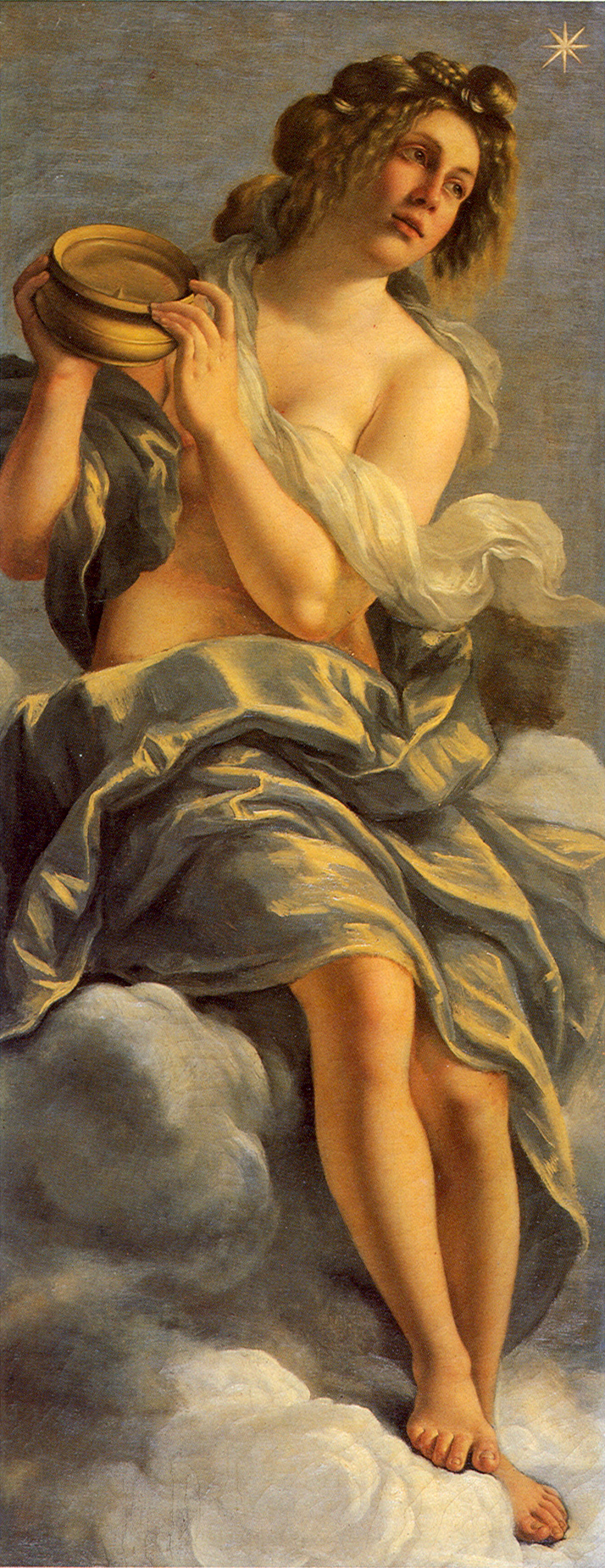
‘Allegory of Inclination’ by Artemisia Gentileschi, c1615
– 1616, ceiling canvas Casa Buonarroti, Galleria, Florence.

Heaven appears to be a firmament in this painting, ‘Allegory of Inclination’ by Artemisia Gentileschi.

Shown above.

Her dreamy-peculiar distant expression.  Sensuous handling of the subject material.  Modesty covered fleetingly as if by a soft breeze.  A bowl of revelation.  The star of Magi.  Hair tied attractively away from her face to depict important work with far-sighted vision.

Porcelain skin for chastity.  The absence of extreme shading for angelic purity.  Harmonious legs.  Withdrawn body posturing.

Artemisia Gentileschi is quite the feminist throughout her work.  I perceive her as willfully strong, confident and determined.  Respected as an equal both in society and as a female artist of her generation.

Michelangelo’s nephew, Michelangelo Buonarroti, does not surprise me with his considerable regard at choosing according to eQuality for work relating to the artistic interior decoration at Casa Buonarroti.

Artemisia delivers fine art each and every time.

‘Danaë’ by Artemisia Gentileschi, c1612, Oil paint, copper, 41.5 cm (16.3 in) × 52.5 cm (20.7 in).

Danaë ‘ shown above is an unusual composition.

This artwork, to my mind, describes two stories in one painting.  Especially with the interpolation between Danaë and various artworks of Cleopatra by Orazio and Artemisia.

Interestingly Orazio, her father [link shown earlier in this article] also uses similar gold coins falling in his $30.5 millionDanaë‘ masterpiece sold January 2016.

His ‘Danaë‘ painting here:

https://en.wikipedia.org/wiki/Dana%C3%AB_(Orazio_Gentileschi)#/media/File:Orazio_Gentileschi_-_Dana%C3%AB_and_the_Shower_of_Gold_-_2016.6_-_J._Paul_Getty_Museum.jpg

With professional art collecting all factors might be evaluated.  Historical, monetary, emotional, sentimental, proficiency, influence, provenance, creativity, artistic status and social interconnection.

That Artemisia was an industrious woman is a true testimony of her fighting spirit to achieve artistic greatness.  A spirit that urges a naturally gifted person without compromise to stand proudly with her peers.

Please note that a scholarly article is available online by Britiany Daugherty which includes inciteful research into Artemisia Gentileschi’s life and works, link here:

http://digitalcommons.unl.edu/cgi/viewcontent.cgi?article=1056&context=artstudents

Standard