
Pictured immediately below is a delicious basket of fruit with apples, grapes and pears ready for eating by Italian past Master Guiseppe Arcimboldo.
Auctioneers entitled the painting in sale lots as ‘A Reversible Anthropomorphic Portrait of a Man Composed of Fruit’. It sold for $104,000 in 1999 and again a year later for $1.4 million through Sotheby’s.
Great art can be profitable and pleasurable to own.
The National Gallery of Art, The British Museum and New York Botanical Gardens have all paid homage to Guiseppe Arcimboldo in recent years. Publicized acquisitions, exhibitions and events.
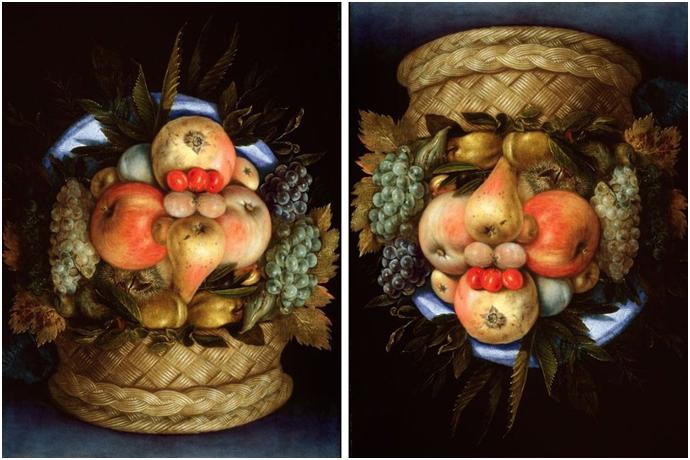
Arcimboldo like many Milanese artists was heavily influenced by Leonardo Da Vinci. Whilst naturalistic drawings have been with us for millenia, artists like Da Vinci had begun to popularize nature in scientific terms of proportion, accuracy and physiology.
Da Vinci was by no means the first but we see a positive interest of intermingling man or woman with nature throughout Arcimboldo’s paintings. This likewise influenced people to see their relationship with the natural world in a less religiously defined manner. Not so frightening or mysterious to their superstitious sensibilities.
Did old world paintings contribute to a shift in how people viewed the mystery of life and our place in a mind-boggling Universe? It would be fruitless to think otherwise. Fruity wordplay huh.
The Unfathomable Artist poses amusingly in his mirror, raises his eyebrows up and smiles cheekily to himself.
Speaking in musical terms we all appreciate that Antonio Vivaldi is famous for ‘The Four Seasons’. Yet so too is Arcimboldo from a prior era. Please take a look at ‘Winter: An anthropomorphic portrait of a man’ shown below:
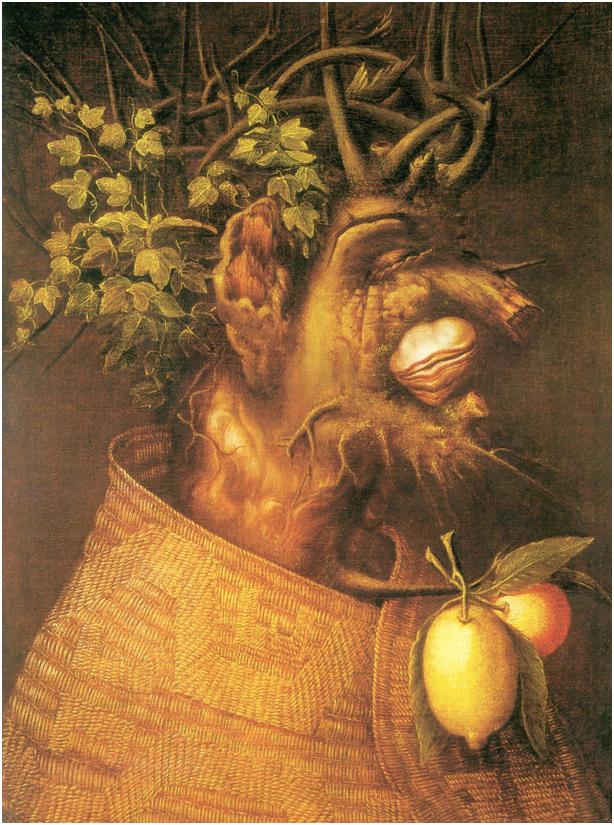
Arcimboldo painted the seasons avidly. Perfecting and experimenting with compositions as all great artists do. Looking at Winter version 3 above with lemons sprouting from the caricature’s neck one cannot help notice Guiseppe’s highly definitive textural style. Equalled by art greats yet impossible to surpass. Perfect is fit for purpose. Rarely is perfection of itself.
Arcimboldo is to Wicker Baskets as Van Gogh is to Sunflowers. Signed, sealed and delivered. Owned.
Simile, reversible and object-orientated portraiture became his undoubted speciality from the 1560’s onwards especially following his appointment by Ferdinand I in 1562.
One of his most famous paintings, ‘Vertumnus’, painted for Rudolf II ‘Holy Roman Emperor’ is based on the Roman god of the seasons. Shown below colourfully resplendent and might I say quite flattering when compared with some of his earlier portraits.
Rudolf II must have possessed a good sense of umor ad sanctimoniam affectans and respected Arcimboldo greatly to happily receive such a brilliant masterpiece. It also shows the influential gravitas that well known paint artists held amongst royalty, aristocracy and the wealthy. Historical diplomatic assignments by Sir Peter Paul Rubens dramatically attests.
Intellect, creativity and sensitivity. We all have these qualities.
Portrait paint artists interact personably with people to fill a canvas. What we see is what you get. Honesty will always produce the best portrait in my opinion. Every great portrait artist across any medium knows things about you whilst busily working away.
Oils become creative fruit juices swirling around our minds eager for the appropriate brush.
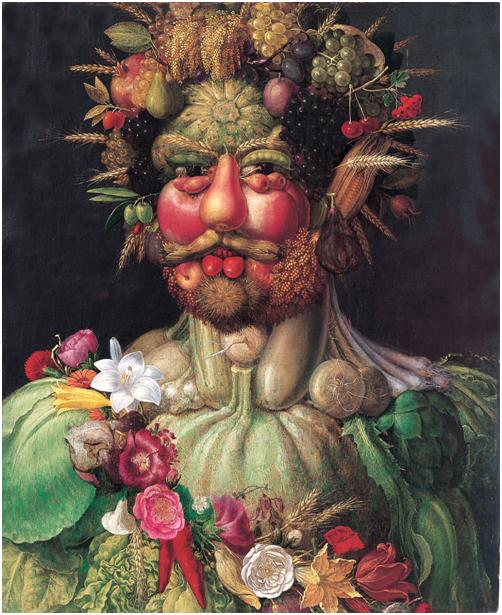
‘Vertumnus’ 1590/1.
 The Unfathomable Artist