le Renoir Surérogatoire

‘Luncheon of the Boating Party’ [1880 to 1881] by Pierre-Auguste Renoir, Oil on canvas, 51.26 in (h) x 69.13 in (w).

Continuing my tradition of providing Wikipedia links for artists, here is a link to the page of renowned French Impressionist painter Pierre-Auguste Renoir:

https://en.wikipedia.org/wiki/Pierre-Auguste_Renoir

For an interactive image ala ‘Luncheon of the Boating Party’ please click here and hover your mouse over the people in the painting: https://en.wikipedia.org/wiki/Template:Renoir-BoatingParty-ImageMap

Interlude.  I will return to writing this article after eating some much needed food and drinking a lovely cup of tea.  Sorry, Renoir’s painting has made me hungry and I simply cannot write another word after this one.

I wish my thoughts to flow satiated as I am.  Renoir’s work is precise, pastel-soft at times, spontaneous like eating, romanticized, prettily arranged and sometimes pre-Renaissance and/or pre-Raphaelite in style.

Pierre-Auguste is capable of realist depictions wherever he felt the subject material became ameliorated.  We see examples of this in his portraits of Claude Monet and Alfred Sisley, elevating their dignity and social standing.  Quite likely Renoir ‘clung to them’ with strong regard.

At this latter well known saying I thought immediately of Michel de Nostredame [Nostradamus – https://en.wikipedia.org/wiki/Nostradamus] and his distinctive oddities.

‘If a meteorologist predicts troublesome weather, for thoust seeth through eyes that you do not see – do you then say that the meteorologist is a god bringing it upon you?’

Eau de toilette.  It seemed strange for me to write this spontaneously until I then quickly read:

“Painting must not stink (purr) of the model and one must, neuertheless, smell (sentir) nature in it.” – Pierre-Auguste Renoir.  Quotation online in Bodies of Art: French Literary Realism and the Artist’s Model” by Marie Lathers.

__________________________________________________________________________

I wish to talk about ‘Luncheon of the Boating Party’ [1880 to 1881] by Pierre-Auguste Renoir.

The interaction between the characters is truly exceptional by any normal standards of paint art working.  Care, observance, ponderance, yearning, aloof inexperience, nervousness, mutual co-equal friendship, comfort, serious business discussion and guarded affection from others. __________________________________________________________________________

Thoughts arriving like the Sun at its travelling.  My brain is acting gregariously with a multitude of thoughts as I type.  Renoir’s artworks are enlivening my inspirations so I shall share a new saying from last night inspired of an ancient saying:

‘That we are travelling with the Sun at great speed in all four directions, actually seven, is insight beyond my comprehension at this time.’ – by Matt The Unfathomable Artist, September 2017.

G.R.A.V.>i>T.Y.

Σ

__________________________________________________________________________

‘Study of a Seated Bather’ [1897] by Pierre-Auguste Renoir features a dainty composition of a model bathing nude, shown immediately below:

‘Baigneuse Assise. Study of a Seated Bather.’ [1897] by Pierre-Auguste Renoir, Original softground etching in black ink [1897] signed with the artist’s signature stamp Also signed in the plate. From the edition printed by Louis Fort for Renoir (circa 1910). Edition first issued by Vollard to accompany the album: ‘La Vie et l’Oeuvre de Pierre-Auguste Renoir’, Paris 1919, On light cream wove paper. Sheet: 12 1/2 x 9 1/4ins. Plate: 8 5/8 x 5 3/8ins (220x137mm).

I enjoy all his nude artworks.  There is nothing more honest, intimate and natural than the naked human body as an artform.  Intimacy need not be brash, disrespectful or undignified.

Respecting the beauty of the human form, its near miraculous function and the emotions we feel through our bodies begins as a true gift.  The nakedness at birth.

The idea of birth brings me to the next painting, shown here:

‘Pink and Blue – The Cahen d’Anvers Girls’ [1881] by Pierre-Auguste Renoir, Oil on canvas, 119 × 74 cm (46.9 × 29.1 in).

The pensive almost lost-looks upon the girls faces is a glorious masterpiece within ‘Pink and Blue – The Cahen d’Anvers Girls’ [1881] by Renoir.

The sisters are trying to appear comfortable holding hands.  Alice Cahen on the left resting a hand upon her ribboned belt, no doubt tired from posing.  Her sister Elisabeth imagining her smile as best she can from quite sometime ago, I expect, as they patiently stand in complex finery.

They are so sweet.  Each expression a breath-takingly triumphant replication of life by the painter.

Quite Beyond Words.

Let’s take a look at ‘Pont-Neuf’ by Pierre-Auguste Renoir, shown below:

‘(le) Pont-Neuf’ [1872] by Pierre-Auguste Renoir, Oil on canvas, 74 cm × 93 cm (29.1 × 36.6 in).

It’s always very difficult to choose artworks for my page, however, I usually select spontaneously the paintings that appeal to me personally in some way.  If I wrote an article on a different timeframe a different painting would likely be presented.

We’re all influenced by mood and learned coincidence.

English artist L. S. Lowry must have loved this painting, well, I do hope he did see this artwork.

The symmetry, lines and perspective in ‘Pont-Neuf’ make this one of the most perfect cityscape paintings I’ve seen.  As a comparison of styles from the late 19th Century Impressionist Era to Contemporary early-21st Century artworks I would encourage you to view Titus Agbara‘s cityscapes:

‘Sunday Morning at Kessington Park Road’, also

‘Cambridge Circus – Where Thoughts Meet’ and his four-hour completed artwork of Scotney Castle as appropriate for this article, here:

https://www.saatchiart.com/titus_agbara

Renoir is to French Impressionist art as Titus Agbara is becoming to Nigerian Contemporary art.

Famous.

Standard

Joseph Mallord William Turner

Would you like to go on a journey with me?  Please think for a moment where I might take you.

We can cross oceans of time.  The fabrics of space.  I will open up the Universe with my hands for you.  Inversely of understanding.  A design from the outside.  Pulling at the edges like a canvas stretched across beams.  Atomic order.  Nucleic.  Archaeological charcoals and elementals masking the span for all its measurement.

'Snow Storm - Steam-Boat off a Harbour’s Mouth' by Joseph Mallord William Turner - Exhibited 1842 - Oil paint on canvas - 914 mm x 1219 mm

‘Snow Storm – Steam-Boat off a Harbour’s Mouth’ by Joseph Mallord William Turner – Exhibited 1842 – Oil paint on canvas – 914 mm x 1219 mm

‘Snow Storm – Steam Boat off a Harbour’s Mouth’ by Joseph M W Turner is amongst my favourite of his works.  The human mind fills the void.  Forms its own imagination.  You perceive what you are able to comprehend.  Reality it is not.  A construct of perception as an idea.  The basis for an impressionistic viewpoint.

The above artwork by Turner is a cacophonic masterpiece.  You look at this and heard.. nothing.

Until now.

I merely lifted my canvas from its cardboard box to show him without commenting or referencing the title of my artwork – ‘Creative Mind’.  At that precise moment a professional creative told me and I quote his words pretty much verbatim here, ‘It makes my brain think all sorts of things’.. I knew it had achieved everything I wanted from the outset.  Perfectly.

Turner has immense influence to this day.  Everyone says this.  Let me give you an example.  If you would like to view Whitewall Galleries online (here in the UK) and look up Chris and Steve Rocks you will see this for sure.

As a side note in abstraction I also strongly recommend the work of Danielle O’Connor Akiyama.  With these recommendations I speak from personal interest in their quality.  This is not a reflection of other artists merely that their work was on show when I visited the gallery sometime ago.  Impressive and beautiful.

Turner’s masterpiece above shows layers of intricacy, a sheen of glazed light, depth of feeling and stormy chaos.  Truly iconic.

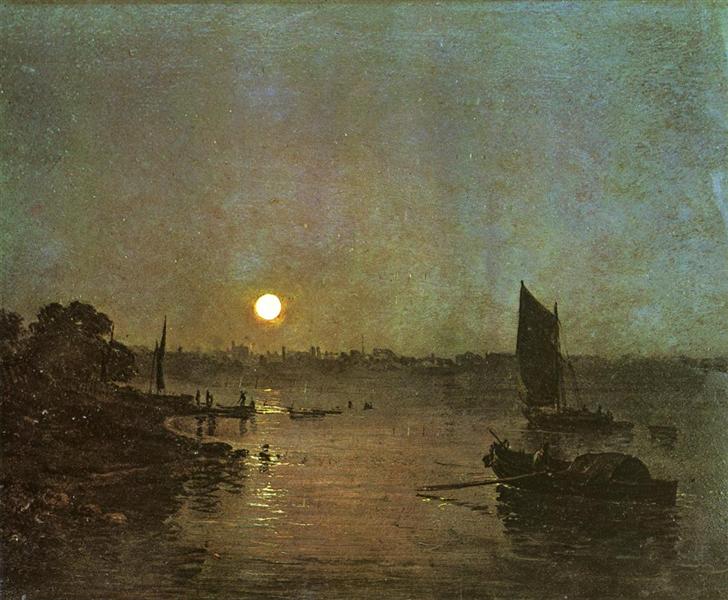
This brings us nicely to the value of his photographic realist paintings.  Consider viewing Turner’s next painting, immediately below, to Chopin’s Nocturne in E flat major Opus 9 No. 2 as I myself did.

'Moonlight, a Study at Millbank' by Joseph M W Turner - Exhibited 1797 - Oil on panel - 31.5 x 40.5 cm - on display at the Tate Gallery, London, UK

‘Moonlight, a Study at Millbank’ by Joseph M W Turner – Exhibited 1797 – Oil on panel – 31.5 x 40.5 cm –
on display at the Tate Gallery, London, UK

‘Moonlight, a Study at Millbank’ has such eerie reality that it pulls us in as if by one of the ships ropes about our midriff.  Our faces feel the cold-still nightly breeze.  We can hear light winds through the sails.  Quietness and a gentle drifting along of taut wood bound together strong for the working.

Two curious sayings I share now that I have read of my Great great Uncle artist Mr FMR aforementioned in my previous blog.  ’12 horses on the strength’ and that he was ‘the cat’s whiskers’ to his Mother and Father.  I really would like to paint these two expressions after the preceding works already waiting in the theatrical wings of my mind.

The latter expressionistic idea would not only be construe from Mr FMR’s sayings herewith.  You see at ‘middle’ school our class was given a project to complete.  I was thirteen years of age and chose to write about wildlife.  I enjoyed drawing the faces of big cat’s, exceedingly I practised.  Yet my drawing ability by my own admission is mostly immature during my earlier years.

Do you know the violinist who really cannot play or the singer who is yet able to fully master singing?  For a fact both always exist and some latterly of their age, renowned.  I am one and the other.

It’s quite the strangest thing that some artistic things I could accomplish in painting and drawing with ease whilst other subjects I struggle/d at almost impossibly.  Art is learning.  Nobody on earth ever picked up paints, crayons or pencil and drew with expertise immediately.  No one.  Ever.

Again I shall digress, oh Mr L.S. Lowry I love you so very much my dear fellow.  For two exemplary reasons that my heart chases after like horses toward their hurdles for riding.

Turner’s work appears effortless.  Clearly though, as shown below, Turner’s learnedness at professional draughtsmanship produces finely exquisite angles and perspectives beyond stark portrayal.  For sure there is art in architecture.

Lines meet curves, leans and masses of concrete order.

'Tintern Abbey: The Crossing and Chancel' (looking towards the East window) by J. M. W. Turner - 1794 - Graphite & Watercolour on paper - 35.9 cm × 25 cm

‘Tintern Abbey: The Crossing and Chancel’ (looking towards the East window) by J. M. W. Turner – 1794 – Graphite & Watercolour on paper – 35.9 cm × 25 cm

Turner is rightly regarded as a British exemplary of artistic influence.  His classical self portrait is to appear on the Bank of England’s £20 note from 2020 following a public selection process.  Perhaps I waited wisely for the right time to make deserved commentary about Turner.  Without doubt a pleasure to write this blog article and in eager readiness for sometime now.

Loudly whispers ‘Constable! Constable!’, Edgar Degas and Sir Edward Coley Burne-Jones, 1st Baronet – someone, somewhere, somehow please an encore!’

For some within art Time really has no limitation whatsoever.  God, the Dove or the Dragon are unable to conquer unto destruction nor death.

‘The Living Artwork Eternal That Breatheth Not.’

It’s the journey of life.

Standard