
Would you like to go on a journey with me? Please think for a moment where I might take you.
We can cross oceans of time. The fabrics of space. I will open up the Universe with my hands for you. Inversely of understanding. A design from the outside. Pulling at the edges like a canvas stretched across beams. Atomic order. Nucleic. Archaeological charcoals and elementals masking the span for all its measurement.

‘Snow Storm – Steam-Boat off a Harbour’s Mouth’ by Joseph Mallord William Turner – Exhibited 1842 – Oil paint on canvas – 914 mm x 1219 mm
‘Snow Storm – Steam Boat off a Harbour’s Mouth’ by Joseph M W Turner is amongst my favourite of his works. The human mind fills the void. Forms its own imagination. You perceive what you are able to comprehend. Reality it is not. A construct of perception as an idea. The basis for an impressionistic viewpoint.
The above artwork by Turner is a cacophonic masterpiece. You look at this and heard.. nothing.
Until now.
I merely lifted my canvas from its cardboard box to show him without commenting or referencing the title of my artwork – ‘Creative Mind’. At that precise moment a professional creative told me and I quote his words pretty much verbatim here, ‘It makes my brain think all sorts of things’.. I knew it had achieved everything I wanted from the outset. Perfectly.
Turner has immense influence to this day. Everyone says this. Let me give you an example. If you would like to view Whitewall Galleries online (here in the UK) and look up Chris and Steve Rocks you will see this for sure.
As a side note in abstraction I also strongly recommend the work of Danielle O’Connor Akiyama. With these recommendations I speak from personal interest in their quality. This is not a reflection of other artists merely that their work was on show when I visited the gallery sometime ago. Impressive and beautiful.
Turner’s masterpiece above shows layers of intricacy, a sheen of glazed light, depth of feeling and stormy chaos. Truly iconic.
This brings us nicely to the value of his photographic realist paintings. Consider viewing Turner’s next painting, immediately below, to Chopin’s Nocturne in E flat major Opus 9 No. 2 as I myself did.
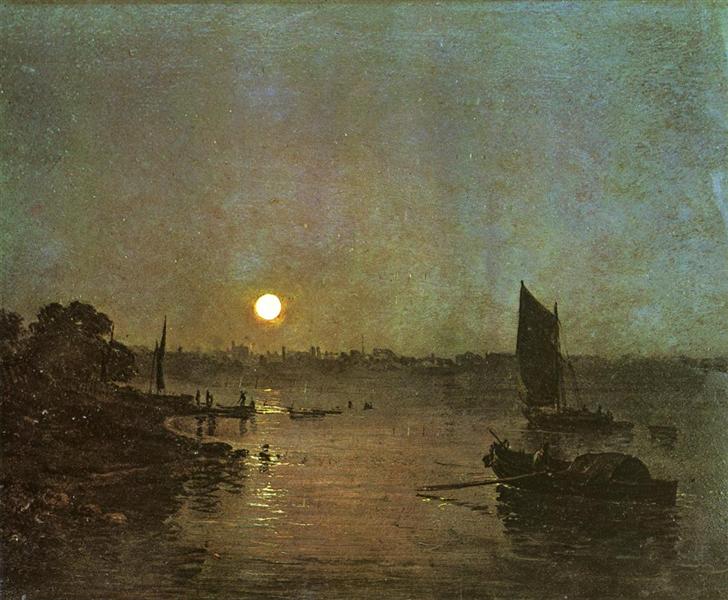
‘Moonlight, a Study at Millbank’ by Joseph M W Turner – Exhibited 1797 – Oil on panel – 31.5 x 40.5 cm –
on display at the Tate Gallery, London, UK
‘Moonlight, a Study at Millbank’ has such eerie reality that it pulls us in as if by one of the ships ropes about our midriff. Our faces feel the cold-still nightly breeze. We can hear light winds through the sails. Quietness and a gentle drifting along of taut wood bound together strong for the working.
Two curious sayings I share now that I have read of my Great great Uncle artist Mr FMR aforementioned in my previous blog. ’12 horses on the strength’ and that he was ‘the cat’s whiskers’ to his Mother and Father. I really would like to paint these two expressions after the preceding works already waiting in the theatrical wings of my mind.
The latter expressionistic idea would not only be construe from Mr FMR’s sayings herewith. You see at ‘middle’ school our class was given a project to complete. I was thirteen years of age and chose to write about wildlife. I enjoyed drawing the faces of big cat’s, exceedingly I practised. Yet my drawing ability by my own admission is mostly immature during my earlier years.
Do you know the violinist who really cannot play or the singer who is yet able to fully master singing? For a fact both always exist and some latterly of their age, renowned. I am one and the other.
It’s quite the strangest thing that some artistic things I could accomplish in painting and drawing with ease whilst other subjects I struggle/d at almost impossibly. Art is learning. Nobody on earth ever picked up paints, crayons or pencil and drew with expertise immediately. No one. Ever.
Again I shall digress, oh Mr L.S. Lowry I love you so very much my dear fellow. For two exemplary reasons that my heart chases after like horses toward their hurdles for riding.
Turner’s work appears effortless. Clearly though, as shown below, Turner’s learnedness at professional draughtsmanship produces finely exquisite angles and perspectives beyond stark portrayal. For sure there is art in architecture.
Lines meet curves, leans and masses of concrete order.

‘Tintern Abbey: The Crossing and Chancel’ (looking towards the East window) by J. M. W. Turner – 1794 – Graphite & Watercolour on paper – 35.9 cm × 25 cm
Turner is rightly regarded as a British exemplary of artistic influence. His classical self portrait is to appear on the Bank of England’s £20 note from 2020 following a public selection process. Perhaps I waited wisely for the right time to make deserved commentary about Turner. Without doubt a pleasure to write this blog article and in eager readiness for sometime now.
Loudly whispers ‘Constable! Constable!’, Edgar Degas and Sir Edward Coley Burne-Jones, 1st Baronet – someone, somewhere, somehow please an encore!’
For some within art Time really has no limitation whatsoever. God, the Dove or the Dragon are unable to conquer unto destruction nor death.
‘The Living Artwork Eternal That Breatheth Not.’
It’s the journey of life.
 The Unfathomable Artist