Banksy Is The Street Art Master.

'Keep Off Our Worms' - Banksy original graffiti artwork

‘Keep Off Our Worms’ (2014) – Banksy original spray paint artwork

In 2014 this original artwork, pictured above, appeared on a wall in Clacton-On-Sea, Essex, England one week prior to a UK Parliamentary by-election.

I see five grey looking pigeons and a bright-looking bird suspended upon a single ‘tight-rope’ perch.

What do you see?


'Laugh Now But One Day We'll Be in Charge' (2002) by Banksy - spray paint on canvas - 12in x 12in

‘Laugh Now, But One Day We’ll Be in Charge’ (2002) by Banksy – spray paint on canvas – 12in x 12in

I see a definitive quotation.  A statement referenced with a placard or a pinafore.

Is ‘Laugh Now, But One Day We’ll Be In Charge’, above, explaining animalistic human traits?  The fight for resources?  Or greed?

Should we imagine that brute force will gain authority over intellect?  Perhaps it touches upon equality, working conditions and slave labour?  How about the evolving cycle of Man vs Woman?  I’m not trying to provide a dominant argument here.

The beauty of a great artwork is personal opinion.  Provocation for thought and emotion.

The most recognisable street artist of our generation, Banksy, certainly makes international headlines time and again!  The exclamation felt quite natural to include.  ‘Read all about it, read all about it – Banksy has sprayed our walls and doors!’

People show strong appreciation when they know they are being loved.  Ideas challenged.  Behaviour scrutinised.

I personally chose the artwork images to display in this blog article.  Each original artwork has already been represented with worldwide coverage throughout the popular press.  Banksy creates street art that speaks influence and popularity.


'This'll Look Nice When It's Framed' by Banksy (2010, San Francisco)

‘This’ll Look Nice When It’s Framed’ by Banksy (2010, San Francisco, USA)

The above artwork – all photographs taken from the Banksy Website – appeared in the Mission District at Valencia and 20th Street, San Francisco, California, USA.

The artwork pensively references the historical viewpoint of ‘on-the-wall’ art pieces.


'Mobile Lovers' (2014) by Banksy

‘Mobile Lovers’ (2014) by Banksy

This depiction of a warm embrace, as pictured above, appeared on a doorway next to the Broad Plain Working With Young People club in April 2014.  It first sold for £403,000, which is a staggering price for any living artist to achieve.

With ‘Mobile Lovers’ Banksy is highlighting the disconcerting divide caused by our growing technological dependence offset against personable human interactions.  If unchecked this is a serious pandemic that is ‘sneaking up behind’ the human race in a multitude of ways.

It’s not difficult to observe people engrossed in their social media pages during get-togethers.  How can connecting be disconnecting at the same time?  What are the long-term effects?

Banksy uses his art and global appeal to help address this problem with a beautiful message.  Satirical and empathic, especially the choice of location – a youth centre.  A new technologically adept generation coming through.

Can modern relationships survive this technological minefield?

Much more than that, great artworks reverberate.  Their intrinsic value increases monetarily and intellectually from generation to generation.

Banksy is inspiring visionaries, a new stream of artists and The Public with his own carefully crafted style.  Challenging hard-line views with humour, stark remonstrations and perfectly executed art concepts.

Banksy is the ‘street art’ cool Andy Warhol of the people.

And we all know that there “Ain’t nobody cooler than that.” an artist said.

Standard

Merlin’s Jin Cocktail

Ancient Merlin Illustration circa 1300

Ancient Merlin Illustration circa 1300

I’ve just conjured up an alcoholic cocktail and named this “Merlin’s Jin“.

Here is how to prepare my newly created cocktail:

Muddle the juice from five Merlot grapes along with seven crushed spinach leaves into the base of a shaker, add a triple shot (3x35ml’s) of London Dry Gin (a double is acceptable at 88ml’s total (if US 44ml shots).

Now add a large sprig of mint (crushed), muddle one ripe fig into the shaker.  Shake and fine strain onto three ice cubes into your cocktail glass.

Garnish with one spinach leaf and one mint leaf made to float centrally on top of your cocktail into a sort of mathematical Plus+ sign formation.  Pull the mint leaf through a split created in the middle longitudinally along the midvein of the spinach leaf to accomplish this.

Enjoy.

Cocktail Recipe requires:

5 x Merlot grapes
7 x Spinach leaves (crushed)
3 x London Dry Gin shots (35ml UK shot measure)
1 x Large sprig of mint (crushed)
1 x Ripe fig (muddled)
3 x  Ice cubes
1 x Cocktail shaker
1 x whole Spinach leaf (to garnish)
1 x whole Mint leaf (to garnish)
1 x Cocktail glass per serving
One Tablespoon to roll and crush the leaves

Matt The Unfathomable Artist – Copyright © 1st December 2015

N.B. If you’re underage to drink alcohol; not permitted to drink alcohol due to your beliefs or for personal reasons you choose not to drink alcohol then please click the following blog link for a non-alcoholic ai-na fruit smoothie drink called the “StrAwBaBy PaWS Fruit Smoothie” here:

https://theunfathomableartist.wordpress.com/2016/01/12/ai-na/

Standard

An interview with TITUS AGBARA

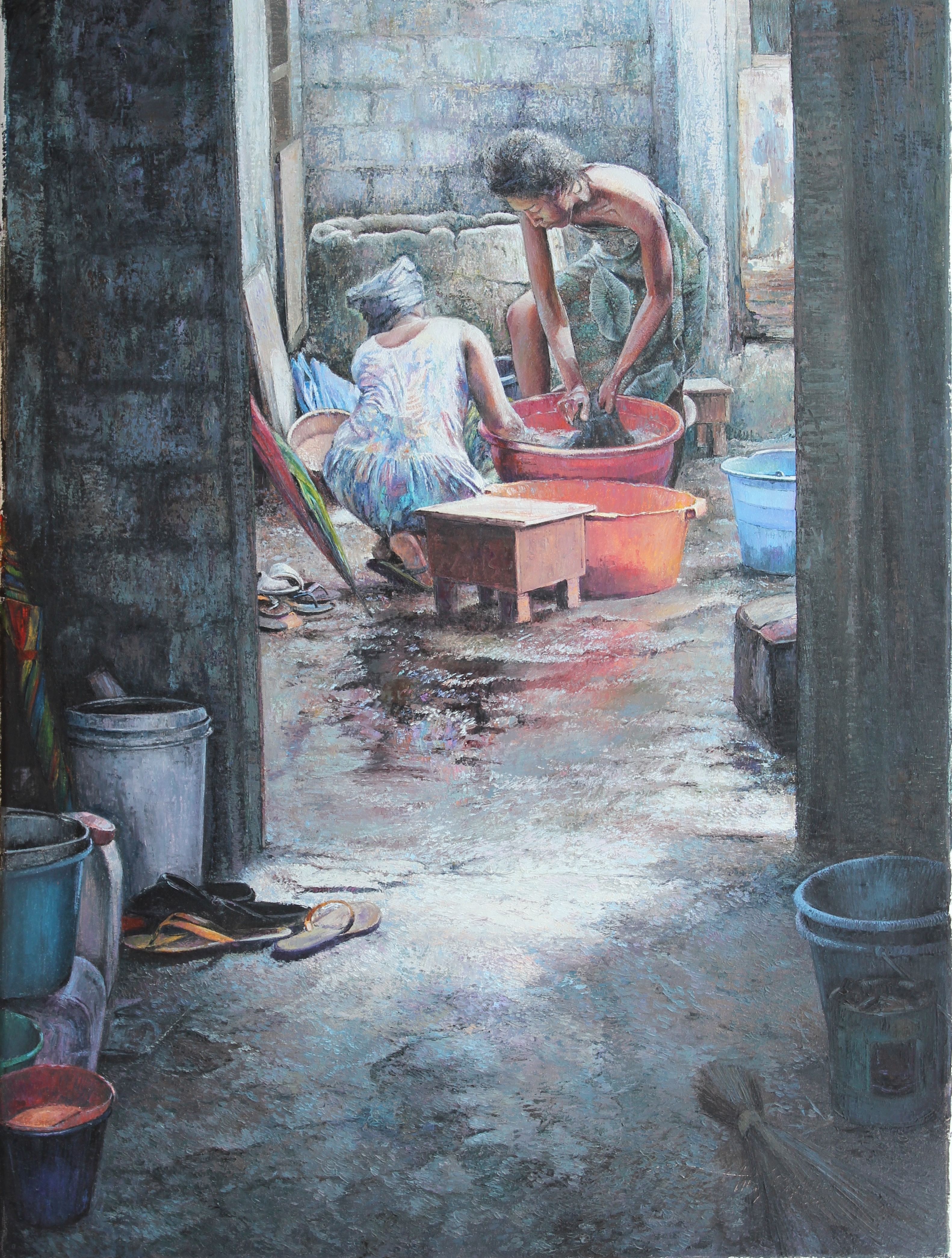
Family & Beyond by Titus Agbara Medium: oil on canvas Size: 60inches x80inches

‘Family & Beyond’ by Titus Agbara
Medium: Oil on Canvas
Size: 60 inches x 80 inches

Before you read my commentary about Titus Agbara and our fun Q&A session I’d like readers to imagine a very different kind of tranquility and frame of mind.  I say this so that you may happily place yourself within Titus Agbara’s world.

People from Africa have the purest sense of language.  A few years ago I was speaking to two African men who had travelled to the UK quite some years previous to live here.  Their beaming faces clearly stood out to me along with the beautiful way they spoke.  We shared some amusing stories prompting one of the African men to move his left leg slowly in front of him and then slowly behind him, standing on his right leg as he did so.

Whilst I watched him merrily rocking I asked him why he was moving his leg like this.  With a huge smile he replied full of joy, ‘I am laughing, this is how we laugh.  With our feet.’

That same African man was speaking to me like a man whose spirit was flying high in the clouds whilst yet perfect in his full soberness.  That moment by definition is Natural Art.  A culmination of specific people and their cultural style communicated to me through this one man.

Travel to Greece and you will see Greek friends naturally hugging each other with ease and an assured gracefulness.  You already know the peoples inclined to bowing, those to handshaking and the peoples kissing from cheek to cheek.  Natural Art tells us about people and their culture.

The photograph below is a beautifully classic diptych by Titus Agbara defining his artistic style:

'Still At Peace' by Titus Agbara Medium: oil on canvas Size: 40 inches x 60 inches

‘Still At Peace’ by Titus Agbara
Medium: Oil on Canvas
Size: 40 inches x 60 inches

Titus works almost entirely with palette knives requiring the artisan skill and steadiness of surgeons who are themselves masters at their work.  Titus’ style, as discussed in a previous blog about Morgan Weistling [My Morgan Weistling Blog Writeup] demonstrates a strong story-telling acumen within his art.  Whereas Weistling prefers a romantic style, Titus is pragmatic and practical in depicting many of his life scenes.

Few paint artists are able to mix colours as masterfully as Titus Agbara and his American colleague aforementioned.

True, some paint artists choose to have a simplistic art palette in terms of colour and this also works well in producing fantastic art.  Realist Landscapers and Life Scene artists invariably enjoy a superfluous array of colours and hue definitions.  At his most frugal Monet was distressed at the limitation of his palette colours.  He preferred the variety of colours that his success and wealth soon brought to him – literally by the couriers of his day.

This is why I make reasonable comparisons and continue this by asking you to please take a look at Thomas Eakin’s magnificent painting ‘The Gross Clinic’ here:

The Gross Clinic [1875] by Thomas Eakins Oil on Canvas 240cm by 200cm

‘The Gross Clinic’ [1875] by Thomas Eakins
Oil on Canvas
240cm by 200cm

As regards Thomas Eakins it is at this high standard of colour mixing excellence and pragmatic pictorial documentation of modern life scenes with which I compare Titus Agbara.

Great art speaks for itself and is commensurate to the sale price of art works – now and for the future.  Ambitious artists like Titus will actively ensure their work is well-known internationally.

Art dealers are most interested in artistic quality, fame, influence and popularity.  With this criteria in mind Titus’ impressive resume reads as a testimony to his life within the art world.

'As Our Mother Told Us' by Titus Agbara Medium: Oil on Canvas Size: 40 inches x 30 inches

‘As Our Mother Told Us’ by Titus Agbara
Medium: Oil on Canvas
Size: 40 inches x 30 inches

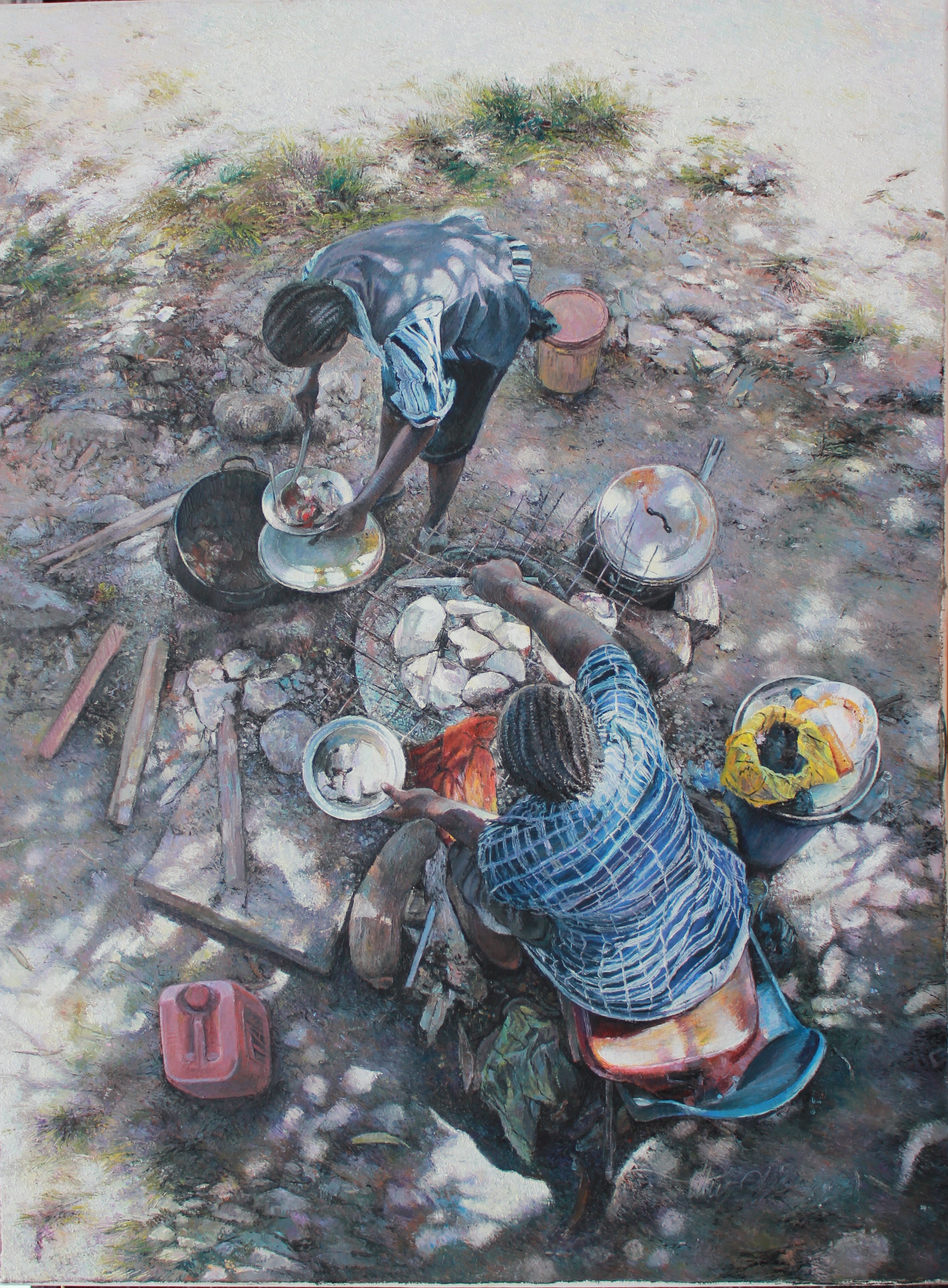
Below Titus depicts a traditional African family cooking scene from a uniquely unusual angle and perspective.  The art world always needs painters who have the courage to paint exactly what they see for all its natural beauty:
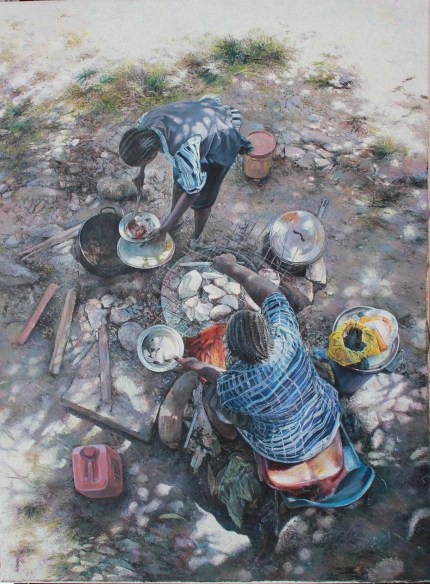
'Inspirational Appetite' by Titus Agbara Medium: Oil on Canvas Size: 40 inches x 30 inches

‘Inspirational Appetite’ by Titus Agbara
Medium: Oil on Canvas
Size: 40 inches x 30 inches

With depictions of serene beauty through his artistic flair let’s see what Titus Agbara has to say about his art shall we?

A Q&A with Titus Agbara:

Matt The Unfathomable Artist [Matt, TUA] – How long do you typically work on a painting?

Titus Agbara – “I think I could finish a painting for one month depending on how often I work on it.  When I am into serious painting, yes, then I have to make sure I paint on a daily basis.  I try to see if I can finish a painting within the space of three months.”

Speaking of his last two paintings ‘As Our Mother Told Us’ and ‘Inspirational Appetite:

Titus – “Yes, the two last works, each of them take me three months to finish.”

Matt TUA – “Is this because of drying times?” [during the painting process]

Titus – “No, its not the drying time because actually I don’t want my painting to dry on time before I finish it.”

As an artist myself I believe this reveals something about good technique and his insistence on a workable art process.  Wet-on-wet oil application allows Titus to change aspects of his painting whilst it is in progress.

Referring to his work on Sky Arts ‘Portrait Artist of the Year 2014’, a nationally televised art show for the UK and Ireland which requires art competitors to complete a portrait painting within four hours:

Titus – “To complete a painting in four hours, yes, that’s why I had to work fast and make sure, but actually I do take my time.  I feel a little relaxed when I’m around my studio.”

Matt TUA – “Yes, I don’t think there is a right or a wrong for any particular artist because that shows how proficient an artist is.  To do the complex scene that you did on Landscape Artist of the Year 2015…”

Actually shown here, please take a look – Titus Agbara Time Lapse Video]

“…I was literally, I mean, I couldn’t believe how you could manage to do that in four hours.  I really was very impressed.  It was how much definition there was in it within four hours [that] is astonishing.  I’m not surprised with the fees you are able to command with your work.  It does come down to how accomplished an artist is.”

Titus mentions his Facebook page.  You can see this here: Titus Agbara on Facebook].

Just imagine the dedication required to spend three months on a single painting with the modern speed of life!  His commentary is in complete agreement with my own specified time frame to complete a painting.  Usually I give myself three months to complete a new canvas dependent upon its size and complexity.

Matt TUA – “Do you see yourself working in television within an art capacity Titus?  They have panels for judges and artists alike.  Is that something you would actively seek?”

Titus – “Yes, it’s something I’d like to do.  I’ll never like a situation where it’s just about my talent and that’s just for me alone.  Well yes, I like to see young ones coming up.”

Matt TUA – “Yes, somebody with your experience and incredible CV dating back to the 90’s, you’ve got that, if you like, art pedigree.  Your CV puts you in that position where people, execs, would be looking for that sort of experience.”

Matt TUA – “What advice would you give to new artists?  You know, someone just starting out?”

Titus – “My advice for someone who is just starting out is the basic change.  First of all you should apply to the principles of art and its element.  Paint yourself with it, to which you learn about the experience.  Its up to you how to identify yourself.  Then start to look into yourself in whichever way you want to express yourself.  Where you are starting from before you go to a particular place in life.”

Matt TUA – “I absolutely agree.  That is the perfect answer really, I couldn’t have answered that better.  Like you say, find out how you go about art making itself from a technique point of view and practice.  Then look inside the person.  Find out what they have to offer, what their style of art is and what they’ve got to say.  I was thinking, do you have any self portraits?”

Titus – “Yes, for the Portrait of the Artist 2014 I had to submit a Self Portrait and that was my second portrait that I had done for myself.”

Matt TUA – “Do you have a favourite artist Titus?  Someone from the past or present, someone who has most influenced your work?”

Titus – “I have stuck to one artist from my youthful age and that has been Monet.  I’ve got some of his books.  For artists of our time, yeah, I only get to look at your,.. [Titus is new to my art whereas I’ve known Titus’ work for sometime] ..to see how you paint and look at how you have done your own paint but for my initial starting age, yes, I think it was Monet’s painting that really inspired me a lot.”

[When professional artists look at their colleagues paintings we first look at the art itself just as everyone admires to do so.  Then we become interested in knowing how they went about making their painting from a technical perspective.

For instance, the fact that I know Titus prefers to use his palette knives for delicate objects within his paintings truly amazes me.]

Matt TUA – “Well I’ve got to be honest I think Monet is probably a favourite for many of us and yes he is one of my favourites too without a doubt.  Well, this is how you have developed such an extremely good portfolio and why you are able to sell your paintings at a premium price really in the competitive art market.  So that is a good testimony to you and it certainly shows in your work.  Well I hope you have enjoyed having a chat with me.  I wish you every continued success with your art and hopefully we can keep in touch.”

Titus – “Thank you very much Matthew.”

Matt The Unfathomable Artist – “Thank you Titus, much appreciated.”

Standard

Jackson Pollock Wows

No. 5 (1948) by Jackson Pollock. 243.8 x 121.9 cm (8ft by 4ft)

No. 5 (1948) by Jackson Pollock.
243.8 x 121.9 cm (8ft by 4ft)

No.5 completed in 1948 is without doubt the most famous abstract painting ever.  Produced by dripping paint onto the canvas during an ordered creative art process.  No. 5 has a beauty all of its own.

Pollock was working at a time when the whole abstract art movement was positively vibrant with pace and ascendency.  If you could hop into H.G. Wells “Time Machine” and travel back to Pollock’s art era you would see the equalling influence of leading abstract painters during his life.

Every artist has their own style and constructive technique.  What demonstrably impressed me about Pollock is his professionalism.  He is meticulous, innovative and inspirational.  Clients often expressed their appreciation for his work with profound eloquence describing the beauty of his art as a rapture or a deeply spiritual experience to them.

Jackson enjoyed layers to add depth.  He understood that dissemination can be beautiful if it’s ordered and fashioned in an exciting way.  This expertise that color and structure can be strongly emotive is why he is a Master of the modern art era.

An Abstract giant where there is little or no perceptible form to discern except that which we perceive as feeling within.

What makes popular?  Who holds the secret?  Why does something non-living have continuing value both monetarily and as a connection to the human experience?  Perhaps the answer is the very question.  Out from a non-living arty contrivance we see the personality on the canvas, the fiberboard, the paper or the multitude of ‘watercoloured skies’.

Can we really be objective about art?

Standard

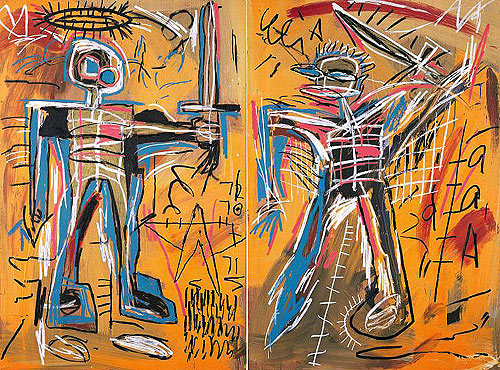
Empathic Depictions by Jean-Michel Basquiat

Untitled known as 'Two Heads on Gold', 1982. Acrylic and oil paintstick on canvas [80 × 125 in 203.2 × 317.5 cm]

Untitled ‘Two Heads on Gold’, 1982 by Jean-Michel Basquiat
Acrylic and oil paintstick on canvas
80 × 125 in- 203.2 × 317.5 cm

Today I finished watching the latter half of a docu-movie entitled Jean-Michel Basquiat: The Radiant Child.

Let me please ramp up some intellectual thoughts for your consideration.  Ok, well up until several weeks ago I didn’t know that Charles Bird King’s father was killed by a native American.  This would not be poignantly significant except that Charles Bird King is almost singularly remembered as one of the greatest historical portrait artists of native American culture in a truly positive light.  Dignifying the perspective of native Americans in his day and beyond to our time.

The question to ask from this docu-movie in my opinion is – How did Basquiat die at 27 years of age?  Obviously his lifestyle choice was conducive to this.  He was sucked up into a decadent torrent, seemingly casting himself off in an instant.

Can anyone here expect to cast a pebble into the sea only to find that same pebble rise to the surface of the waters and roll back towards you?  What you actually do is skim the pebble upon the surface many times to see it skipping along the smoothness of waves.

I’m deeply moved by this film because I see almost precisely the same sensitivity and fragility that Van Gogh no doubt possessed during his own lifetime.  37 years and 27 years is merely glancing at the surface of what life has to offer.

At this point I would mention that perhaps watching Pina (preferably in 3D) by Wim Wenders is also a strongly emotive film experience.  That is, if you would like to tap into your deep inner sensibilities for an hour or two.  Personally speaking I do sincerely become immersed in a range of emotions during these arty indulgences.

Back on track to Jean-Michel Basquiat.  Firstly a superior artist to any reference of what we might consider good or acceptable art in quality.  His drawing in a child-like manner explains how he felt as a person in this highly competitive commercial world.  Cartoonistic, raw and excitable in style.  Abrupt, often complex and bold.  Stark and beautifully complimentary.  Largely attractive colour contrasted arrangements.

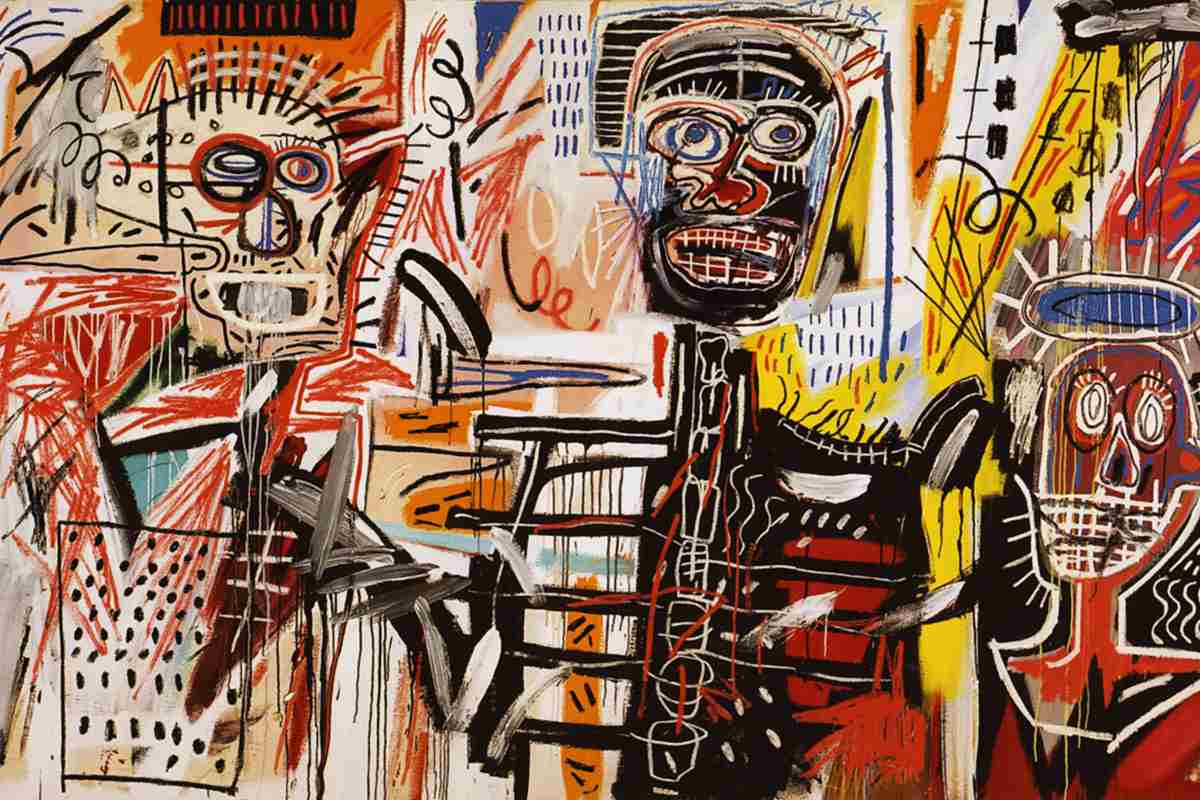
Philistines – 1982. Acrylic, crayon on canvas, 183 x 312.5cm.

Philistines – 1982 by Jean-Michel Basquiat
Acrylic, crayon on canvas, 183 x 312.5cm

Is Jean-Michel Basquiat explaining some of his own life experiences in his painting above?  I would strongly accept this hypothesis.

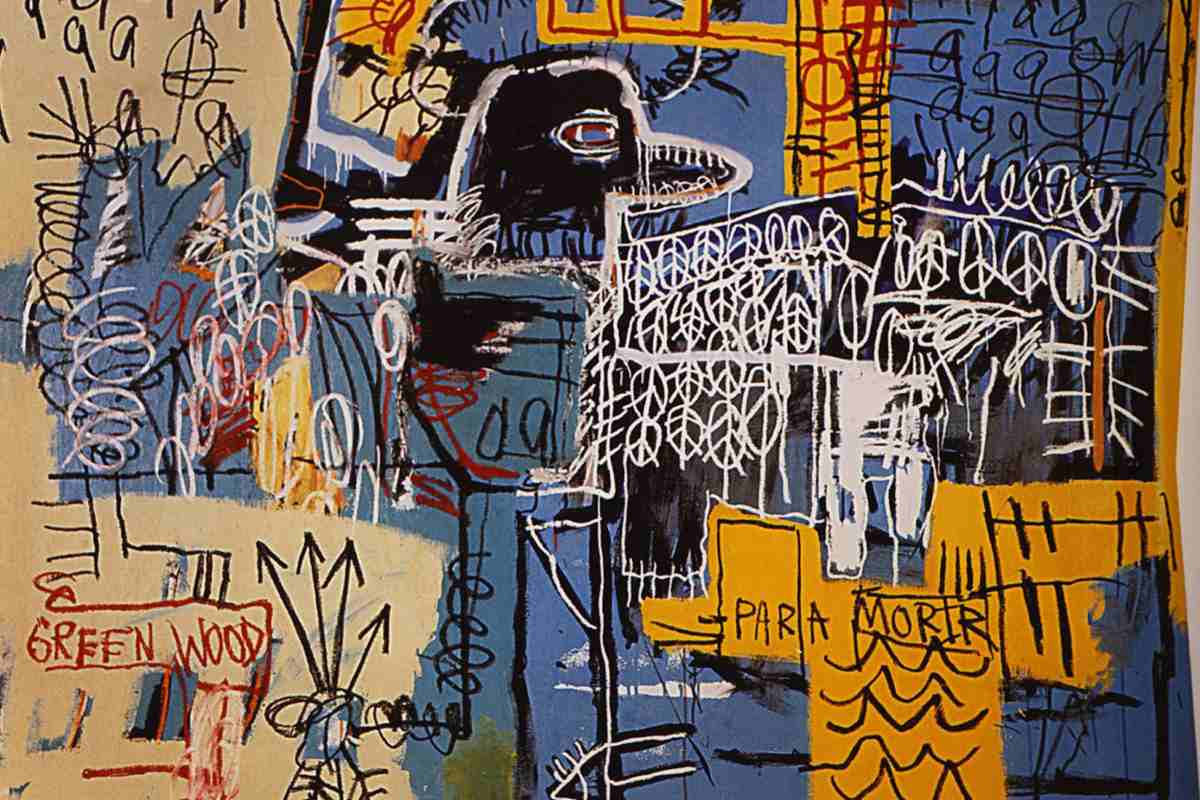
Bird on Money, 1981 by Jean-Michel Basquiat. Acrylic, crayon on canvas - 167.5 x 228.5cm

Bird on Money, 1981 by Jean-Michel Basquiat.
Acrylic, crayon on canvas – 167.5 x 228.5cm

Come on surely we would all like to own a Basquiat?  Colourful and interesting doesn’t even begin to describe a Basquiat.  His influence in artists like Banksy is almost a given.  Basquiat clearly dignifies many artists within his paintings so I think its posthumous reward his art is still living and breathing today.  Speaking street and high brow intellectualism as one.

Del Monte, c1984-1985 by Jean-Michel Basquiat and Andy Warhol. Synthetic polymer paint & silkscreen ink on canvas. 76 x 88 in. (193 x 223.5 cm)

Del Monte, c1984-1985 by Jean-Michel Basquiat and Andy Warhol
Synthetic polymer paint & silkscreen ink on canvas
76 x 88 in. (193 x 223.5 cm)

I’ve included this latter painting above to add controversy to the whole art valuation debate.  What is a piece of art worth?  This painting sold for $1,082,500.  Unusually Jean-Michel Basquiat chose not to use visible words or letters in this artwork.  The branding work is synonymous with Andy Warhol’s style.  An art collector would pay this sum purely based on the strong friendship that Andy Warhol and Jean-Michel Basquiat had or perhaps because JMB is a genius for unspoken commentary?

Art is each their own personal feeling.  But I tell you something, when I saw the slave ship briefly referenced in one of Jean-Michel Basquiat’s paintings during the docu-movie aforementioned, well, sometimes it takes time to see what an artist is saying or feeling on many levels.

Personally I think this is Basquiat referencing his savvy worldly acumen and woefully addictive tendencies with honest sentimentality.  I would be surprised if the brilliance of his style does not find influence in my own future artworks ‘through a new mind’ in some way.  I certainly hope so because I loved the man himself.  A great pity he is no longer with us as a person and masterful artist.

Standard

Basquiat, Matt & The Soul Stream

 Jean-Michel Basquiat (American, 1960–1988) Offensive Orange, 1982, Acrylic on Wood, 182.5 x 122 cm. (71.9in x 48in)


Jean-Michel Basquiat (American, 1960–1988)
Offensive Orange (1982)
Acrylic on Wood – 182.5 x 122 cm. (71.9in x 48in)

I’m half-way through a movie about Basquiat and wish to quickly share my feelings about his artwork and influence.

The docu-movie is entitled ‘Jean Michel Basquiat: The Radiant Child’.  To me this film piece is like breathing fresh air – a kind of necessity, exhilarating, a soberly intoxicating clarity of streams for thought.

Basquiat is the core essential mindset for paint artists.  This is what being an artist in any form is all about.  Communication.

Existential in form and conscience.

Everyone is capable of enjoying art.  Seeing how art collectors and art dealers respond to art is quite fascinating in its own right.

Quite a number of explanations Basquiat provides during this docu-movie, to the moment at least that I have reached in the docu-movie, offer insight into what drives each individual artist.  Beyond our surroundings, almost separately describing our world in various art forms is part of the nature to communicate.

I like that Basquiat was a great music lover, poet and earnest fan of past and contemporary famous artists.  As the docu-movie describes, influence.. is through a new mind.  Very good.  Every great artist has enjoyed consuming art as food for thought.

Banksy most definitely included.

Now I’m returning to the docu-movie to write the second part of my Basquiat article.

The second part of my Basquiat article is here:

https://theunfathomableartist.wordpress.com/2015/07/14/empathic-depictions-by-jean-michel-basquiat/

Standard

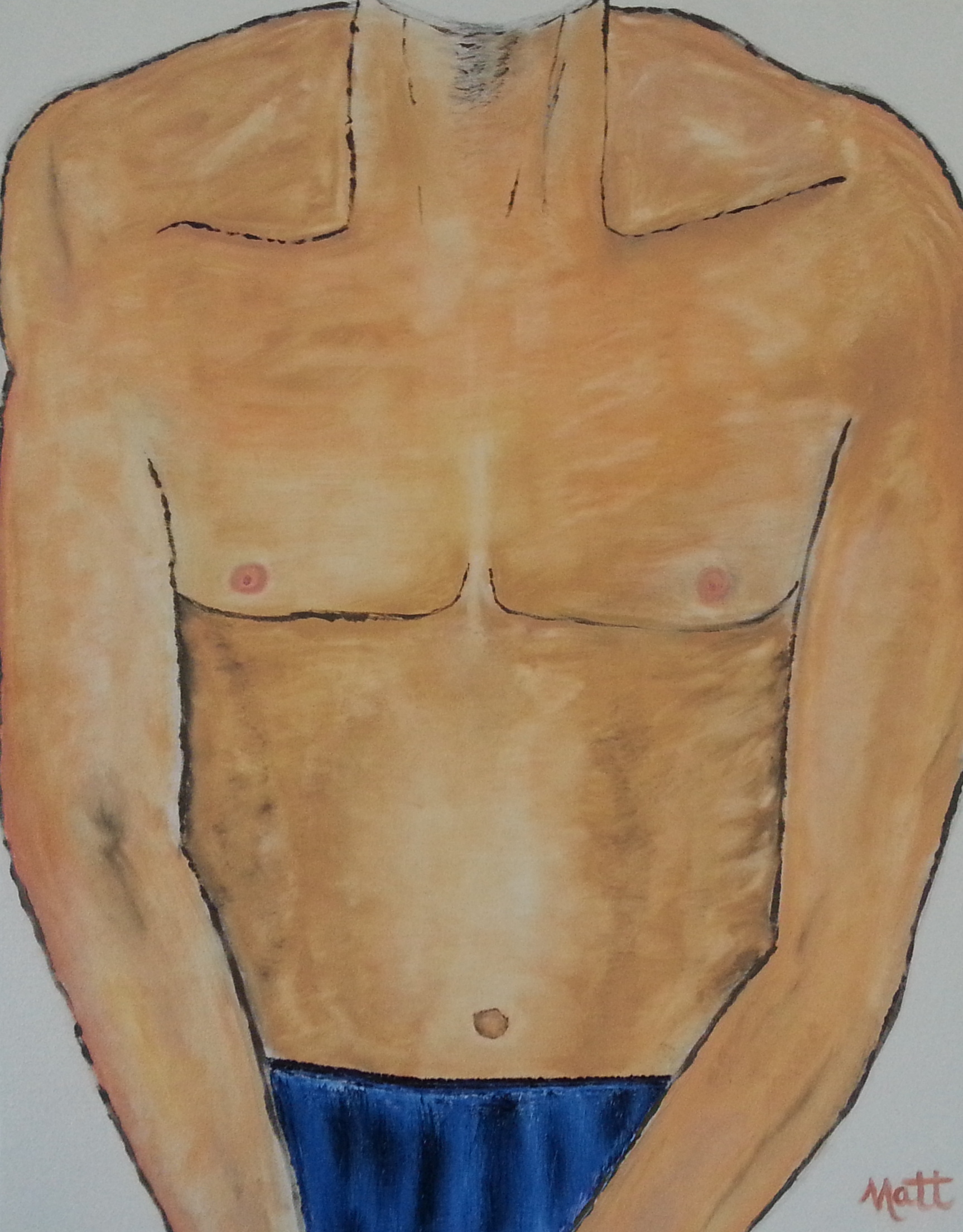
Self Portrait Of My Body

Self Portrait of My Body - oil painting on canvas. (28in x 36in) completed March 2014.

‘Self Portrait Of My Body’ – Oil painting on canvas, 28in x 36in, completed March 2014.

Spontaneity can be a sort of art I suppose.  No wonder Picasso was delighted when he found his Kahnweiler moment.

‘We speak with pigments from the Earth.

We are talking with our hands.

Debating with lines, curves, shapes and expressions.’

Hear now a shifting of thoughts like rocks hurled to the Earth.  If the Earth was not flat who would keep banging their drum to deny it?  If the Earth did not move around the Sun who would chastise those that disagreed?  Science changes.  It evolves.  Science is literally Knowledge.

Who laughs at the one who was laughed at before?  It’s all a matter for Time.  Continuously chasing the tail.  Encircling.  Eating the dust like worms.  Churning the land.  Too many absurdities.  How can anyone who is not like this one understand?

Even in one hundred years and ten there were none like this one to be seen.  A rarity.

Painting originates from rocks.  Oh words why do you keep on arriving constantly at a speed and rate {} cannot easily express to peoples?

Of origin.  Sinew itself almost speaks in the quietness.

I like to share these things with you.

Standard

Morgan Weistling – Modern Art Master

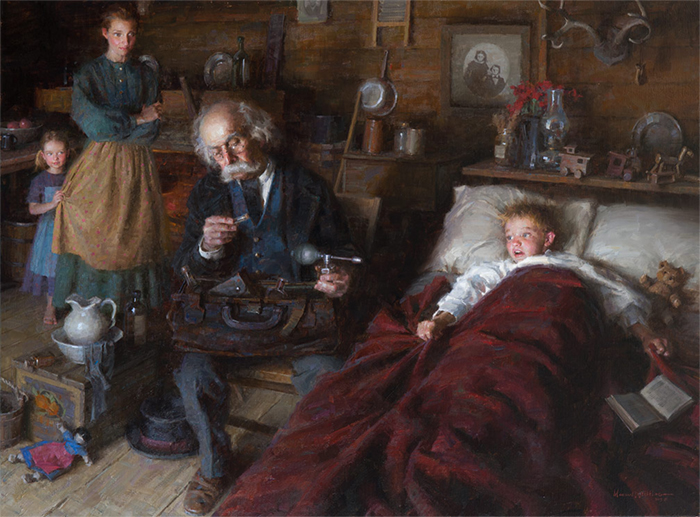
Morgan Weistling (pronounced ‘why-st-ling’) is a well known American artist producing a variety of pleasingly nostalgic artworks imbuing complex storylines and romantic warmth.  Please take a look at ‘The Country Doctor’ shown below if you have not already seen this masterful artwork in art magazines just as I did a couple of years ago:

'The Country Doctor' 36x48 Masters of the American West - Autry Museum, Feb 2nd 2013

‘The Country Doctor’ (36 in x 48 in)
Masters of the American West – Autry Museum – February 2nd 2013

As described in the painting caption you can visit the Autry Museum in Los Angeles and see Morgan Weistling’s work for yourself.  Morgan Weistling is listed as one of their honored artists along with his inherently gifted daughter, Brittany.

The American West, Civil War and American Indian themes abound – including theatrical productions to further transport you into another era entirely.

Heterogeneous facial expressions, the clever use of light, natural or incandescent, a subjective focal point and a deep never ending storytelling where we might imagine Phillis Wheatley and T. S. Elliot at pleasure to find the right words to express.

One could ask ‘Who knoweth thy heart of mine?’

It’s clear that following on from his previous profession as a top movie Illustrator, Weistling is an especially ambitious Master Artist.  We might think he gained his storytelling ability from articulating entire movies in posters.  Afterall a picture paints a thousand words, and truly each learning experience we conquer adds to our ever growing repertoire.

However, in reading his biography the Weistling family is entrenched in strong family values and the art of teaching from generation to generation, which in turn transcend the heartfelt warmth found in both Morgan and Brittany’s Fine Art paintings.

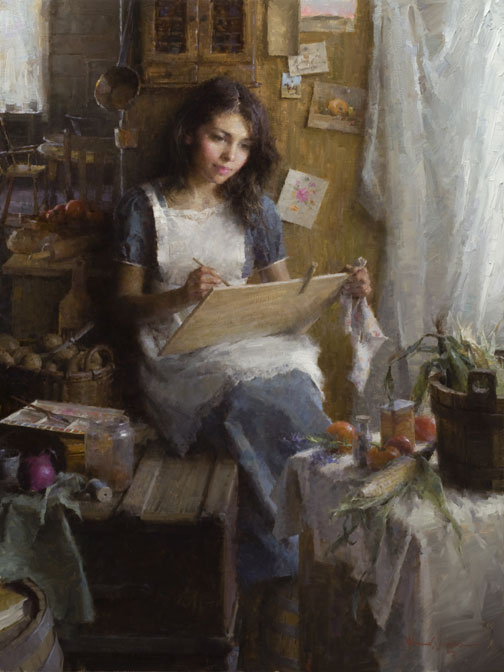
‘The Artist’ shown below is Morgan’s daughter:

The Artist

‘The Artist’ by Morgan Weistling

‘The Artist’ is a classically constructed painting that is bereft of time.  Actually, I do wonder at what Brittany is drawing.

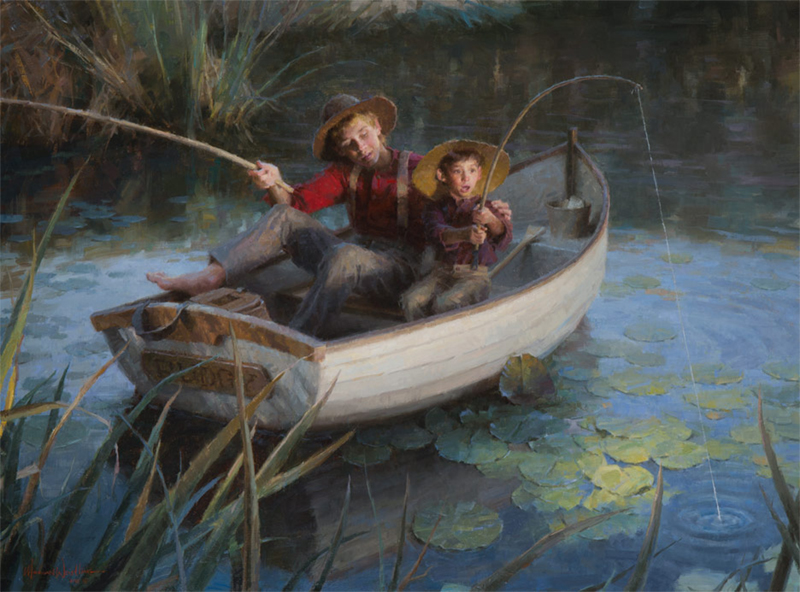
I just had to include ‘The Fishing Hole’ here:

'The Fishing Hole' by Morgan Weistling 30

‘The Fishing Hole’ by Morgan Weistling
(30 in x 40 in)

A beloved uncle taught me how to fish when I was a boy, so I find this painting highly endearing.  Also, in an early photograph of my Dad pictured circa 1965 he is with his younger brother whom I’ve never met, holding up a fish whilst my Dad is smiling.  This latter anecdote a treasured moment of a sepia tone reminiscent of photography from an oak-aged American Western scene.  Exactly the profound effect Morgan’s paintings have in moving us emotionally.

Each and every professional Artist is different, offering their own personable character of qualities.  Different backgrounds and interests.  With all his characters on the canvas Morgan has perfected his Fine Art style.

Value is always with the heart whilst an artful mind is fed with bread and fish.

Standard

New York Exhibition Highlight

Hank Willis Thomas, Unbranded: A Century of White Women, 1915-2015

513 W. 20th Street, New York, NY 10011 USA Friday, April 10, 2015–Saturday, May 23, 2015
Hank Willis Thomas - Just as our Forefathers intended, 2015/2015, digital chromogenic print. 26 1/2 x 60 3/4 inches (print size) Courtesy of the artist and Jack Shainman Gallery, New York.

Hank Willis Thomas – Just as our Forefathers intended, 2015/2015, digital chromogenic print.
26 1/2 x 60 3/4 inches (print size)
Courtesy of the artist and Jack Shainman Gallery, New York.

This Exhibition Highlight is focussing on acclaimed photo artist Hank Willis Thomas, whose natural artistic creativity and technical expertise had already found talented beginnings by the time he had picked up his first camera.

Our interest with past and present Art Masters is to get to know them through their art.  Clearly world media readership has recognised Hank Willis Thomas on the merit of his art and its powerful commentary.

Hank has established himself as a famed artist with justifiable comparison to other leading living artists such as Damien Hirst and Banksy.

Art sometimes asks questions about society.  With this in mind few Artists have the far reaching effect in abundance as Hank Willis Thomas along with his notable artistic contemporaries.

His current New York Exhibition is creating new moments to reflect and discuss our shared ethos from a distinctly intellectualised viewpoint.

I have included the following Artnet link for further information explaining the various concepts behind his Exhibition:

The 1 Must See Art Event In New York This Week: Hank Willis Thomas at Jack Shainman Gallery

The Unfathomable Artist has this to say:

“If something seems out of proportion what can we do to help?  What positive difference can we personally make?

Well the best answer I can gift is from a famous poem I wish to quote:

    ‘Me.  We.’

            by Muhammed Ali.”

Standard

Pure Pieter Claesz

Let’s take a look through the looking glass…

Vanitas with Violin and Glass Ball by Pieter Claesz, c1628.

Vanitas with Violin and Glass Ball by Pieter Claesz, c1628.

For dear Readers of my blog it is thoroughly my disposition to draw out your feelings about art; explain what art is to myself personally and give glimpses of my personality and so forth.

In the previous blog post you might be given to thinking – is The Unfathomable Artist saying he had a bad attitude? No, not at all.  My intention was to discuss individual relativity and perspective.

Why?  Why is the question we begin with thirstily.  It never ceases.  Hastily using up our time in pursuits with the greatest appeal.  Discarding subjects and activities that we believe will have lesser relevance, impact or interest in our lives.  However, perspectives do change.  We grow as human beings along with our knowledge.

Maturity is control of self.  True love is a relinquishing of self in some aspects.

Whilst we are faithful to our former teenage selves in much of our personality, our understanding and life experiences continue to shape us.  How much of the teenage essence of ‘you’ remains distinctly your presently known character?  An interesting social conversation.

To teenage Readers it is best said – follow your heart in all useful pursuit and be in contentedness. Promising you that this will bring you a happier and more enriched artful life now and in time.

The Pieter Claesz painting shown above is a masterpiece of itself.  Can we as avid art connoisseurs find the originator of this concept?  Lewis Carroll – oh how much we do love your art with its superlative imagination.  The Champion, the Card Player, the Giant and the Boy.  The Machine made out of Time.

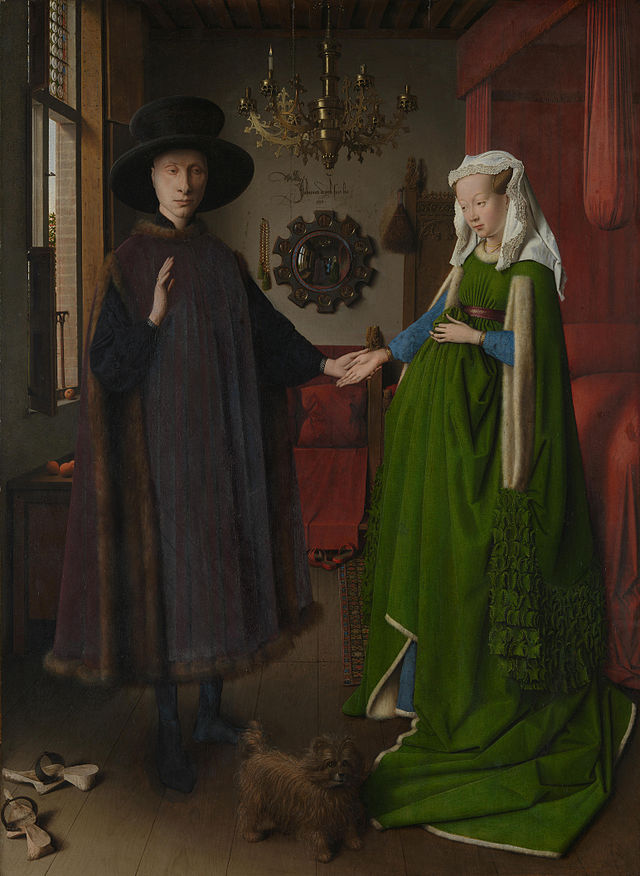
Glimpses of the masterful Arnolfini Portrait by Jan van Eyck, 1434 and its looking glass.

Arnolfini Portrait by Jan van Eyck, oil on oak, 1434.

Arnolfini Portrait by Jan van Eyck, oil on oak, 1434.

Reverberations usually begin in a single moment.  Eureka.  They say.

Consider this, please.  When you want something achievable does it burn as brightly as Canis Majoris doth vie in your heart?  The shifting of the Earth-encompassing-storm takes not a single day.  Eight luminaries drag not their feet, lo, happily under control they make their equidistant riding along for us.

Art pieces are often the fashions of their time well made for our continuing affection.  Look at Rothko’s many abstractions along with his contemporaries.  Similes and patterns because we desire to share in co-existing.  Art movements created before your eyes to the sensibility of touch.

Phases of collective art exploration and future inspiration.  Moving it is therefore even now.

CAN I CREATE AN ART MOVEMENT?

These words strong of typography.  Should one believe as such? Dare think such a lofty idea?  Do not and shall certain of aghast be!  This audacity, sometimes a wretchedness bring, always an elation sought.  Whatever is for a taking, what good is there in not giving of a good return?

Have you seen the sepia-like monochromatic quality of Pieter Claesz painting within the choosing of colour for his composing?  Genius of creativity.  Like antiquitus plate-made photography.  Please I implore you to see his other works from Wikipedia or other public sources.

That I could see even one Pieter Claesz painting in true light for myself!  A reading of my Blog John W Waterhouse & The Lady of Shalott – https://theunfathomableartist.wordpress.com/2014/08/21/john-w-waterhouse-the-lady-of-shalott/ may gift you a sense of my personable love of art.

An expansion later with joyful happiness at the multitude of calculations to follow.

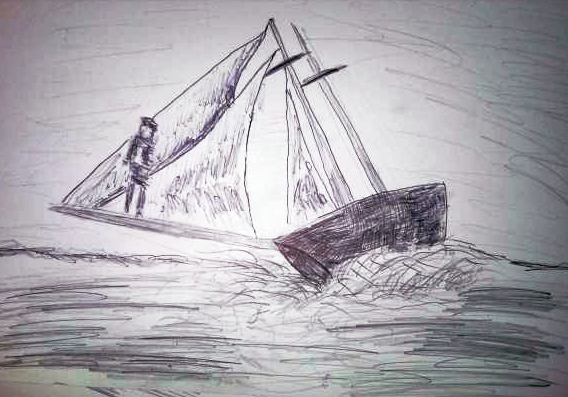
For now I share a swift ink sketch:

‘Man Sailing In Tumultuous Waves’ [2012] quick sketch on card paper by Matt The Unfathomable Artist.  Photograph digitally edited.

‘Man Sailing Tumultuous Waves’ [2012] sketch on card paper by Matt The Unfathomable Artist.

Standard