The Qingming Festival Masterpiece

An immensely historical painting popularly translated into English as “Along The River During the Qingming Festival” pre-dates Claude Monet’s “Garden of the Princess” by more than seven centuries.

The latter was painted in 1867 whilst the ancient Chinese cityscape was painted during the 12th Century by Zhang Zeduan – if we choose to use the Gregorian calendar as a reference point.

Both paintings are truly beautiful works of art.  They provide us with a busy cityscape using a panoramic view referencing capital cities during the time of their creation.  Each painting gifts us with a window into the lives, the ergonomic structures and customs of the people we see.

Monet is seated by permission to focus on the Quai de Louvre and Left Bank in Paris.  Zhang Zeduan is likewise granted to carry out his important artistic commission centuries earlier.

The man is asked to stand at a gate to carry out his work by specific request.  Monet paints from a balcony of the Louvre itself overlooking the scene below.  Intriguing artistic similarities.  Immediately Monet’s painting sprung to my mind when I studied the original Qingming Festival painting from the 12th Century.

Edouard Manet and Renoir too.  Indeed, it’s true that Monet admired Oriental art although his style is clearly European.  All great artists draw inspiration from past and present Masters.  Chinese Master artist Qi Baishi is notably humble in his praise of his favourite Chinese painters.

Bianjing now modern Kaifeng in China was the capital of the Northern Song Dynasty (960 – 1127) some thousand years after the Romans had begun establishing Londinium as the new capital of Brittannia.  In doing so the Romans replaced the settlement at Camulodunum for what we now know as London over Colchester in England respectively.

The original Chinese painting by Zhang Zeduan has extraordinary value wrapped up in its scrolls through its past ownership, cultural influence and endearment to Chinese art throughout the proceeding centuries.  A reverence that has inspired newly stylised remakes of the original for important occasions since.

Among these fine art remakes is an expert version presented to Emperor Qianlong in 1737.  The remake is updated only to reflect 18th century culture whilst remaining faithful in composition to the original.

Convergence, divergence and intransigence is intrinsically valuable to the ongoing cultural heritage of World Art.

Let us please take a considered look at “Along The River During the Qingming Festival”.  Respectfully appreciating that a language may be translated in various ways.  For a certainty, choosing a popular title for an artwork is wise.  Zhang Zeduan excels completely in his use of movement, detail, structuring and artistry.

Along the River during the Qingming Festival

The original painted scroll above measures five and a quarter metres across and ten inches high so it is difficult to imagine its impressive visual scale.  Especially as most Readers will view this image using a modest electronic device.

A large scale animated digital screen artwork has been produced incorporating the original and displayed in the China Pavilion at the Shanghai Expo 2010. 

This can be viewed by clicking here:  http://www.youtube.com/watch?feature=player_embedded&v=-AVzwui5-5w and for a closer view here: http://www.youtube.com/watch?v=SbzQ-JPlc9g

The animation is astonishingly rendered and helps to capture the affection in which the original painting is held.

I love both these paintings.  Zeduan painted fashionably of his day according to Chinese artistic style and tradition.  We see this Chinese style consistently throughout the following centuries up to and beyond Monet.  Beloved themes embraced like fruit bowls upon tables.

Just as Monet himself contributed to modern Impressionistic Art, Zeduan has greatly influenced Asia’s contemporary artists.  It’s wonderful to see artists around the world gaining inspiration from world art.

I have seen the influence of artists like Qi Baishi in the artistic style of living painters on the other side of the globe.  Professional Artists whose excellent work I’ve viewed up close and personal in art galleries.

I would like to include Monet’s “Garden of the Princess” in this Blog since we have discussed this painting also.

Here it is:

Garden of the Princess by Claude Monet

Garden of the Princess by Claude Monet

It has been a joy to write my Blog once again.

Matt The Unfathomable Artist
Standard

Gustav’s Gold

Ownership of gold has been highly desired throughout the ages by Kings, noblemen, ordinary peoples, various religions and most old and new world cultures.  Gold is long established as a sign of affluence, stability and a benchmark for commercial trade.

It’s a representative emblem for the ultimate achievement in Olympic sport.

Kingdoms have fought bloody wars and conquered lands for the want of it as spoil.  Ships made from wood sailing across thousands of years of ocean have loaded up its sheer weightiness. Entire countries have been changed forever as a result of its influence.  True to this day.

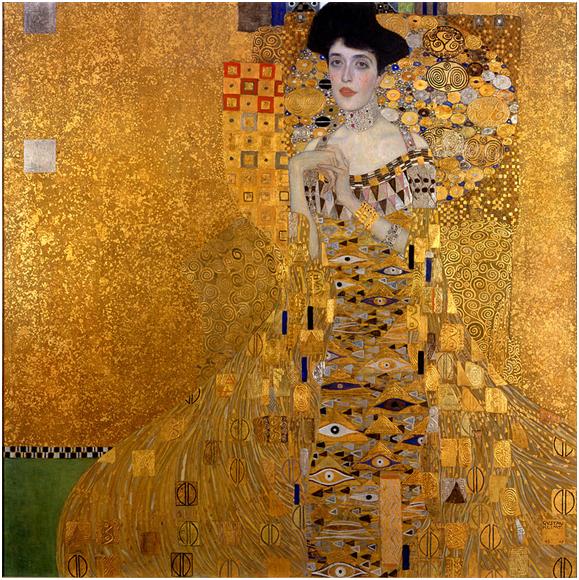
The “Portrait of Adele Bloch-Bauer I” by Gustav Klimt, an Austrian painter born on 14th July 1862 is easily one of the most breathtaking golden paintings our eyes can feast upon, here:

Had I myself asked this Lady to sit for me whilst photographing her I would rightly be proud of her pose and aristocratic expression.  The painting has an extraordinary realist quality especially when we consider that pale complexions amongst ladies were the height of fashion and beauty of their day.

Surrounding her is a symphony of gold with complex patterns adorning her gold dress and background details. Squares, swirls, rectangles, semi-circles, Egyptian style eye designs and triangular embroidery across her chest.  We are seeing a very wealthy woman.  This particular painting is composed of a dignified and formal manner to add to its importance.  Few would argue against this being a glorious display of financial significance.  Indeed the artist is himself trading upon a shrewd and savvy brilliance.

I understand that Klimt took three years to complete this portrait.  The canvas is 54 inches by 54 inches and therefore fairly large compared with some of the individual portrait dimensions we can see in Museums and Art Galleries.  The Mona Lisa is 30 inches by 21 inches as an example of one likewise famous reference point.  Of course, there are artists who have almost exclusively specialized in large canvas sizes – excluding artworks within chapels, cathedrals and churches for this moment.

All the signs that “Portrait of Adele Bloch-Bauer I” is a true masterpiece of art commanding its high commercial value is testament for us to see and read.  World renowned artist, historical relevance, artistic quality and exemplary conceptual expertise.

“Portrait of Adele Bloch-Bauer I” can be viewed at Neue Galerie, New York specialising in the very best German and Austrian Art.

Standard

Vincent and his Sunflowers

Having planted sunflowers in my own garden and watching them grow to a very great height like the proverbial beanstalk I can understand the fascination.  The width of the flower itself is quite breathtaking and the yellow mirrors the Sun for its beauty.

Van Gogh – or shall we prefer to call him Vincent as he has invited us to do?  We all probably know that Vincent’s Sunflowers paintings have been amongst the most expensive in history.  He artily studied sunflowers extensively and produced a varied array of styles and compositions.

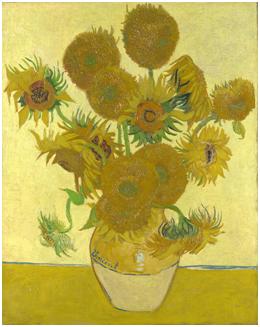
I would like to talk about version F.454, Van Gogh’s fourth version. Here is a picture:

Vincent depicts these sunflowers with vibrant yellows symmetrically contrasted against a lighter background and darker yellowy-gold floor to offset the vase’ lighter lower-half colour.  This is pleasing to our eyes and allows us to see all the details perfectly.

The sunflowers show strength, positivity and respectful humbleness.  The six flower heads boldly facing us could be a matter-of-fact declaration of facing challenges.  Readers will appreciate that Vincent was a master of composition so naturally he will choose to paint the flower heads artistically.  It is also true that Vincent would use his imagination with some compositional details to better the artistic appeal.

I know personally speaking that paintings are influenced by our moods at the time.  Subconscious feelings will rise to the fore.  As expressive creatures we cannot help translate this into our arts for all to see, hear or feel with our hearts and our minds.

Vincent’s voice is clearly heard within this yellow Sunflowers version by the epitome of joy and happiness we see.  Interestingly, whilst the background is beautifully simple the sunflowers are detailed.  I enjoy the way he has managed the seed heads in the flowers that face us, with the light specks dancing around.

White light bounces off the mid-top of the vase and the artist has chosen to write his name on the vase like a personable gift.

The flair for movement is consistent with his swirling style.  I love this about his artworks, his sense of movement.

Each person sees an artwork differently so I am by no means saying this is so or that is so about this painting.  Sacre bleu with blue lining all around.  I am much happier that you might like my interpretation of this great painting and the things I felt about it.

I can say that like all art lovers I would love to have one of Van Gogh’s paintings adorning my wall.  A visit to a Museum or Gallery graces us with a chance to pretend for a moment that one of his Sunflowers paintings is ours.

If only for a brief moment.

– Matt, The Unfathomable Artist

Standard

Discussing Expensive Artworks

If you were asked to talk about your favourite fruit, sport or hobby how long would I enjoy sitting and listening to you intently? Please think about what you would say to me.  I am interested.

Perhaps one subject is more interesting to you than another?  Well in discussing the most expensive artworks, I have chosen the paintings that I would like to include for the purpose of this blog.  Given the opportunity I’m fairly confident I could talk about them all day.

Hopefully you will enjoy what I have to say about the paintings and learn something new you did not know.

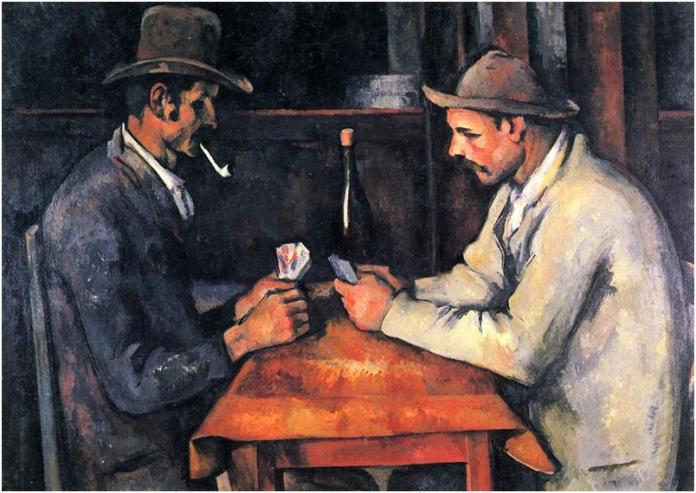
For those still with me reading let us start with one of the most expensive oil paintings “The Card Players” (fifth version) by Paul Cézanne.

Here it is:

Cézanne likely chose a popular theme amongst artists past and present.  Card playing remains highly popular in modern society so it makes sense for an artist to choose themes that will have relevance throughout time.  Past cultures show the earliest known references to card playing at least as far back as Imperial China in the 9th Century A.D.

Of course it would be quite easy for me to reference the basis and idea for these cards to the ancient Middle Eastern world and bring it forward to us through every century and millennium.  All that is required is slight of hand, a little magic and et voila.

A quick look at playing card paintings and surely many of us will remember those playing card paintings with dogs?  I think they’re fabulous but let’s get back to “The Card Players”.  What we are seeing here is the result of a concerted and perfected effort from Paul Cézanne to instill in us his personal vision for this popular theme.

Look at it.  This masterpiece of art is truly absorbing.  The composition draws us into the two players world of poise, concentration and importance.  Clearly these two men have two different styles of card play.  One is sat near bolt upright whilst the other is partly hunched.  Both are serious players yet the man on the left appears relaxed in contemplative thought merrily with pipe in his mouth.

The player on the right looks somewhat forlorn don’t you think?  Likely he is concerned at his hands prospects.  Or maybe he is a seasoned hustler?  Either way all this purposeful positioning doesn’t give us any space to conclude that this game is anything at all to do with sociable conversation.

The angle Cézanne has chosen for the playing cards gives us the appearance that the playing hand on the left is stronger, seemingly with nothing to hide from our personal viewing point.  Naturally their hands rest upon the table in constant anticipation and the absence of drinking glasses gives us the impression that this is a competitive pastime where playing pride is at stake.  The bottle has its cork stopped inside.

Everything is on hold.  Sport is immensely competitive.

Perhaps Cézanne preferred the table to be centrally close in front of us, as if we’re sitting with them, to focus our attention along with the players?  I’m personally sure of this ingenious possibility.

This composition invites us into the game as personal spectators with its minimalist intimacy.  I say this because some of the versions of his playing card themed artworks involved other people in some way or another within the paintings.

There are more colourful versions of his playing card series whereas the painting you see here on this page has a pastel colour tone.  Their faces are very expressionistic and there is no doubting the extremely fashionable influence of this art period during the late 19th Century.

An impressionistic art style that has stood the test of time into the 21st Century not least thanks to Paul Cézanne and his entire “The Playing Cards” series of paintings.

If you have chance to check out this particular series I’m sure you will see the individual emotion and artistic quality within each of these playing card paintings.

Standard

An Affinity with Rothko

Art is a passion and an obsession.


My interest is very much about describing a wider perception, understanding and emotional feeling.

As such Mark Rothko’s work is of considerable affinity to me.

Rothko delighted in the emotional connection viewers of his artworks frequently described.  Equally my priority and innermost necessity is to achieve this same emotional connection with each and every artwork I create.

Having studied great artists’ works in Museums and permanent Public Art Galleries I found my own ecstatic joy in viewing their works.

At this moment I would like to explain exactly what I feel on seeing a great artwork by using a John Constable painting I viewed as my primary example.

I didn’t immediately realize I was viewing a Constable as I passed through a local Museum.  I stopped and suddenly what I can only describe as ‘the feeling’ came over me.  It’s a kind of euphoria, a sheer delight welling up deep within.  That is to say my whole body and mind itself is responding to what I’m seeing.  This sort of feeling occurs regularly for me viewing great artworks.  It doesn’t have to be a well known artist, it’s just that it so happens to occur more often with their artworks than not.

It makes me smile every time this happens when I subsequently read the commentary notes of the artist and its description.

Okay, so why did I lead this article with Mark Rothko?

Well, one of the most satisfying things about art is the immediate reaction, memory and thought provocation I’m hoping to achieve long after anyone has viewed my work.

Without doubt Rothko achieved this time and again.

Rothko No 14

Rothko No 14

Standard