John Singer Sargent – Portrait Art’s Everything

‘Carnation, Lily, Lily, Rose’ [1885] by John Singer Sargent, Oil on canvas, 68.5 in × 60.5 in

The title for the above painting by John Singer Sargent ‘Carnation, Lily, Lily, Rose’ is from the song called ‘The Wreath‘ by eighteenth-century operatic composer Joseph Mazzinghi.

The two girls are the daughters of Frederick Barnard an illustrator by profession.

Dolly aged eleven is to our left and Polly aged seven is standing in front of her to our right.  Sargent found inspiration to include Chinese lanterns whilst sighting them during an earlier boating expedition on the Thames with American artist Edwin Austin Abbey.

This en plein air technique literally influenced by Monet to John Singer Sargent was completed over countless sessions whilst visiting Broadway, Worcestershire, England – The Cotswolds.

I promise you would find a visit to the Cotswolds oh so very pretty just like these two adorable girls painted herewith.  Therewith or herewith – its almost like going back in time.

The house of these very gardens was then owned by yet another friend of Sargent’s – American painter, writer and sculptor Frank Millet.  Sadly he died in the sinking of the RMS Titanic in 1912.

A 2016 auction of the beautiful “Poppies – A Study Of Poppies for ‘Carnation, Lily, Lily, Rose'” sold for £6,858,000 USD at Sotheby’s.

The history, its painted subjects, the luminous mastery and intricate technical derivation would make the original ‘Carnation, Lily, Lily, Rose’ a grand prize for any serious Art Collector.

What do you like most yourself about this painting?

The trodden grasses?  The girls’ concentrated facial expressions?

Warm Chinese lanterns incandescently glowing amidst arty white lillies?

I particularly love that Barnard’s daughters are thoroughly engaged, individually, in an unspeaking togetherness.  A shared purpose to delight each other and themselves equally.

John Singer Sargent gifts us with this painting for the ages.

‘Robert Louis Stevenson and His Wife’ [August 1885] by John Singer Sargent, Oil on canvas, 20 1/2 x 24 1/2 in

Rock and roll baby!

I thought of The Beatles when I first saw the painting ‘Robert Louis Stevenson and His Wife’.  Sgt Pepper’s Lonely Hearts Club Band and more specifically George Harrison.

Stylistic lyrical geniuses.

Robert Louis Stevenson is super cool.  Sargent captures Robert’s inherent quirkiness, his restlessness of thought.  Creatives can, at times, exhibit this characterisation without being aware of their indifferent juxtaposition.

Art takes over the mind.  It becomes the working of the hands.  The pacing of the feet by sheer conscious will.

Interestingly his wife appears almost ghostly and distant in this full-bodied reddened portrait.  Stevenson looks as if he wants to ‘get away’ to his writing even as Sargent’s brush strokes are being formed.

The opened door and positioning of our protaganist might seem incidental.  However, would you have chosen this composition over all other possible scenic angulations?

We have to say ‘Eureka!’

John Singer Sargent is a true portrait artisan.  The Rubens of his generation.  Sargent is as accomplished at Impressionist works as he is portrait Realism.

‘The talk of the town’..  Sargent probably knew someone’s ‘ears were burning’.

‘Miss Elsie Palmer’ [1889-90] by John Singer Sargent, Oil on canvas, 75 1/8 x 45 1/8 in

I found the pose of ‘Miss Elsie Palmer’ quaint and disciplined.  A pragmatic solution to posing for great lengths of time.  Her hair natural and the clothing fabrics a multitude of folding criss-crossing layers.

Miss Elsie Palmer’s eyes look rather mournful here.  This is a professional portrait revealing a practically perfect young lady in every way.  Modest and likeable.  Sargent’s use of light and dark is exemplary as expected.  Mood is, as Warhol commented in his own way, where Sargent’s genius shines.

Looking through his vast body of work is hugely pleasurable for any art lover.  Blending of interactive foreground and background details.  His unique artistic quality incorporated from canvas to canvas.

Quite remarkable.
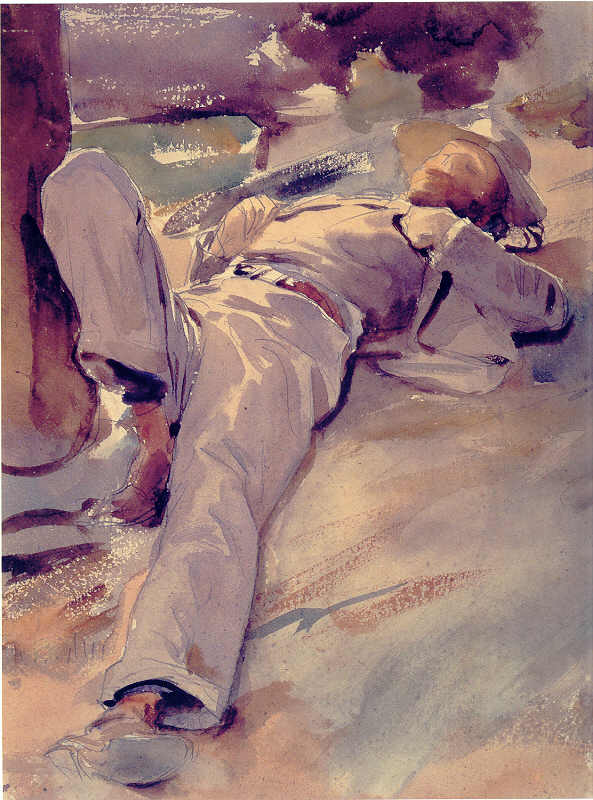
‘Lawrence Alexander “Peter” Harrison’ [c1905] by John Singer Sargent, Watercolor on paper, 50.16 x 33.02 cm

Immediately above is a relaxed Impressionist portrait of the artist ‘Lawrence Alexander “Peter” Harrison’ by his close friend John Singer Sargent.

Immediately pictured below please take a look at Sargent’s fellow artist Giovanni Boldini‘s (1845 -1931) likewise expert rendition ‘Portrait of the Artist Lawrence Alexander “Peter” Harrison’:

‘Portrait of Lawrence Alexander “Peter” Harrison’ [1902] by Giovanni Boldini,
Oil on canvas, 49 5/8 by 39 3/4 in

Boldini’s portrait is regal and dignifying in its own exquisite artistic right.

Whilst Sargent’s portrait clearly demonstrates his extreme skill at Impressionism.  The sense of body and movement in both artworks is outstanding.  Please remember that Sargent is strongly regarded as the epitome of classical high society portraiture.  True it is too.

Yet he is also very brave artistically with his career.

Impressionist works.  Perfected landscapes.  Architectural masterclasses.  Ordinary peoples, time-indefinitely painted during his various travels.

John Singer Sargent – Art at Everything.
Standard

What is New Under the Sunset?

The Unfathomable Artist is about to go off at a tangent.  Please hold onto your chair for my inexplicable thoughts and feelings.

Arty contemplations are with me every day. Analysing. Calculating. Thinking to the height and the depth to know and understand EVERYTHING of use or note.

By my own choice of moniker, ‘Unfathomable’ things that if only this mind could tell but cannot. You think you know how lonely lonely really is, do you?

I tell you, you know of a loneliness, but the loneliness that I am speaking how can you know it? Oh please, how can I be speaking also to a swan and yet not?

Wholeheartedly I sympathise with your times of loneliness, having listened to the likeness of a hundred individual voices calling out to me.  Can you understand a little better?  Do please look at the heart.  See how I keep seeing it and wondering at it.

If you throw a stick as far as you believe it will go, does it fall short?  Even this I don’t understand.  And yet if I said that I understand it entirely do you then think I’m talking nonsense?  Am I indeed proving Unfathomable to you?

Believe me when I say that I’m not even trying to do so!  Sacre bleu.

Why at the beginning, and why at the midst of this very writing.  Where is my mountain?  I’ve waited at a distance even from my youth.

A powerful King himself needs help and a Courtier tells him where he should go.  For a surety, a stream of thoughts have originated merely from one.

Modernly, hey lets have some fun 🙂

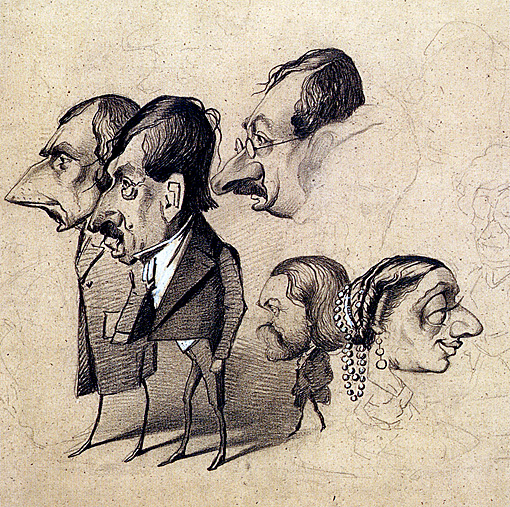
Petit Pantheon Theatral – 1860, pencil on paper by Monet

Petit Pantheon Theatral 1860 by Monet

Petit Pantheon Theatral 1860 by Monet

Caricature is always strong in popular culture.  Humour is a great way to bring people together in an inoffensive way.  Living here in the UK I’m well aware of ‘Punch’ magazines historically satirical influence.

In Monet’s style above I clearly see the likeness with a French children’s cartoon and animation of international renown.

The Ball Shaped Tree Argenteuil – 1876

The Ball Shaped Tree Argenteuil 1876 by Monet

The Ball Shaped Tree Argenteuil 1876 by Monet

I hadn’t seen this composition before.  Immediately the sight made me laugh.  My brother and I each have elements of this painting composition within one of our paintings without knowledge of this particular Monet artwork.  Quite made my day and now amongst my own personal favourites from Monet’s painting works.

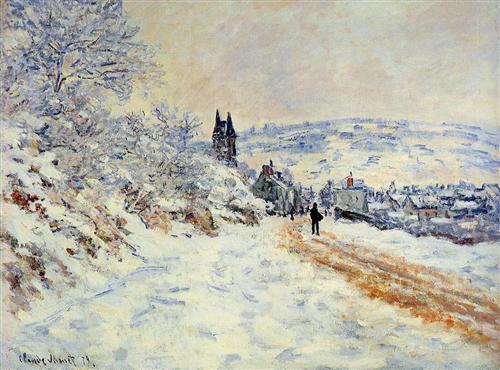
The Road To Vetheuil – Snow Effect

The Road To Vetheuil Snow

The Road To Vetheuil Snow

This composition has inspired at least one prodigy in my opinion.  Capable artists will undoubtedly draw inspiration from fellow artists, past and present.  For a fact this has already happened with my own work at the professional level.  Years ago I might add.

If a composition resonates with me it will be stored up.  It resurfaces in a subconscious way.  Originality. Creatively.

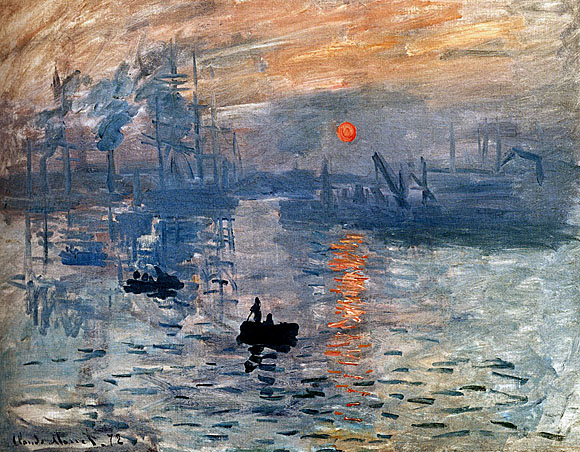
Impressionist Sunrise by Monet

Impressionist Sunrise by Monet

Sunsets offer a wealth of hues and a oneness with our planet.  I myself stored up in my mind sunset photographs I took whilst fishing many years ago.  Sitting idyllically with trees and frogs all around, supping beer and quaffing sweet coffee.

Digital technology is useful to help place art on your living room wall.  Regrettably I didn’t print my three ducks in a sunset photograph from the early 2000’s!

I really must at some very contemplative time draw those three ducks in the sunset I marvellously captured.

Bouquet of Sunflowers by… Claude Monet:

Bouquet of Sunflowers by Monet

Bouquet of Sunflowers by Monet

“Gauguin was telling me the other day—that he’d seen a painting by Claude Monet of sunflowers in a large Japanese vase, very fine. But—he likes mine better. I’m not of that opinion.” – a quote from November 1888 by Vincent Van Gogh.

Having developed compositions from my own personal creativity, artists should not be apologetic for the influence of great artists like Monet and Van Gogh even during their lifetime.  It is natural.  People can decide for themselves whether compositions show their own originality.

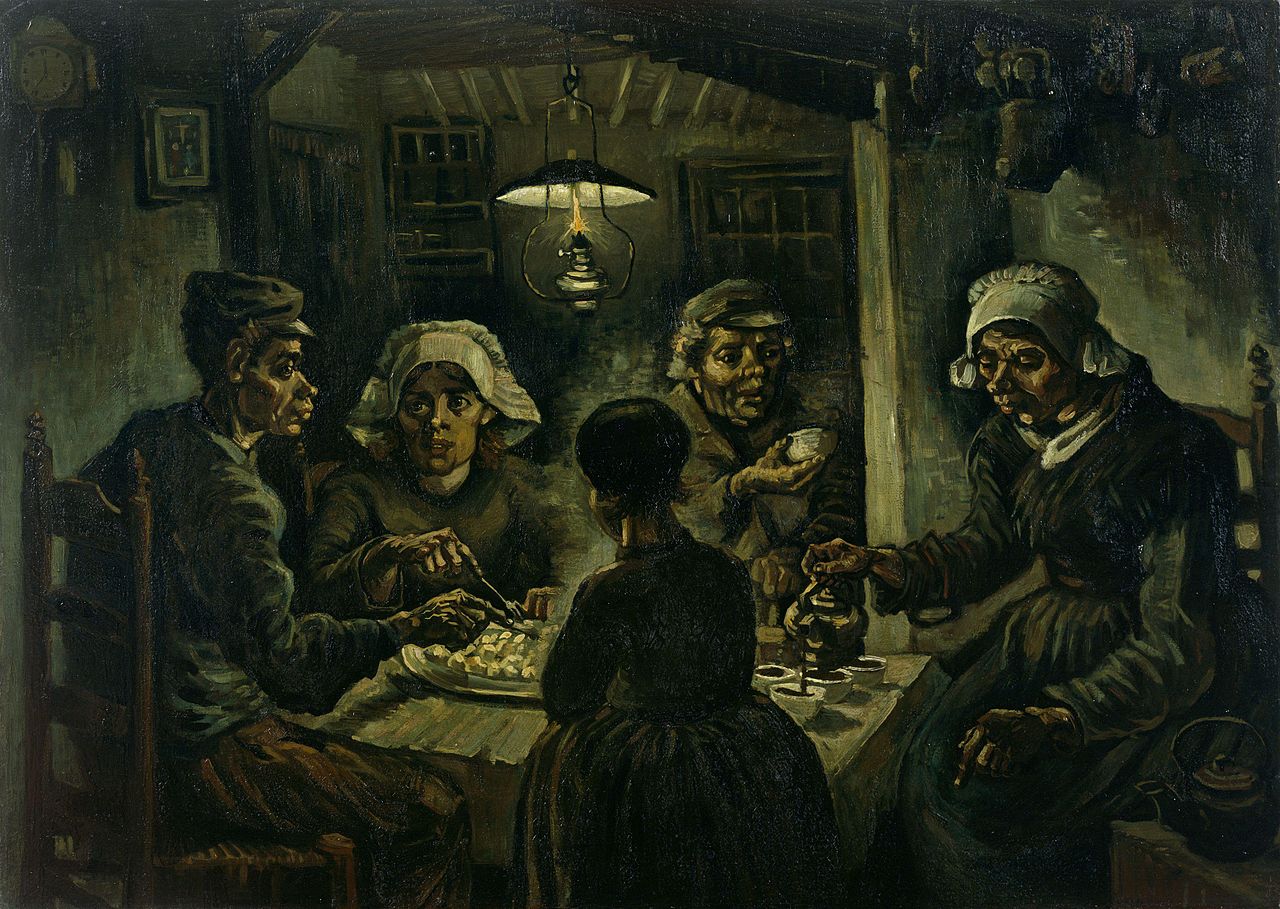
The Potato Eaters by Van Gogh

The Potato Eaters by Van Gogh

Fruit and fish in bowls and Flowers in Vase compositions strictly excepted.

Such compositions are pretty much the standard by which to judge a painters skill.

I do have a completed flowers composition.  For twelve months I grew to love my unusual composition although I haven’t published it openly, yet.  It will be a multiple version piece whilst I build upon its existing conceptual ideas.  Texture and somewhat starry daisies, by my own admission.  Rapturous laughter to myself, unquote.

‘Hey Vincent, I’m chasing after your ambitious nature good sir.’

For me art never dies.

Standard

The Qingming Festival Masterpiece

An immensely historical painting popularly translated into English as “Along The River During the Qingming Festival” pre-dates Claude Monet’s “Garden of the Princess” by more than seven centuries.

The latter was painted in 1867 whilst the ancient Chinese cityscape was painted during the 12th Century by Zhang Zeduan – if we choose to use the Gregorian calendar as a reference point.

Both paintings are truly beautiful works of art.  They provide us with a busy cityscape using a panoramic view referencing capital cities during the time of their creation.  Each painting gifts us with a window into the lives, the ergonomic structures and customs of the people we see.

Monet is seated by permission to focus on the Quai de Louvre and Left Bank in Paris.  Zhang Zeduan is likewise granted to carry out his important artistic commission centuries earlier.

The man is asked to stand at a gate to carry out his work by specific request.  Monet paints from a balcony of the Louvre itself overlooking the scene below.  Intriguing artistic similarities.  Immediately Monet’s painting sprung to my mind when I studied the original Qingming Festival painting from the 12th Century.

Edouard Manet and Renoir too.  Indeed, it’s true that Monet admired Oriental art although his style is clearly European.  All great artists draw inspiration from past and present Masters.  Chinese Master artist Qi Baishi is notably humble in his praise of his favourite Chinese painters.

Bianjing now modern Kaifeng in China was the capital of the Northern Song Dynasty (960 – 1127) some thousand years after the Romans had begun establishing Londinium as the new capital of Brittannia.  In doing so the Romans replaced the settlement at Camulodunum for what we now know as London over Colchester in England respectively.

The original Chinese painting by Zhang Zeduan has extraordinary value wrapped up in its scrolls through its past ownership, cultural influence and endearment to Chinese art throughout the proceeding centuries.  A reverence that has inspired newly stylised remakes of the original for important occasions since.

Among these fine art remakes is an expert version presented to Emperor Qianlong in 1737.  The remake is updated only to reflect 18th century culture whilst remaining faithful in composition to the original.

Convergence, divergence and intransigence is intrinsically valuable to the ongoing cultural heritage of World Art.

Let us please take a considered look at “Along The River During the Qingming Festival”.  Respectfully appreciating that a language may be translated in various ways.  For a certainty, choosing a popular title for an artwork is wise.  Zhang Zeduan excels completely in his use of movement, detail, structuring and artistry.

Along the River during the Qingming Festival

The original painted scroll above measures five and a quarter metres across and ten inches high so it is difficult to imagine its impressive visual scale.  Especially as most Readers will view this image using a modest electronic device.

A large scale animated digital screen artwork has been produced incorporating the original and displayed in the China Pavilion at the Shanghai Expo 2010. 

This can be viewed by clicking here:  http://www.youtube.com/watch?feature=player_embedded&v=-AVzwui5-5w and for a closer view here: http://www.youtube.com/watch?v=SbzQ-JPlc9g

The animation is astonishingly rendered and helps to capture the affection in which the original painting is held.

I love both these paintings.  Zeduan painted fashionably of his day according to Chinese artistic style and tradition.  We see this Chinese style consistently throughout the following centuries up to and beyond Monet.  Beloved themes embraced like fruit bowls upon tables.

Just as Monet himself contributed to modern Impressionistic Art, Zeduan has greatly influenced Asia’s contemporary artists.  It’s wonderful to see artists around the world gaining inspiration from world art.

I have seen the influence of artists like Qi Baishi in the artistic style of living painters on the other side of the globe.  Professional Artists whose excellent work I’ve viewed up close and personal in art galleries.

I would like to include Monet’s “Garden of the Princess” in this Blog since we have discussed this painting also.

Here it is:

Garden of the Princess by Claude Monet

Garden of the Princess by Claude Monet

It has been a joy to write my Blog once again.

Matt The Unfathomable Artist

Standard