I discovered the artworks of French painter Marcel Dyf whilst viewing the social media of an art blogging site. A warm thank you to all creators and supporters of our mutual enjoyment for international Art.
Please enjoy a video of Marcel Dyf’s artworks courtesy of Learn from Masters on Youtube, video above. I’ve also created a poem inspired by Marcel’s artworks to share with you entitled Sacré Ciel.
“Sacré Ciel” a poem by Matt The Unfathomable Artist:
You can download either of these same-said links for further research at your own leisure.
‘Christ in the Wilderness‘ [1872] by Ivan Nikolaevich Kramskoi, Oil on canvas, 180cm × 210cm.
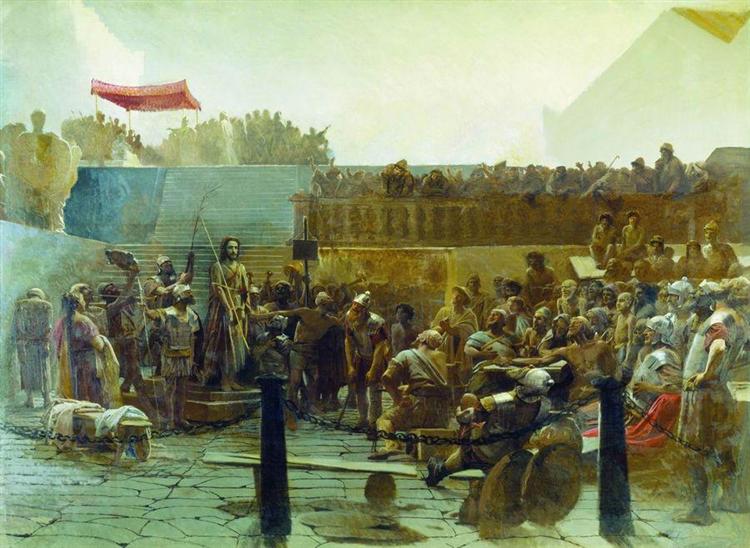
‘Laughter! Hail, King of the Jews‘ [1877-82] by Ivan Nikolaevich Kramskoi, Oil on canvas, The Depth vs The Height.“Imagine, really: there is a guy who says – only I know where salvation is. Well … fine, let’s dress him up as a jester-king … and seeing this show, everyone, everyone who was there roared with laughter … ” quotation by Kramskoi himself.
“I used to cry in the most Northern Place of My People. They would see me and they would cry heavily with me in their hearts. My People are in the East and the South Places too. I have My People in the Islands throughout the Divers Places and in the Western Places where the Elk calls out like the Angel that made them strong.”
The Unfathomable Artist holds no specific political or religious affiliation other than with persons retaining the utmost moral regard for life.
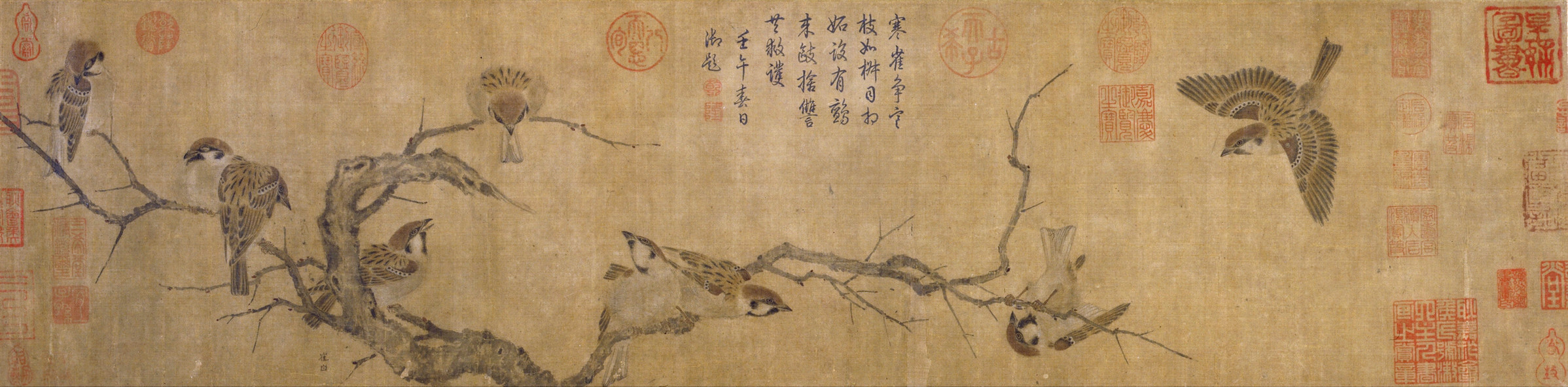
‘Wintry Sparrows‘ [latter half of the 11th century] by Cui Bai, Ink and colours on Silk, 23.5 cm (9.2 in) height x 101.4 cm (39.9 in) width, displayed at The Palace Museum, Beijing, China.
Let’s begin by imagining that any quote I include in this article is being spoken to you in an unemotional voice like that of a fully functioning mechanised Robot.
For instance…
– *Hello, my name is Kuǐlěi Móxiàng*
Please familiarize yourself with this Wikipedia link about superlative 11th Century Chinese painter Cui Bai [link here].
Also excitedly view the extraordinary mechanical genius of Japan’s 19th Century engineer and inventor Hisashige Tanaka:
[Video published by The Asahi Shimbun Digital, Japan – ]
Further detail about Tanaka’s ingeniously made creations can be activated by clicking this link regarding The Myriad Year Clock [here]. I will feature The Myriad Year Clock again later whilst reading this article.
On the morning of 6th September 2018, after I walked upstairs into a first-floor bedroom, why look, several sparrows were sunbathing on my window ledge. Brown wings fanned outwards, squat like Sumo’s upon the Earthling-moulded platform supporting their well-fed bodies.
Perceivingmy close proximity through the ledge window, they all took flight with one accord.
In the past I’ve watched sparrows completely ignore my Labrador dog in the garden, both oblivious of interest toward each other. I’ve watched greedy Wood pigeons fly directly over ground feeding sparrows, a matter of mere inches to hoover up the available food. Again, oblivious to each other.
They perceive, understand. My mind fathoms such things all the time, each day.
Did I ever tell you, *I love Art* <= electronic statement without question.
My opening introduction is to applaud imaginative human concepts of art and physical craft dating back aeons ago.
Those Cui Bai – ‘Wintry Sparrows’ could have easily been perched upon my window ledge; and despite a thousand years of time his sparrows would look no different to the aptly named House sparrows I joyously visaged that same said morning.
*raises eyebrows open mouthed in sheer euphoric delight* <= my face when I saw those amusingly adventurous sparrows.
*Erm*, chewing non-descriptively on a carrot, *you are still playing the Robot voice game, right?*
Cui Bai’s sparrows are typically busy, playful little birds. Scouting food. Encouraging congregation as if resplendent branches are offices, homes or la-la-larders.
*silly cat, silly cat why can’t you find us?* – they tweet melodically, Robotically, in our fun game.
As friends.
We can think of sparrows like ‘antiquitous’ carriages in construction, for there are many kinds. Wood being one of their most favoured sitting positions, mostly in the high places.
The individual species of sparrows are listed immediately below, with modern Chinese sparrow species highlighted in bold.
You can quickly ISBN scan *bloop.. bloop..* over these species to continue reading my article happily thereafter:
‘Magpies and Hare‘ [circa 1061] by Cui Bai, Ink and colours on Silk, 193.7 cm (76.2 in) height x 103.4 cm (40.7 in) width. Currently at National Palace Museum, Taipei.
We see both personality and interpersonal communication within ‘Magpies and Hare’ by Cui Bai, who was also known as Cui Bo.
Goodness, everything is alive in Cui Bai’s artworks. True animated mastery. It looks as though we could roll down the hillside like children. The oriental breeze meets delicate leaves. The Magpies appear to be at odds with the hare, squawking their disapproval at Hare’s presence.
Hare is bemused by their intolerance, *I just want to eat my greens, Magpies, for my belly is yet full.*
The branch work sinuously interesting. The furrows provide depth. Right-sided shadows, particularly on Hare, turn 2D imagery into three dimensional painted realities. Sporadic grasses likely hint at Hare’s immutable softness. Positional height and strength of the dominant tree shrub explains the harsh vantage point of the Magpies.
It could also be said the Magpies are defending their nearby home with vigour.
Either way, Hare isn’t harming anyone.
Hare, Tortoise, Turtle, Giant Panda, Sparrow, Crane or Gibbon.
The magnificent one, two, three, four, five, six, seven.
I’d like to conclude this article for you with a very special arrow, “The Arrows That Entertain Us“:
[Video clip courtesy of NHK Japan, about modern Japanese watchmaker Masahiro Kikuno].
‘A Woman And A Girl Driving’ [1881] by Mary Stevenson Cassatt, Oil on canvas, 35 5/16 × 51 3/8 inches (89.7 × 130.5 cm).
Featured here in the painting entitled ‘A Woman And A Girl Driving’ [1881] by Mary Stevenson Cassatt we have the bracing posture of Odile Fèvre, niece to artist Edgar Degas. The lady is Lydia the artist’s sister with the groom riding along facing the rear and sitting behind our two main subjects.
# Interesting fact – Do you know the names of any horse carriages by their constructed style and purpose?
Okay, well here is the name of some popular carriages during the latter 19th Century including a few modernly represented carriages too:
To be honest I only knew fourteen of these carriage names.
In her painting we see the lesser detailed fauna of the Bois de Boulogne. A heavily cropped composition of horse and carriage to showcase the occupants. The steadied seating of young Odile and Lydia’s concentration to drive carefully whilst holding horse-drawn reins.
Yes, a woman actually driving in the late nineteenth century. Although now it’s the early 21st Century and we should all be hovering about on magically carpeted skateboards pretending its 1985.
Flux capacitor fully charged, of course.
– “Times are a changin’ like the dog and it’s tail.” – chimed the Coachy, who had clearly seen the various where-with-alls of the known ages come and go.
Purraps ye olde Coachy is proper ‘edless and has seen ye time and times thee only throws a stick at?
Hey, I wonder if ole’ Coachy knows Charon, the ferryman? They’d get along swimmingly together.
Lydia looks responsible. The groom is contemplating bachelor life passing by. I have to laugh that Cassatt has wondrously captured the man with all his intrepid apprehension. Although posing in a horse drawn carriage for goodness knows how long must be quite challenging.
Beautiful too.
I do love her painting.
‘Sara Wearing A Bonnet’ by Mary Stevenson Cassatt.
‘Sara Wearing A Bonnet’ by Mary Stevenson Cassatt is a masterpiece.
Sara’s origin is currently a mystery to me.
Cassatt sketched and painted Sara around fifty times from circa 1900/1 through to, at least, 1907. Cassatt’s determined efforts to replicate same subject person’s in different compositions was likely influenced upon seeing works by Peter Paul Rubens and Antonio Allegri da Correggio.
Mary is exceptionally thorough in her artistic training and study of past Masters.
What intensity do you need to enjoy composing the same person fifty times? Look at Sara, she is divinely beautiful at such a delicate young age. It’s a testament to Mary Cassatt that she also finds Sara’s inner qualities of grace, patience and charm time and again in her compositions.
Sara has an incredible sense of purity that radiates through her adorable complexion. Personally I think Mary viewed her expression so perfectly painted here that she hastily put down her brushes.
The artwork is just so.
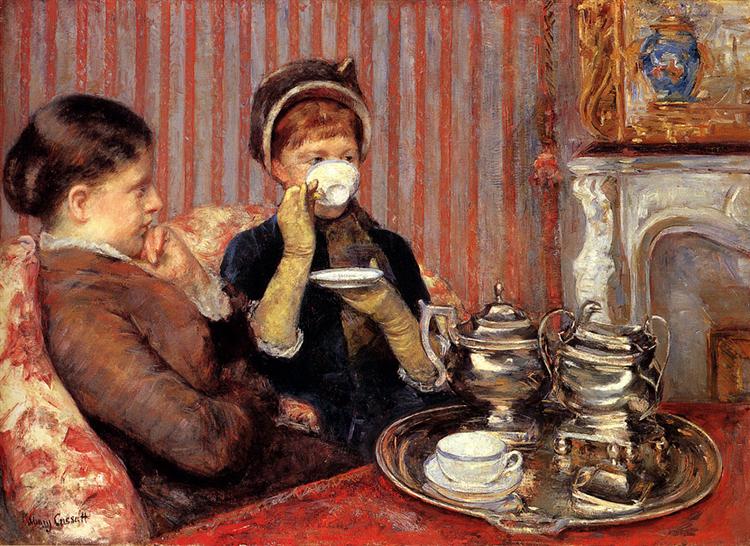
‘The Tea’ by Mary Stevenson Cassatt [c1880-81], Oil on canvas, 64.77 cm x 92.07 cm (25 1/2 ins x 36 1/4 ins).
Anyone for tea?
‘The Tea’ by Mary Stevenson Cassatt, shown above, is a true delight to behold. To our left Lydia Cassatt, the aforementioned carriage driver, appears deep in thought. Hair shining, superbly posed, revealing her personality to us in a new way – a friendly looking lady.
The tea drinker, cup to lips, is dainty and prim. We are able to glean her nature in this fleeting movement to sup, along with the pretty societal decorum of her era.
The tea service belonged to Mary Stevenson, the Cassatt’s Grandmother whom Mary herself is named after. Likely the tea service is expensive as this was made specifically for their Grandmother. Therefore in this painting we have direct connections to the artist’s family heritage. Notwithstanding that the silverware itself is beautifully envisaged for us by Mary.
Honest portrait replication is where Mary Cassatt’s art excels. Without question this is her primary objective in portraiture, irrespective of the background. Mary understood exactly what the fashionable art market wanted. ‘The Tea’ painting shown here was included in two Impressionist Exhibitions, 1880 and ’81.
Mary Cassatt was also lifelong friend to the exceedingly wealthy Louisine Waldron Elder Havemeyer, who was instrumental to the Early 1900’s Suffrage Movement . Louisine herself was a high profile art collector and an active feminist. Proven through the pages of a book entitled ‘Sixteen to Sixty: Memoirs of a Collector’ by Louisine W. Havemeyer.
Women of the early 1900’s were not all shy, retiring types.
However, I’d like to mention that whilst Mary Cassatt was certainly unafraid to voice her opinions, she did respect the global business of art. Her friendships show Mary to be pleasantly malleable and eager to accept positive career direction, regardless of gender.
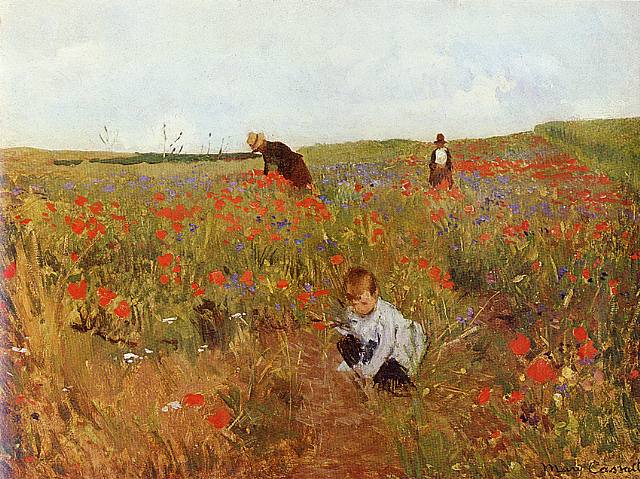
‘Picking Flowers In A Field’ by Mary Stevenson Cassatt [1875], Oil on panel, height 26.6 cm (10.4 ins) x width 34.3 cm (13.5 ins).
If I owned ‘Picking Flowers In A Field’ vibrantly alive above by Mary Stevenson Cassatt it would never leave my possession.
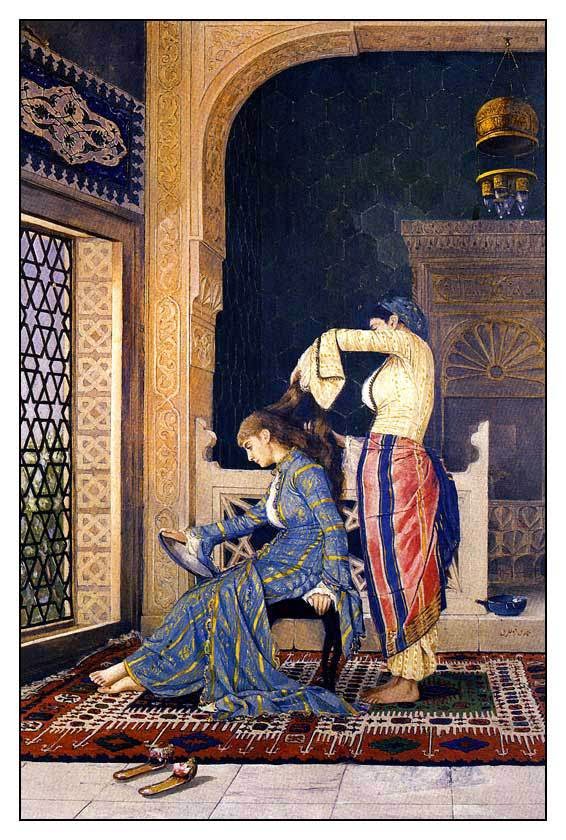
“The Lady Who Has Her Hair Combed” [Saçlarını Tarayan Kız] by Osman Hamdi Bey
Osman Hamdi Bey was born 30th December 1842 in Constantinople, modern day Istanbul Turkey, during the Ottoman Empire.
Wikipedia states that Osman Hamdi Bey was “an Ottoman administrator, intellectual, art expert and also a prominent and pioneering painter. He was also an accomplished archaeologist, and is regarded as the pioneer of the museum curator’s profession in Turkey.
‘Lady Having Her Hair Combed by a Servant’ shown above is an exquisite artwork worthy of its historical value and tender delicacy. I believe The Dolmabahçe Palace may still be exhibiting ‘Lady Having Her Hair Combed by a Servant’.
‘Lady In Yellow Dress Arranging Flowers In A Vase’ by Osman Hamdi Bey
Above we see a lady beautifying a sitting area. One knee bent alludes to a serving attitude whilst looking upwards, channeling her spiritual consideration and deferential poise. Real flowers cleverly merge contextually with the florally patterned couch. An elaborate symbolic replication of the pinkish-white flowers imitates her lithe, servient inclination.
The lady reaches outwards, extending her left foot to attend to her wholesome duty. There is artistic evaluation within her head posing, wholly reflecting the creative nature of her pretty decorative arrangement.
‘Ladies Taking A Walk Holding Umbrellas’ by Osman Hamdi Bey shown immediately above has to be one of the finest artworks you can view, display or own.
Pierre-Auguste Renoir meets Osman Hamdi Bey.
The realist quality, colour composition, masterful use of canvas, glorious shading, far-ground Renaissance trees’ styling and sense of feeling throughout encapsulates the phrase Beyond Words, perfectly.
Perfection to the amplification of millions.
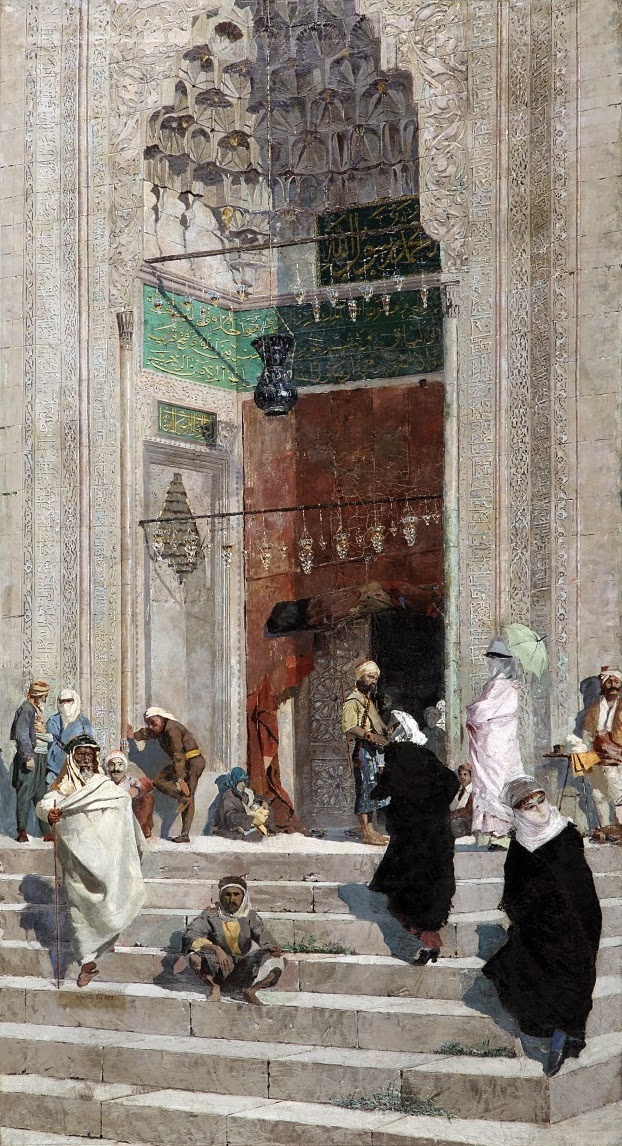
‘At The Mosque Entrance’ by Osman Hamdi Bey, shown immediately above.
John William Waterhouse meets Osman Hamdi Bey in ‘At The Mosque Entrance’.
With the incredibly high prices certain art pieces attain – the ‘Salvator Mundi’ by Da Vinci being the existing summa omnium temporum – I believe this particular artwork also has spiritual merit.
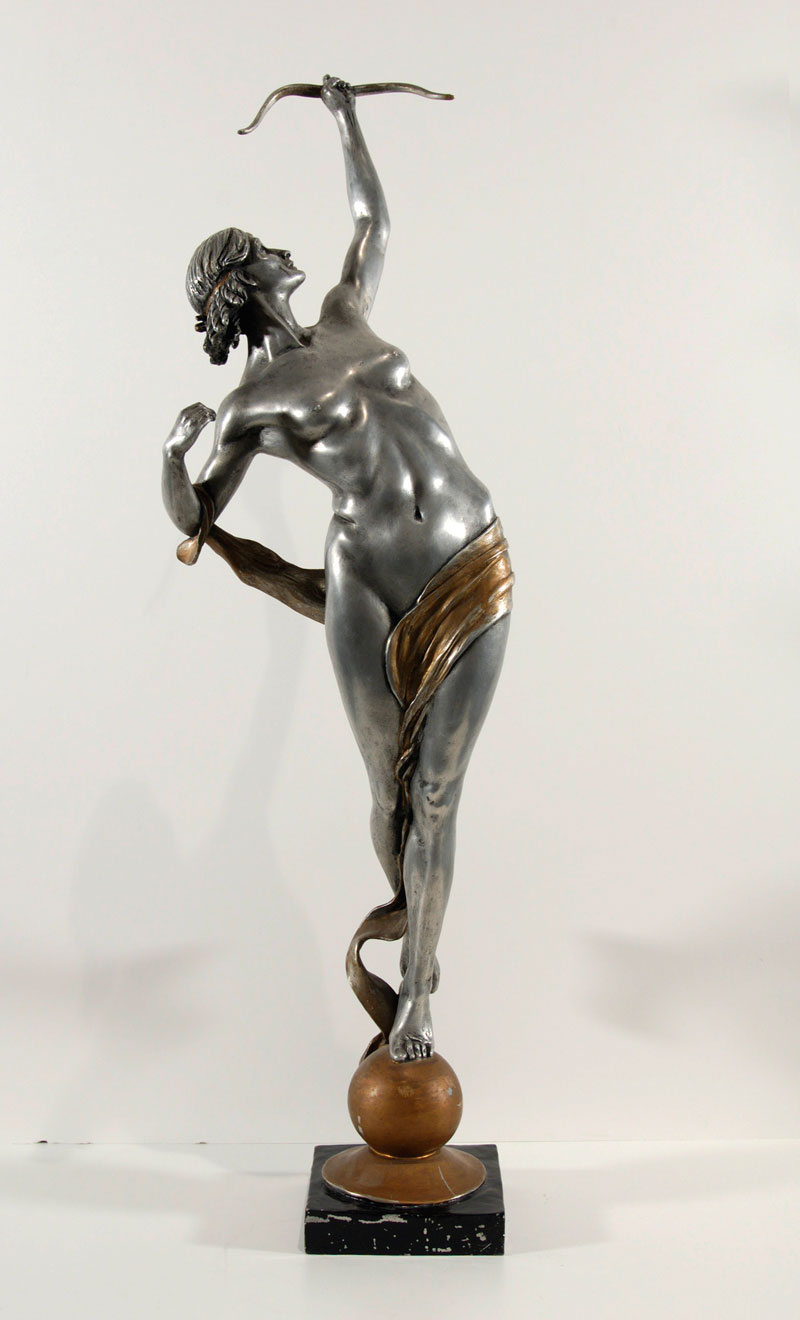
‘Diana’ [1932] by Anna Hyatt Huntington, Aluminum, gold plate and silver plate, 32 1/2 x 9 1/2 x 8 1/2 in.
Anna [Vaughn] Hyatt Huntington born 1876 shared her birthday of March 10th with her wealthy husband Archer Milton Huntington whom she married in 1923.
Relocating to New York City to enable her career to flourish in 1902, A.H. Huntington is one of the greatest representations of female empowerment within art.
Truly inspiring.
Her ‘Diana’ figure shown above was produced in varying sizes, cast materials and alternative compositions. The New York Historical Society and NYC’s National Academy of Design have two larger versions of this cast.
The beauty of this sculpture is immediately eye-catching.
Okay, what does this sculpture reveal to us?
The bow points upwards signalling a contrary position to divinity. Artemis, the Greek name of the latinised Diana, is posturing her own divine power. An understanding of specific ancient texts regarding the usage of arrows in ancient culture as ‘signs’ is intimated in this piece.
Likely Anna Hyatt Huntington was aware of such understated references during her prior sculptural studies and research.
Art professionals know that Anna was particular about physiological designs in terms of historical, anatomical and cultural placement. The ‘Diana’ figure has symbolised adoration of the female form for millenia. From a military perspective the upward positioning of the bow could also represent ambition to further exceed in contested plans.
‘Here on Earth the answer is always a matter of the Height, the Breath and the Depth of things.’
The way Huntington has intended her Diana to pose alluringly beckons the viewer in a feminine way to support her cause.
The figure is both subjective and authoritive in design – a uniquely crafted balance. This might help us to gain insight into Anna’s idea of marital harmony. Anna is not forcing her artistic idea of ‘Diana’ upon you.
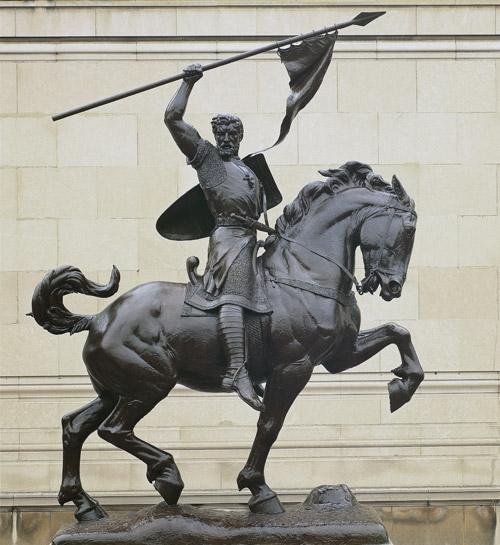
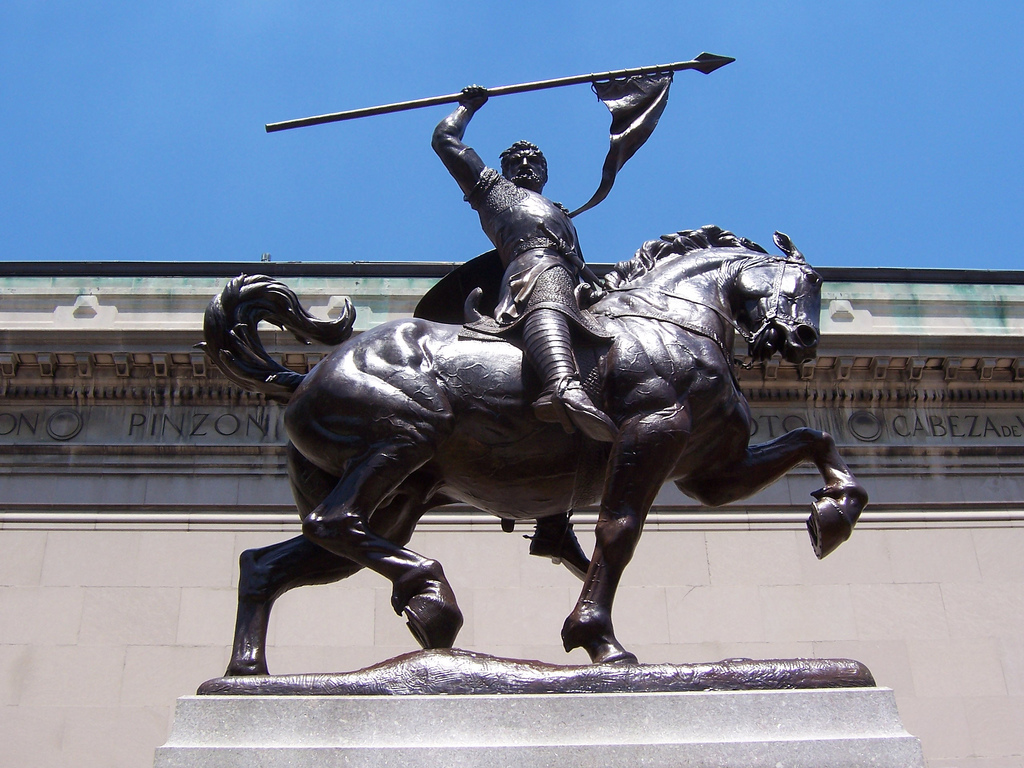
‘El Cid Campeador’ [1927] by Anna Hyatt Huntington, Bronze statue on stone at the New York Hispanic Society of America. Photograph courtesy of the HSA – NYC.
Please click the photographs for further detailing:
‘El Cid Campeador’ in New York by Huntington, pictured twice above, is a highly useful study for fledgling sculptors to investigate. If you’re studying art I would encourage you to do so.
Anna and her husband Archer enjoyed researching fine details. Their vision of art is based upon facts, realism and visibly tangible elements. Regardless of the subject matter Anna was always looking to create a faithfully unique sculpture of the subject wherever possible.
The process of learning about an intended commission preceded her clay studies as an integral part of the intellectual design long before the delivery or final unveiling. Archer was a constant source of inspiration for Anna through his own scholarly interests.
Yet, Anna was already self-sufficient from her art career prior to their marriage. From the 1910’s Anna earned a monumental amount of money per annum – $50,000. This would be at least $1.2 million US dollars annually – adjusted for 2017!
‘The Torch Bearers’ [1954] by Anna Hyatt Huntington, Aluminium sculpture, 6m x 6m x 6.2m. At Ciudad Universitaria in Madrid, Spain. Photograph by JL De Diego.
There are versions of this Spanish sculptural installation by Anna called ‘The Torch Bearers’ (shown above) in Havana Cuba, South Carolina, New Jersey, Virginia and one each at Bridgeport & Redding in Connecticut.
‘The Torch Bearers’ is a truly moving piece of work, part-reminiscent of Michelangelo’s near-ineffable Sistine Chapel ceiling artwork. If you can visit any of Anna’s intricate sculptures I’m sure you will enjoy the whole experience.
Anna Hyatt Huntington’s sculptures along with the ancient ‘Artemision Bronze’ at the National Archaeological Museum in Athens Greece can only be best appreciated visiting them in person.
As friends.
N.B. In keeping with todays article theme of female artistry please check out Marie Hammer’s art, hyperlink below. Her husband, Rusty, writes the Xtreme Art Tourist blog aforementioned.
They both love art as much as Archer and Anna Huntington. After reading about Archer’s Hispanic museum quest from his boyhood this takes some serious doing!
‘Carnation, Lily, Lily, Rose’ [1885] by John Singer Sargent, Oil on canvas, 68.5 in × 60.5 in
The title for the above painting by John Singer Sargent ‘Carnation, Lily, Lily, Rose’ is from the song called ‘The Wreath‘ by eighteenth-century operatic composer Joseph Mazzinghi.
The two girls are the daughters of Frederick Barnard an illustrator by profession.
Dolly aged eleven is to our left and Polly aged seven is standing in front of her to our right. Sargent found inspiration to include Chinese lanterns whilst sighting them during an earlier boating expedition on the Thames with American artist Edwin Austin Abbey.
This en plein air technique literally influenced by Monet to John Singer Sargent was completed over countless sessions whilst visiting Broadway, Worcestershire, England – The Cotswolds.
I promise you would find a visit to the Cotswolds oh so very pretty just like these two adorable girls painted herewith. Therewith or herewith – its almost like going back in time.
The house of these very gardens was then owned by yet another friend of Sargent’s – American painter, writer and sculptor Frank Millet. Sadly he died in the sinking of the RMS Titanic in 1912.
A 2016 auction of the beautiful “Poppies – A Study Of Poppies for ‘Carnation, Lily, Lily, Rose'” sold for £6,858,000 USD at Sotheby’s.
The history, its painted subjects, the luminous mastery and intricate technical derivation would make the original ‘Carnation, Lily, Lily, Rose’ a grand prize for any serious Art Collector.
What do you like most yourself about this painting?
The trodden grasses? The girls’ concentrated facial expressions?
Warm Chinese lanterns incandescently glowing amidst arty white lillies?
I particularly love that Barnard’s daughters are thoroughly engaged, individually, in an unspeaking togetherness. A shared purpose to delight each other and themselves equally.
John Singer Sargent gifts us with this painting for the ages.
‘Robert Louis Stevenson and His Wife’ [August 1885] by John Singer Sargent, Oil on canvas, 20 1/2 x 24 1/2 in
Rock and roll baby!
I thought of The Beatles when I first saw the painting ‘Robert Louis Stevenson and His Wife’. Sgt Pepper’s Lonely Hearts Club Band and more specifically George Harrison.
Stylistic lyrical geniuses.
Robert Louis Stevenson is super cool. Sargent captures Robert’s inherent quirkiness, his restlessness of thought. Creatives can, at times, exhibit this characterisation without being aware of their indifferent juxtaposition.
Art takes over the mind. It becomes the working of the hands. The pacing of the feet by sheer conscious will.
Interestingly his wife appears almost ghostly and distant in this full-bodied reddened portrait. Stevenson looks as if he wants to ‘get away’ to his writing even as Sargent’s brush strokes are being formed.
The opened door and positioning of our protaganist might seem incidental. However, would you have chosen this composition over all other possible scenic angulations?
We have to say ‘Eureka!’
John Singer Sargent is a true portrait artisan. The Rubens of his generation. Sargent is as accomplished at Impressionist works as he is portrait Realism.
‘The talk of the town’.. Sargent probably knew someone’s ‘ears were burning’.
‘Miss Elsie Palmer’ [1889-90] by John Singer Sargent, Oil on canvas, 75 1/8 x 45 1/8 in
I found the pose of ‘Miss Elsie Palmer’ quaint and disciplined. A pragmatic solution to posing for great lengths of time. Her hair natural and the clothing fabrics a multitude of folding criss-crossing layers.
Miss Elsie Palmer’s eyes look rather mournful here. This is a professional portrait revealing a practically perfect young lady in every way. Modest and likeable. Sargent’s use of light and dark is exemplary as expected. Mood is, as Warhol commented in his own way, where Sargent’s genius shines.
Looking through his vast body of work is hugely pleasurable for any art lover. Blending of interactive foreground and background details. His unique artistic quality incorporated from canvas to canvas.
Quite remarkable.
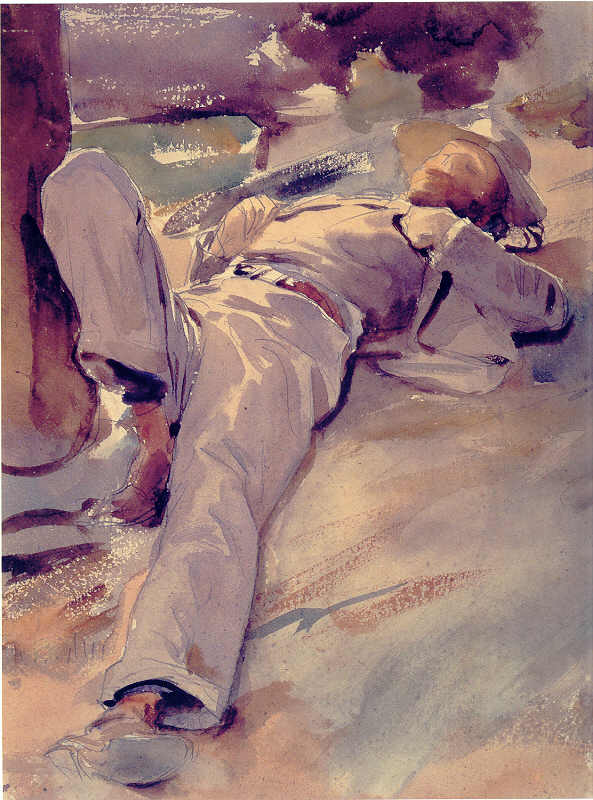
‘Lawrence Alexander “Peter” Harrison’ [c1905] by John Singer Sargent, Watercolor on paper, 50.16 x 33.02 cm
Immediately above is a relaxed Impressionist portrait of the artist ‘Lawrence Alexander “Peter” Harrison’ by his close friend John Singer Sargent.
Immediately pictured below please take a look at Sargent’s fellow artist Giovanni Boldini‘s (1845 -1931) likewise expert rendition ‘Portrait of the Artist Lawrence Alexander “Peter” Harrison’:
‘Portrait of Lawrence Alexander “Peter” Harrison’ [1902] by Giovanni Boldini, Oil on canvas, 49 5/8 by 39 3/4 in
Boldini’s portrait is regal and dignifying in its own exquisite artistic right.
Whilst Sargent’s portrait clearly demonstrates his extreme skill at Impressionism. The sense of body and movement in both artworks is outstanding. Please remember that Sargent is strongly regarded as the epitome of classical high society portraiture. True it is too.
Yet he is also very brave artistically with his career.
Impressionist works. Perfected landscapes. Architectural masterclasses. Ordinary peoples, time-indefinitely painted during his various travels.
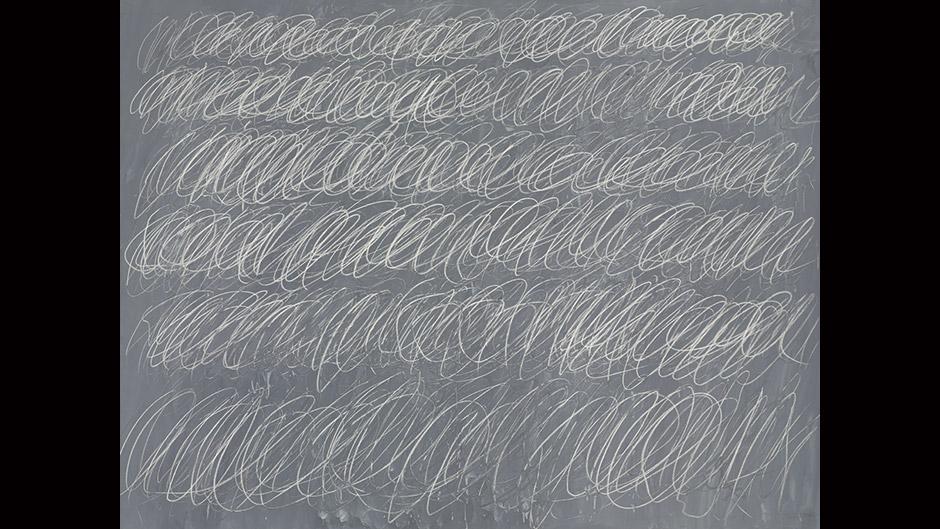
Cy Twombly – Untitled – inscribed NYC, [1968]. Oil based house paint and wax crayon on canvas – 68 x 90 in
The value of art can be truly awe-inspiring.
‘Seismic Waves [first version]’ [15th April 2016] by Matt The Unfathomable Artist, Blue ink on A4 paper, artwork whereabouts unknown.
Tracey Emin is also renowned for art that is timeless and of the moment.
Spontaneous of inspiration.
All artists will speak of their essence, primality or inner conscious feelings overtaking their work. Becoming a sort of seismic needle I suppose. Reacting to inputs, impulses and vibrations somewhere out there in the ether.
I’m not sure whether I’d read about the particular earthquake earlier on that day or not. We all read about these things so often these days. I was moved in a humanly caring way to produce this on paper with ink pen.
There are artists and people generally speaking that are so organised. If I had a spacious art studio I probably would stack everything in perfect order.
Probably.
A collaboration of famous rock musicians, lyrically brilliant songwriters wrote “I put the pen to the paper ’cause it’s all a part of me.”
I’ve always loved those lyrics for all their honest genius. Beyoncé recently referenced historical symbology to her musical performances. Art is an inspiration. Of self and others.
Someone a few years ago wrote:
‘I want to change the world by keeping it the same and I want to change the world by making it different.’. They wrote this to their dear Nan. Electronically so to speak.
Would you like to go on a journey with me? Please think for a moment where I might take you.
We can cross oceans of time. The fabrics of space. I will open up the Universe with my hands for you. Inversely of understanding. A design from the outside. Pulling at the edges like a canvas stretched across beams. Atomic order. Nucleic. Archaeological charcoals and elementals masking the span for all its measurement.
‘Snow Storm – Steam-Boat off a Harbour’s Mouth’ by Joseph Mallord William Turner – Exhibited 1842 – Oil paint on canvas – 914 mm x 1219 mm
‘Snow Storm – Steam Boat off a Harbour’s Mouth’ by Joseph M W Turner is amongst my favourite of his works. The human mind fills the void. Forms its own imagination. You perceive what you are able to comprehend. Reality it is not. A construct of perception as an idea. The basis for an impressionistic viewpoint.
The above artwork by Turner is a cacophonic masterpiece. You look at this and heard.. nothing.
Until now.
I merely lifted my canvas from its cardboard box to show him without commenting or referencing the title of my artwork – ‘Creative Mind’. At that precise moment a professional creative told me and I quote his words pretty much verbatim here, ‘It makes my brain think all sorts of things’.. I knew it had achieved everything I wanted from the outset. Perfectly.
Turner has immense influence to this day. Everyone says this. Let me give you an example. If you would like to view Whitewall Galleries online (here in the UK) and look up Chris and Steve Rocks you will see this for sure.
As a side note in abstraction I also strongly recommend the work of Danielle O’Connor Akiyama. With these recommendations I speak from personal interest in their quality. This is not a reflection of other artists merely that their work was on show when I visited the gallery sometime ago. Impressive and beautiful.
Turner’s masterpiece above shows layers of intricacy, a sheen of glazed light, depth of feeling and stormy chaos. Truly iconic.
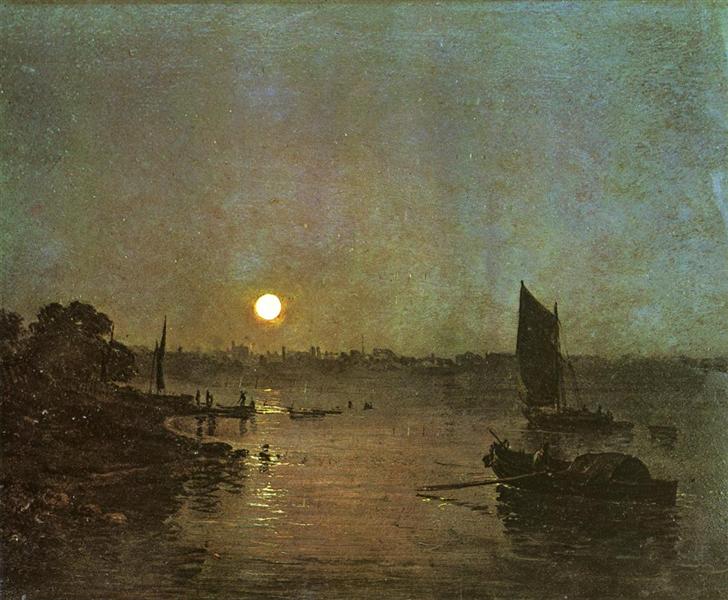
This brings us nicely to the value of his photographic realist paintings. Consider viewing Turner’s next painting, immediately below, to Chopin’s Nocturne in E flat major Opus 9 No. 2 as I myself did.
‘Moonlight, a Study at Millbank’ by Joseph M W Turner – Exhibited 1797 – Oil on panel – 31.5 x 40.5 cm – on display at the Tate Gallery, London, UK
‘Moonlight, a Study at Millbank’ has such eerie reality that it pulls us in as if by one of the ships ropes about our midriff. Our faces feel the cold-still nightly breeze. We can hear light winds through the sails. Quietness and a gentle drifting along of taut wood bound together strong for the working.
Two curious sayings I share now that I have read of my Great great Uncle artist Mr FMR aforementioned in my previous blog. ’12 horses on the strength’ and that he was ‘the cat’s whiskers’ to his Mother and Father. I really would like to paint these two expressions after the preceding works already waiting in the theatrical wings of my mind.
The latter expressionistic idea would not only be construe from Mr FMR’s sayings herewith. You see at ‘middle’ school our class was given a project to complete. I was thirteen years of age and chose to write about wildlife. I enjoyed drawing the faces of big cat’s, exceedingly I practised. Yet my drawing ability by my own admission is mostly immature during my earlier years.
Do you know the violinist who really cannot play or the singer who is yet able to fully master singing? For a fact both always exist and some latterly of their age, renowned. I am one and the other.
It’s quite the strangest thing that some artistic things I could accomplish in painting and drawing with ease whilst other subjects I struggle/d at almost impossibly. Art is learning. Nobody on earth ever picked up paints, crayons or pencil and drew with expertise immediately. No one. Ever.
Again I shall digress, oh Mr L.S. Lowry I love you so very much my dear fellow. For two exemplary reasons that my heart chases after like horses toward their hurdles for riding.
Turner’s work appears effortless. Clearly though, as shown below, Turner’s learnedness at professional draughtsmanship produces finely exquisite angles and perspectives beyond stark portrayal. For sure there is art in architecture.
Lines meet curves, leans and masses of concrete order.
‘Tintern Abbey: The Crossing and Chancel’ (looking towards the East window) by J. M. W. Turner – 1794 – Graphite & Watercolour on paper – 35.9 cm × 25 cm
Turner is rightly regarded as a British exemplary of artistic influence. His classical self portrait is to appear on the Bank of England’s £20 note from 2020 following a public selection process. Perhaps I waited wisely for the right time to make deserved commentary about Turner. Without doubt a pleasure to write this blog article and in eager readiness for sometime now.
Loudly whispers ‘Constable! Constable!’, Edgar Degas and Sir Edward Coley Burne-Jones, 1st Baronet – someone, somewhere, somehow please an encore!’
For some within art Time really has no limitation whatsoever. God, the Dove or the Dragon are unable to conquer unto destruction nor death.


 ]
]










 The Unfathomable Artist