John Singer Sargent – Portrait Art’s Everything

‘Carnation, Lily, Lily, Rose’ [1885] by John Singer Sargent, Oil on canvas, 68.5 in × 60.5 in

The title for the above painting by John Singer Sargent ‘Carnation, Lily, Lily, Rose’ is from the song called ‘The Wreath‘ by eighteenth-century operatic composer Joseph Mazzinghi.

The two girls are the daughters of Frederick Barnard an illustrator by profession.

Dolly aged eleven is to our left and Polly aged seven is standing in front of her to our right.  Sargent found inspiration to include Chinese lanterns whilst sighting them during an earlier boating expedition on the Thames with American artist Edwin Austin Abbey.

This en plein air technique literally influenced by Monet to John Singer Sargent was completed over countless sessions whilst visiting Broadway, Worcestershire, England – The Cotswolds.

I promise you would find a visit to the Cotswolds oh so very pretty just like these two adorable girls painted herewith.  Therewith or herewith – its almost like going back in time.

The house of these very gardens was then owned by yet another friend of Sargent’s – American painter, writer and sculptor Frank Millet.  Sadly he died in the sinking of the RMS Titanic in 1912.

A 2016 auction of the beautiful “Poppies – A Study Of Poppies for ‘Carnation, Lily, Lily, Rose'” sold for £6,858,000 USD at Sotheby’s.

The history, its painted subjects, the luminous mastery and intricate technical derivation would make the original ‘Carnation, Lily, Lily, Rose’ a grand prize for any serious Art Collector.

What do you like most yourself about this painting?

The trodden grasses?  The girls’ concentrated facial expressions?

Warm Chinese lanterns incandescently glowing amidst arty white lillies?

I particularly love that Barnard’s daughters are thoroughly engaged, individually, in an unspeaking togetherness.  A shared purpose to delight each other and themselves equally.

John Singer Sargent gifts us with this painting for the ages.

‘Robert Louis Stevenson and His Wife’ [August 1885] by John Singer Sargent, Oil on canvas, 20 1/2 x 24 1/2 in

Rock and roll baby!

I thought of The Beatles when I first saw the painting ‘Robert Louis Stevenson and His Wife’.  Sgt Pepper’s Lonely Hearts Club Band and more specifically George Harrison.

Stylistic lyrical geniuses.

Robert Louis Stevenson is super cool.  Sargent captures Robert’s inherent quirkiness, his restlessness of thought.  Creatives can, at times, exhibit this characterisation without being aware of their indifferent juxtaposition.

Art takes over the mind.  It becomes the working of the hands.  The pacing of the feet by sheer conscious will.

Interestingly his wife appears almost ghostly and distant in this full-bodied reddened portrait.  Stevenson looks as if he wants to ‘get away’ to his writing even as Sargent’s brush strokes are being formed.

The opened door and positioning of our protaganist might seem incidental.  However, would you have chosen this composition over all other possible scenic angulations?

We have to say ‘Eureka!’

John Singer Sargent is a true portrait artisan.  The Rubens of his generation.  Sargent is as accomplished at Impressionist works as he is portrait Realism.

‘The talk of the town’..  Sargent probably knew someone’s ‘ears were burning’.

‘Miss Elsie Palmer’ [1889-90] by John Singer Sargent, Oil on canvas, 75 1/8 x 45 1/8 in

I found the pose of ‘Miss Elsie Palmer’ quaint and disciplined.  A pragmatic solution to posing for great lengths of time.  Her hair natural and the clothing fabrics a multitude of folding criss-crossing layers.

Miss Elsie Palmer’s eyes look rather mournful here.  This is a professional portrait revealing a practically perfect young lady in every way.  Modest and likeable.  Sargent’s use of light and dark is exemplary as expected.  Mood is, as Warhol commented in his own way, where Sargent’s genius shines.

Looking through his vast body of work is hugely pleasurable for any art lover.  Blending of interactive foreground and background details.  His unique artistic quality incorporated from canvas to canvas.

Quite remarkable.
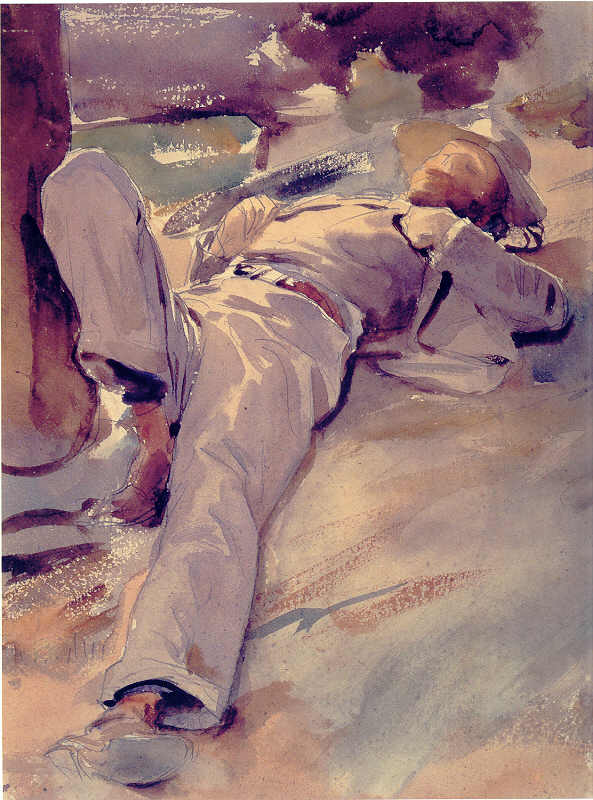
‘Lawrence Alexander “Peter” Harrison’ [c1905] by John Singer Sargent, Watercolor on paper, 50.16 x 33.02 cm

Immediately above is a relaxed Impressionist portrait of the artist ‘Lawrence Alexander “Peter” Harrison’ by his close friend John Singer Sargent.

Immediately pictured below please take a look at Sargent’s fellow artist Giovanni Boldini‘s (1845 -1931) likewise expert rendition ‘Portrait of the Artist Lawrence Alexander “Peter” Harrison’:

‘Portrait of Lawrence Alexander “Peter” Harrison’ [1902] by Giovanni Boldini,
Oil on canvas, 49 5/8 by 39 3/4 in

Boldini’s portrait is regal and dignifying in its own exquisite artistic right.

Whilst Sargent’s portrait clearly demonstrates his extreme skill at Impressionism.  The sense of body and movement in both artworks is outstanding.  Please remember that Sargent is strongly regarded as the epitome of classical high society portraiture.  True it is too.

Yet he is also very brave artistically with his career.

Impressionist works.  Perfected landscapes.  Architectural masterclasses.  Ordinary peoples, time-indefinitely painted during his various travels.

John Singer Sargent – Art at Everything.
Standard

The Edgar Degas Art Ballet

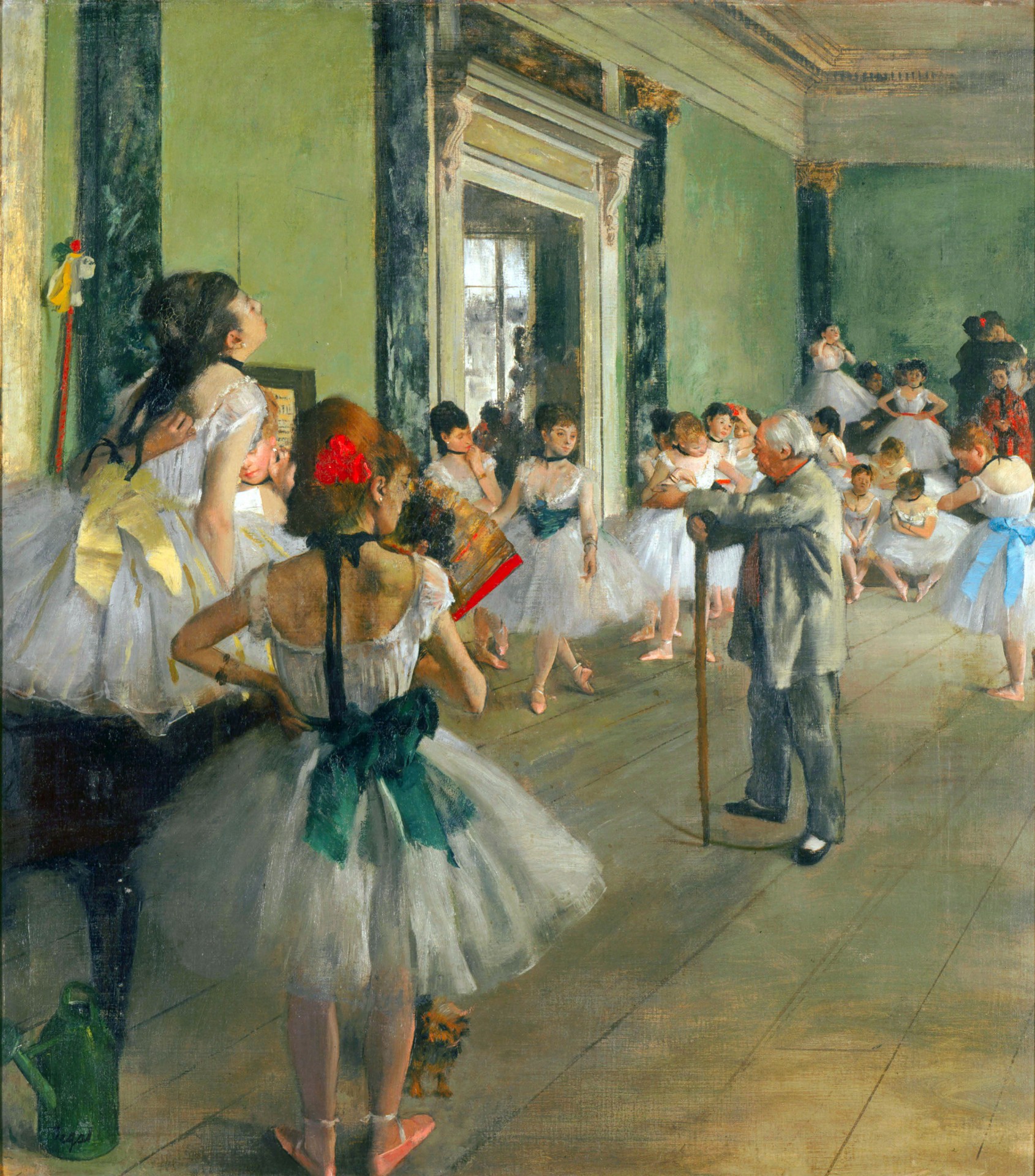
'The Ballet Class' [c1871-1874) by Edgar Degas (b1834-d1917), Oil on canvas, (H) 85 cm; (W) 75 cm

‘The Ballet Class’ [c1871-1874) by Edgar Degas (b1834-d1917), Oil on canvas, (H) 85 cm; (W) 75 cm

Edgar Degas born Hilaire-Germain-Edgar De Gas, 19 July 1834 – 27 September 1917 was a French artist famous for his paintings, sculptures, prints, and drawings. He is especially identified with the subject of dance; more than half of his works depict dancers.”

Opening quotation courtesy of Wikipedia.

Ballet dancers feature extensively by Degas.  Having seen Degas’ work for myself I can irrefutably attest to his awe-inspiring magnificence.  Please let me be clear, I’m talking about breathtaking quality.

The kind of art works that cause me to wonder-at.. much like a child seeing their first puppy.

‘Rover’ a Manchester Terrier popped his adorable puppy head out from our Dad’s coat jacket.  I was about nine years old.  If you had known our first family dog you would have to say his name was perfectly accurate.  Pretty much everyone within our neighbourhood knew him.  Even the butcher ten minutes walk away at the local shops!  Rover had been known to sit outside looking through the window, waiting.

A nearby family watched him enter their open-gated garden, take their large sheepdogs juicy bone from under its nose and leave like the SAS as if nothing had ever happened.  We only knew because they told us – astounded at his sheer audacity!  Rover once got locked in a neighbours garage, barking for a couple of hours to be let out.  They thought it was a neighbours dog, well it was, ours one road and cul-de-sac away.

As children we’d play with our friends and so the opportunity eventually arose for him to craftily sneak off to do ‘Rover’ business.  One of the funniest things was seeing him regularly ‘jogging’ in front of us, tongue-out looking back at us.  Wouldn’t mind except that we were at full speed on our pedal bikes!

Rover – “an animal which ranges over a wide area.”

Degas had a keen interest in gracefulness and the beauty of depicting honesty in his paintings.

‘The Ballet Class’ shown above has an excellent sense of perspective, order and formal instruction as its theme.  The dancers waist bows are multi-coloured with intentional shine or matte finish.  Floorboards and walls would be painted first ready for his complex ensemble of dancers in their individual postures.

Foreground-left, a girl is uncomfortable and fidgety.  Adding to the sense of flexibility and concentration required for intricate ballet moves.  Degas paints intellectual ideas.  Is this the young girl that attends classes for a few weeks then decides it’s not for her?

Her mother might say –  ‘You loved ballet and we brought you all these lovely clothes boutique et al.’

Their ballet teacher is rigid and strictly characterised in polar contrast to the dancers.  We need to ask – was this momentarily observed by Degas or a structured composition by design?

Likely both.

In 2004 I saw an impossible sight of human perception.  I spoke of this phenomenon to a rare few and made especially careful note.  In 2004 I stood by a paint artist working ‘plein air’ in Rhodes not far from the port itself.  Hidden deep was he, peaceful amongst an ‘orchard’ of trees and deep red flowers.  Likely the red hibiscus.

Speaking with the artist whilst he contrived artily of that gorgeous flower, painting also precisely of certain delicate observations.  His brush movements definitive and skilled.

Whosoever can paint as definitely as Edgar Degas deserves to be earnestly proud.  A Realist of his period and highly capable of masterful Impressionist work.

'Achille De Gas' in the Uniform of a Cadet (1856/1857) by Edgar Degas, Oil on canvas, 64.5 cm x 46.2 cm (25 3/8 in x 18 3/16 in)

‘Achille De Gas’ in the Uniform of a Cadet (1856/1857) by Edgar Degas, Oil on canvas, 64.5 cm x 46.2 cm (25 3/8 in x 18 3/16 in)

Achille Degas is his brother.  Posing here relaxed, casual and at ease in his Cadet uniform.

Photographs of paintings allow us glimpses.  Please trust me when I say that having seen ‘The Beggar Woman’ by Edgar Degas for myself that his work defies belief.  Paint has its own texture within oils.  The substance real and magical of properties through the cunning art of visual illusion.

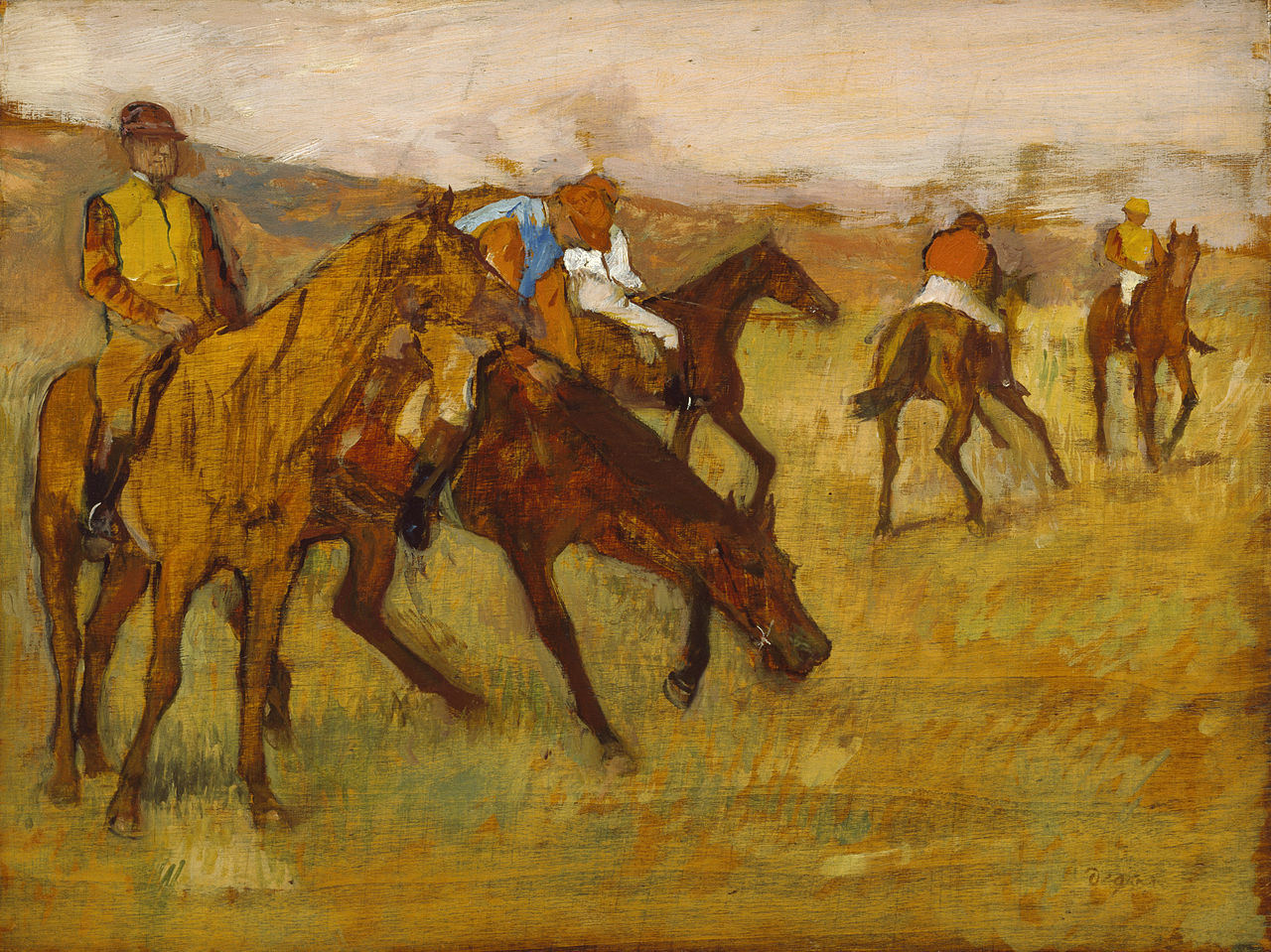
'Before The Race' by Edgar Degas, Oil on panel, (H) 26.4 cm (10.4 in). (W) 34.9 cm (13.7 in)

‘Before The Race’ (1882-1884) by Edgar Degas, Oil on panel, (H) 26.4 cm (10.4 in). (W) 34.9 cm (13.7 in)

Degas produced numerous compositions of horses and their riders.  I chose to include an Impressionist oil painting for this article.  The bowing horse is particularly alive to me.  Living.  Breathing.

That the painting is some 132 years old does not prevent me from wanting to know what on earth he is thinking bucking like this with his rider.  The far-left horse could be viewing the finish line already!  Or perhaps waiting for a gentle squeeze of knees and heels for the cantering.

The chromatic symmetry is a work of art all of its own.  Burnt umbers, oranges and yellows.  It allows for variety as an artist.  Sometimes its good to exclaim ‘What does my sky matter when the foreground subjects become our EVERYTHING.’

Diversity is depth of feelings.

'After The Bath, Woman Drying Her Neck' (1898) by Edgar Degas, (W) 25.59 in x (H) 24.41 in

‘After The Bath, Woman Drying Her Neck’ (1898) by Edgar Degas,
(W) 25.59 in x (H) 24.41 in

The most exciting thing about nude painting?

Naked trust.  Every single time.

Standard

Roots and Daisies

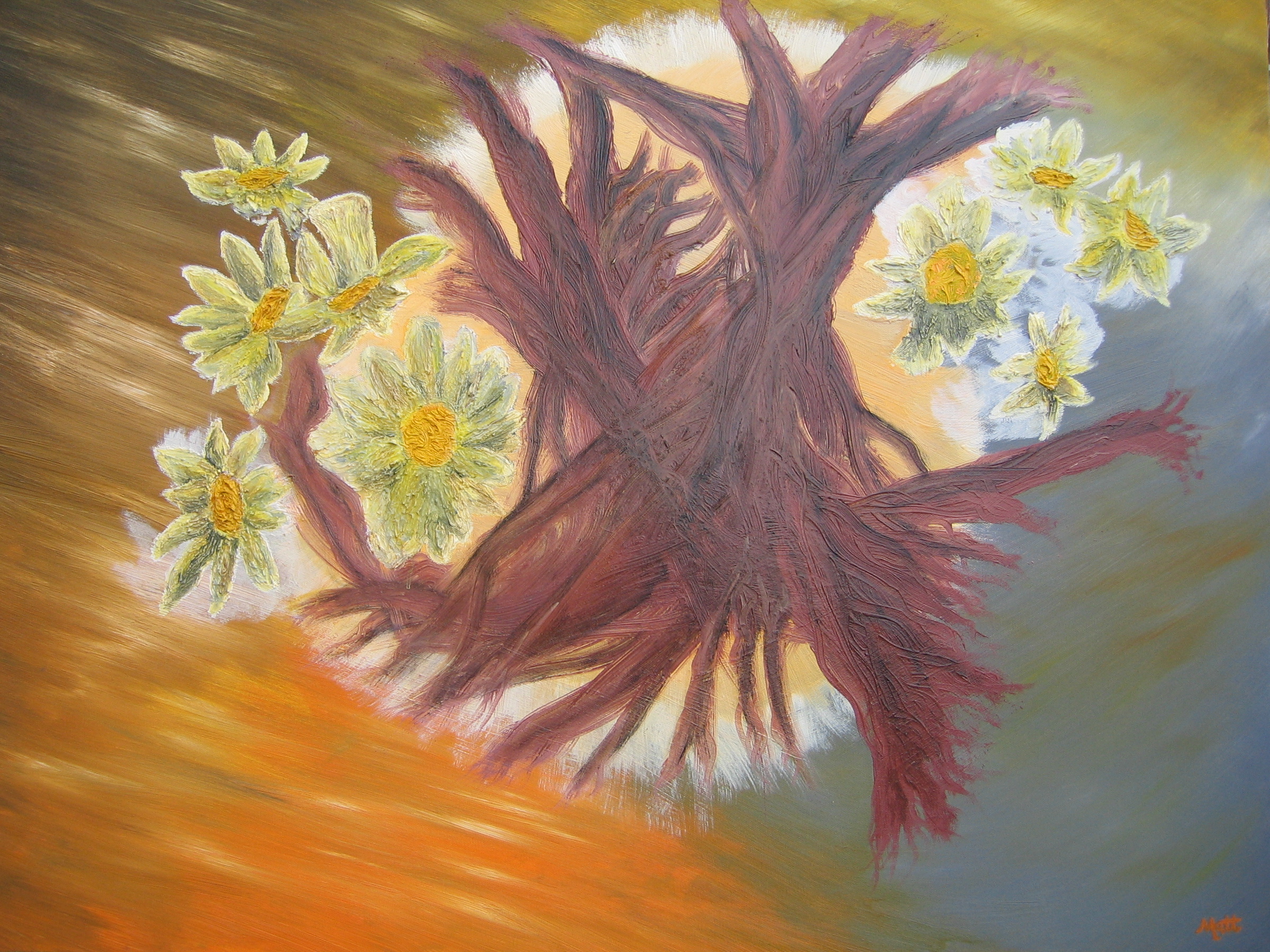
I guess that most artists plan their compositions.  I’m usually no exception to this method of working.  That is until ‘Roots and Daisies’ kind of happened, shown below here:

Roots and Daisies, 2013
“Roots and Daisies” [5th March to 19th March 2013] by Matt The Unfathomable Artist, Oil on canvas, 40 inches x 30 inches.

The composition for ‘Roots and Daisies’ was always intended to actually represent daisies.  I purchased daisies for this express purpose and photographed them in various arrangements on a table.

For me it made sense to create this artwork somewhat different.  To tell you a story.

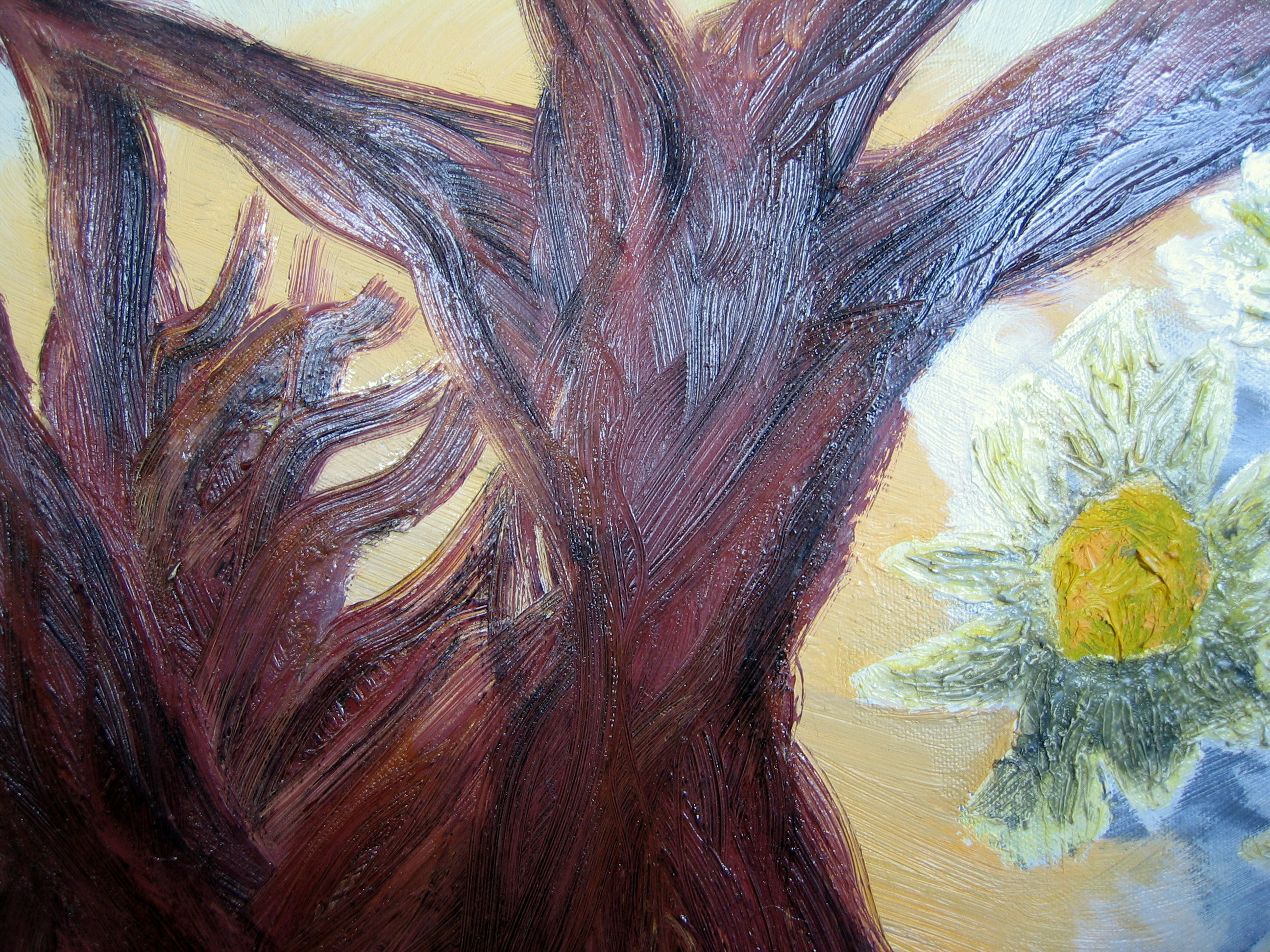
Here is a close up of the artwork roots:

Roots and Daisies, roots in detail.

Please notice the texture, brush lines and cascading light effects.

Again, as with the haze of confusion that I described in an earlier blog [see Art in the Making referring to ‘Creative Mind’] I became absorbed whilst painting the roots in this artwork.  Very much experimentation to find shapes and lines that I found most agreeable.

Overlapping the roots was quite delicious as I continued working with a syrupy linseed oil.  To me as pleasurable as eating figs.

The brush beautifully flowed in immensely relaxing canvas moments. Adding darker paints mostly to the right hand side of the many roots to bring forward depth and solidity.  The roots scattered about like an ancient story of thousands of years passing by.

A composition derived from a 4th March 2013 photograph of a floral arrangement.

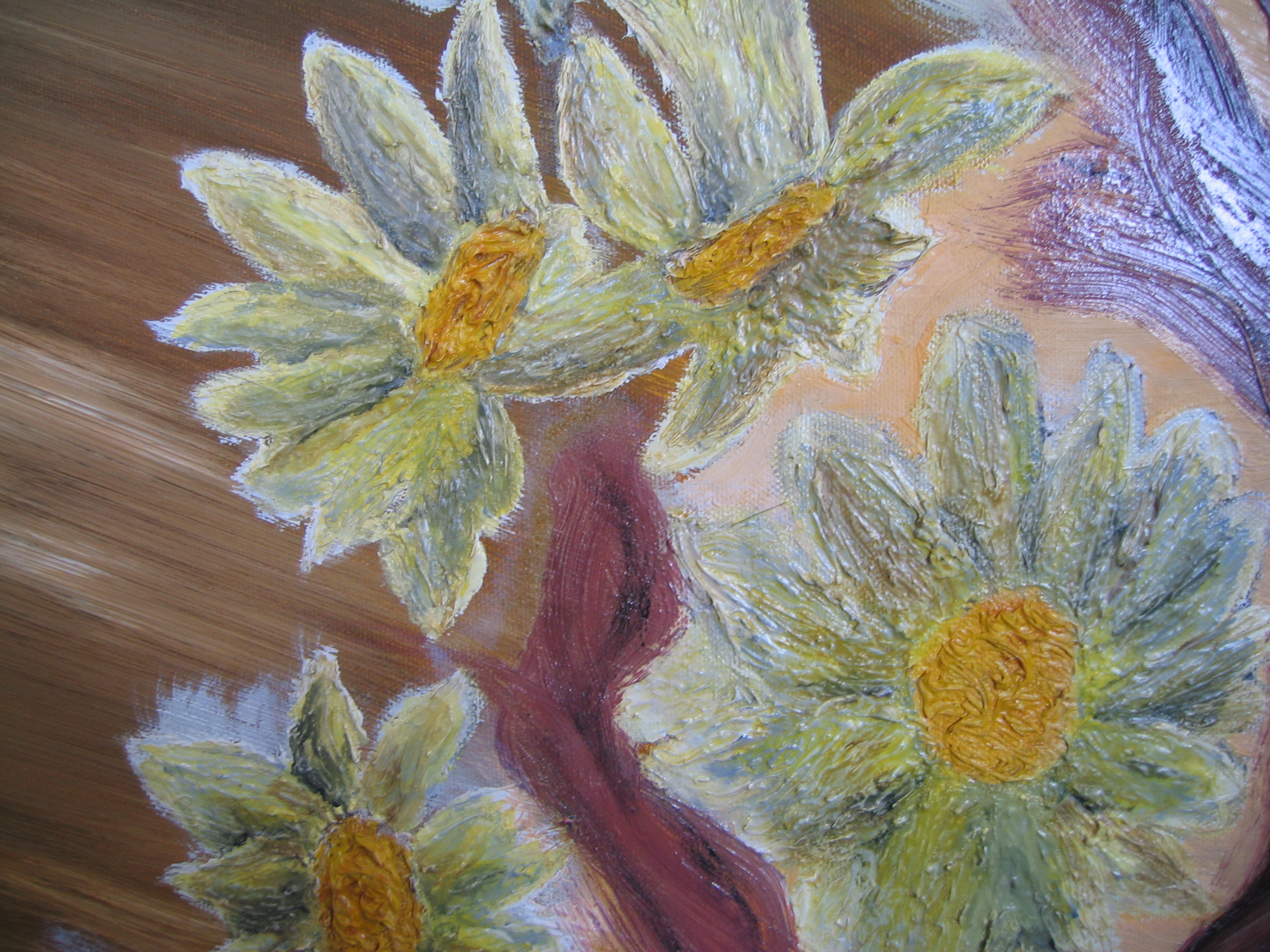
Here is a close up of the left-side daisies:

Roots and Daisies, detail of four daisies with one root amidst.

It would be so lovely to be to Light as Van Gogh is to Sunflowers.

I really do hope you like this composition.

Standard