Kieron After Claude

“Cattle Walking At St Benet’s” [2015] by Kieron Williamson, Oil on canvas, 16ins x 22ins.

Having viewed John David Ratajkowski’s beautifully charming ‘Cow Tuesday’ art pieces online I thought it would be interesting for me to include “Cattle Walking At St Benet’s” by prodigious child artist Kieron Williamson.

Artists incorporate a unique personality and stylistic signature to their artworks.  Art experts know a John Ratajkowski artwork from a Kieron Williamson, a Basquiat from an Andy Warhol.

All masterful artists in their own right.

Where do I begin writing about an artist whom at six years of age was already exciting prospective buyers into making sealed bids for his artwork?

His lifetime earnings have exceeded £2.5 million.. and Kieron is still only 14 years old!

‘I guess’, said the movie veteran, that when you make a child genius we should always appreciate that their early talents have also likely been nurtured from a very young age.  Even so, they are undoubtedly born this way.

Like Justin Bieber musically.. and beyond.

“Cattle Walking At St Benet’s” is glorious.  Cows have that remarkable quality of looking at us pensively.  They’re immensely trusting.  Chewing the cud they couldn’t care less what was going on in another field, sheep grazing by their side.

Kieron’s artwork above captures the layperson’s idea of cows.  Aloof, awkwardly thoughtful and at great efforts in movement at everything until perhaps the Farmer calls.  That’s how I see it.

Then again, I breathe art every single day of my life.  Kieron and John too.
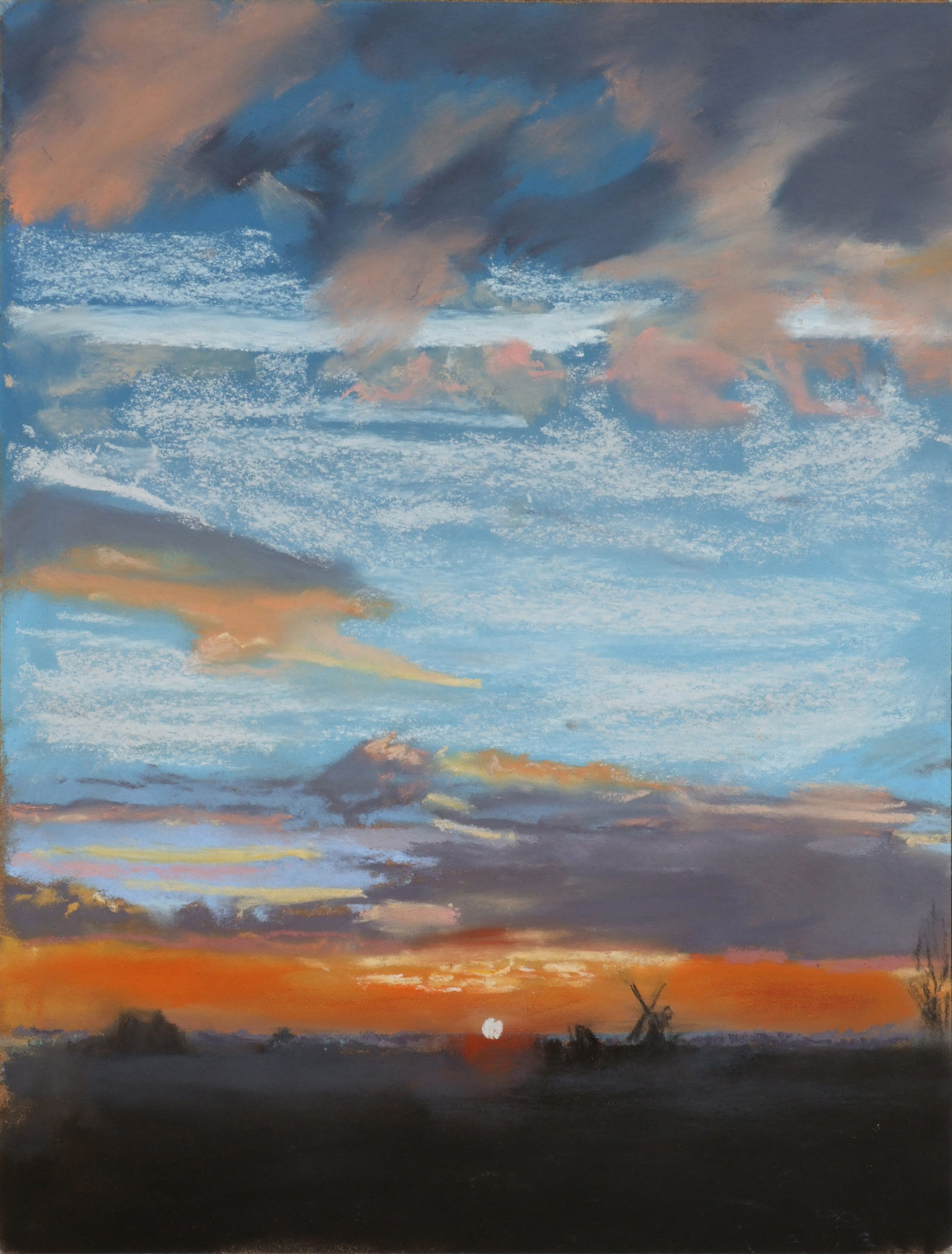
“Dramatic Sunset” [2009] by Kieron Williamson, Pastel from his 2nd Exhibition, 14 ins x 10 ins.

Immediately above is an astoundingly mature artwork by Kieron Williamson when he was just seven years old.  I encourage you to look online to see his people-in-rural-landscapes work.

This sunset pastel is one of my favourite sky scene artworks, ever.  I’m trying to bring forward words to describe here what I’m seeing.  Artists study artists and none more so than lifelong famed British artist David Hockney.

Therefore I can say that this sunset pastel has become ‘pools and portraits’ to the art world in my opinion.  KRW Esq, if you will.
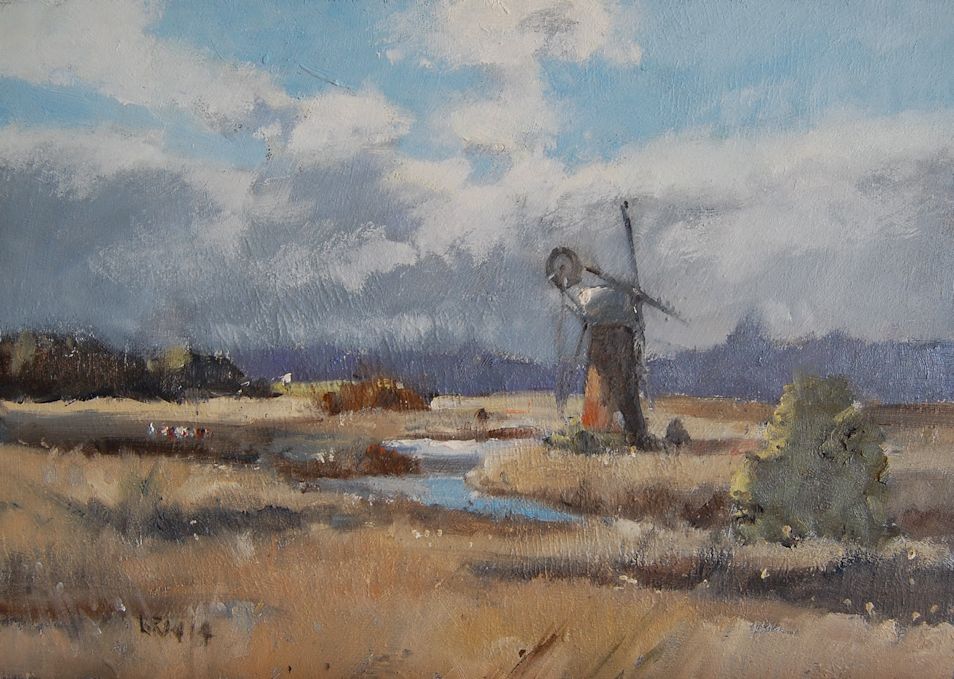
“Distant Cattle” [2014] by Kieron Williamson, Oil on board, 10 ins x 14 ins.

The above artwork “Distant Cattle” contains intense drama.  The wind could be roaring any moment soon.  Those approaching clouds might loom as a thunderous downpour.  This painting is about our relationship with the environment.  How it makes us feel.

‘Urgency mixed with the oils of imperturbability’. 

Thanks Kieron, I’ve hyphenated this new saying as it sounded, dare I say of classic landscape art, inspirationally cool.

JMW Turner’s are cool.  And Hockney too.

Imperturbability, he said.  Oh how this most unusual word somehow reminds me of Roald Dahl and all his wonderful children’s books.

“London Monotone Figure” [2013] by Kieron Williamson, Oil on board, 10 ins x 14 ins.

I continued to sit back in my chair whilst I first viewed “London Monotone Figure” on Kieron’s website:

http://www.kieronwilliamson.com

Anyone familiar with my photography will probably understand why for interconnective reasons:
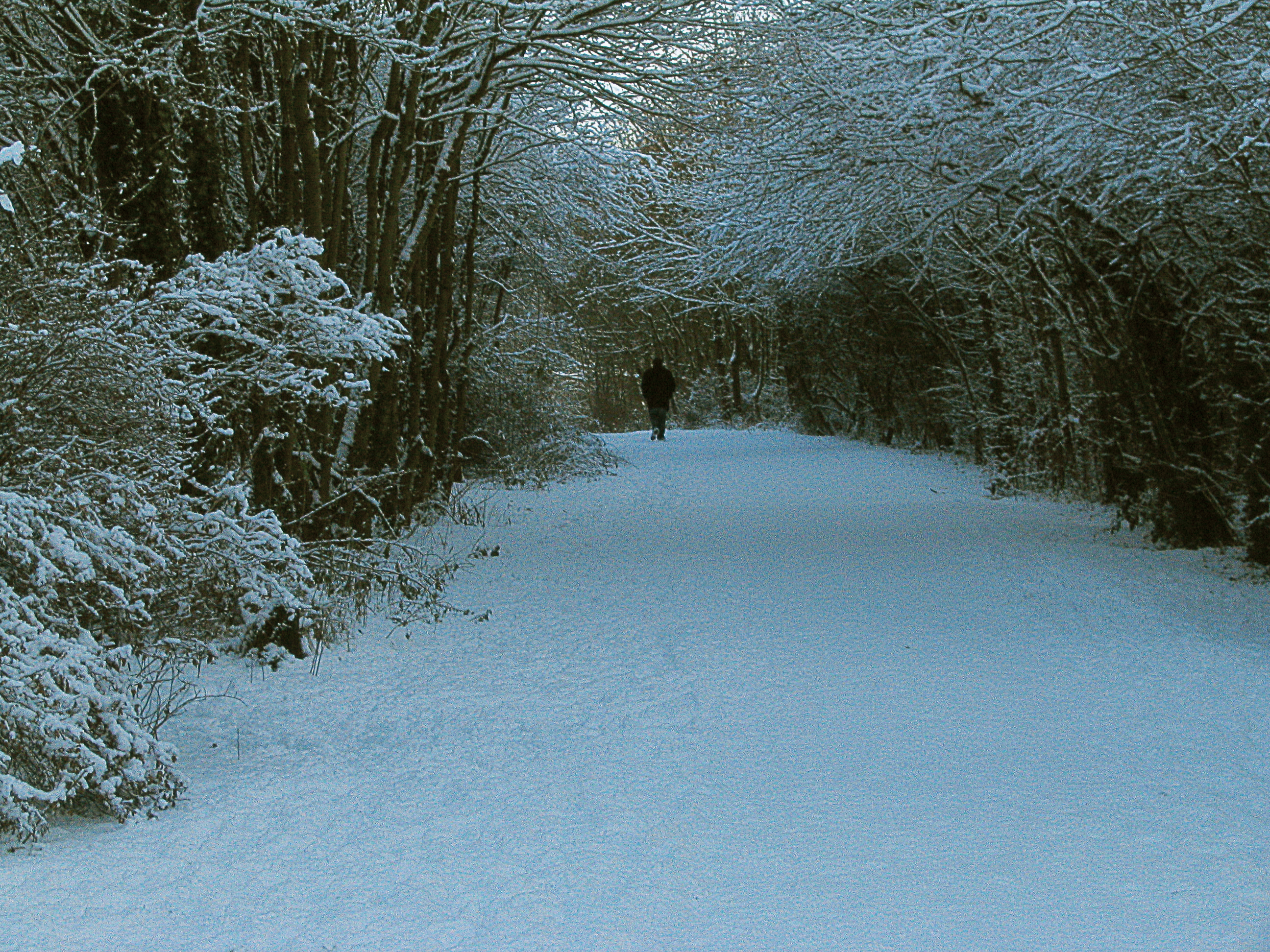
“The Snow Walker” [photographed 6th January 2010, 1635hrs] by Matt The Unfathomable Artist,.  Unknown man walking near and to my hometown local lake.

Interconnective reasons of Imagination and Reality.

You see, at around 9 years of age I was by my own personal request gifted with a children’s book about spycraft.  It was for Christmas that year I think.

Can I please imagine that the solitary figure in Kieron’s painting is a spy vanishing into London’s misty void? Okay, he might be an old man.. in disguise?  Or a blind man tapping his way along the murky pathway?  Kieron’s painting allows artistic licence for our imagination.

Which brings me to my next interconnective thought..

..The 1927 film ‘Metropolis’ by Fritz Lang was my Dad’s favourite movie.  He owned the complete film on video.

The full movie is itself a work of art, inspirational even to this day.  I’ve no doubt my Dad saw a simile of his own mother and father in the film.  Yes a good likeness of character, a simile of my Gran and Grandad.  I’m absolutely certain of this.

M and the spy movie genre began to find its place in film art history.

“London Monotone Figure” is also a superior artwork.  Its simplicity and complexity.  A bluish-grey gun metal palette.  Mysterious, Spooky, Ghostly.  Absolutely charming, characterful and inventive of Kieron’s design.

Kieron Williamson is producing masterpieces in a consistent manner with the dexterity of past greats such as Carlos de Haes.

Here’s to a superb “Family Gathering” as we check the “View From A Window” at “Day’s End, Norfolk” just wishing for the “Blakeney Sunrise” to arrive.

Standard

‘The Foundlings’ – A Poem by Matt

'The Starry Night' [1889] by Vincent Van Gogh, Oil on canvas, 29 in ×  36 1⁄4 in.

‘The Starry Night’ [1889] by Vincent Van Gogh, Oil on canvas, 29 in ×  36 1⁄4 in.

Today I am inspired by three Friends, a Singer, a Painter, the Sons and Daughters of Humankind.

“The Three Desolates in Sight,

A multitude of dwellings readied for sand and clay,

The Foundlings.

A block made by Humankind, its breathing within.

First it’s blow an astonishment,

The building Hammer swift and unyielding for the Second strike.

Those that move around with camels make ancient cakes,

Feet sprout downwards strong as fig roots into the ground.

Palatial Grasses overgrow Dusts by the Water from its Rivers old.

Smiles are The Starry Night,

Peoples of the Vineyards and their Storehouses gather,

Trees spring forth for The Yellow Moon.

Their long necks are made happy,

As Thorns are gathered up for dung.

Even The Horned One recovers and the Grey Tail finds peace.”

– ‘The Foundlings‘ poem by Matt The Unfathomable Artist, Copyright © 9th February 2017.

Standard

Pip McGarry – International Wildlife Artist Extraordinaire

"White Rhino, Lake Nakuru" by Pip McGarry, Oil on canvas, 20in x 18in, Sold at Sotheby's February 1999.

“White Rhino, Lake Nakuru” by Pip McGarry, Oil on canvas, 20in x 18in, Sold at Sotheby’s February 1999.

Choosing Pip McGarry for the express purpose of bringing art and wildlife conservation commentary into my blog took me about 30 seconds.

If it takes former Navy SEALs, ex Marines and Army veteran’s to protect the world’s endangered wildlife heritage then so be it.  Recently I’ve been extremely heartened by international Governmental policies regarding the humane treatment of animals.

Such changes take courage, strong effort and time.

Educating people about the importance of wildlife conservation, ecological recycling and food sustainability is one of the greatest challenges for the human race.

Pip’s work has the capacity to move us into seeing the astounding beauty of our natural world.  Booking your wildlife adventure will help countries unlock the full potential of their ecological economy.  Not just Africa and India, everywhere.

Zoom in at the macro level.  Take in the wider picture.

For younger readers especially I’d like to mention that I loved reading Willard Price adventure books whilst I was at mid-schooling age.  Ferocious and informative, exciting and action packed.  Writing and reading is for everyone to enjoy.

“White Rhino, Lake Nakuru” is a masterful painting of a solitary white rhino seemingly asking us about its future.  Certainly for the Northern White Rhino this could not be more pertinent.  Can we allow poaching to ravage our natural wildlife indefinitely?

The stylish colour paintwork, expression and personality of these graceful creatures make this artwork a forever classic like “Bedknobs and Broomsticks” (1971).

Hopefully you will find your Isle of Naboombu and I’m quite sure your local travel agent would find your itinerary an interesting challenge.

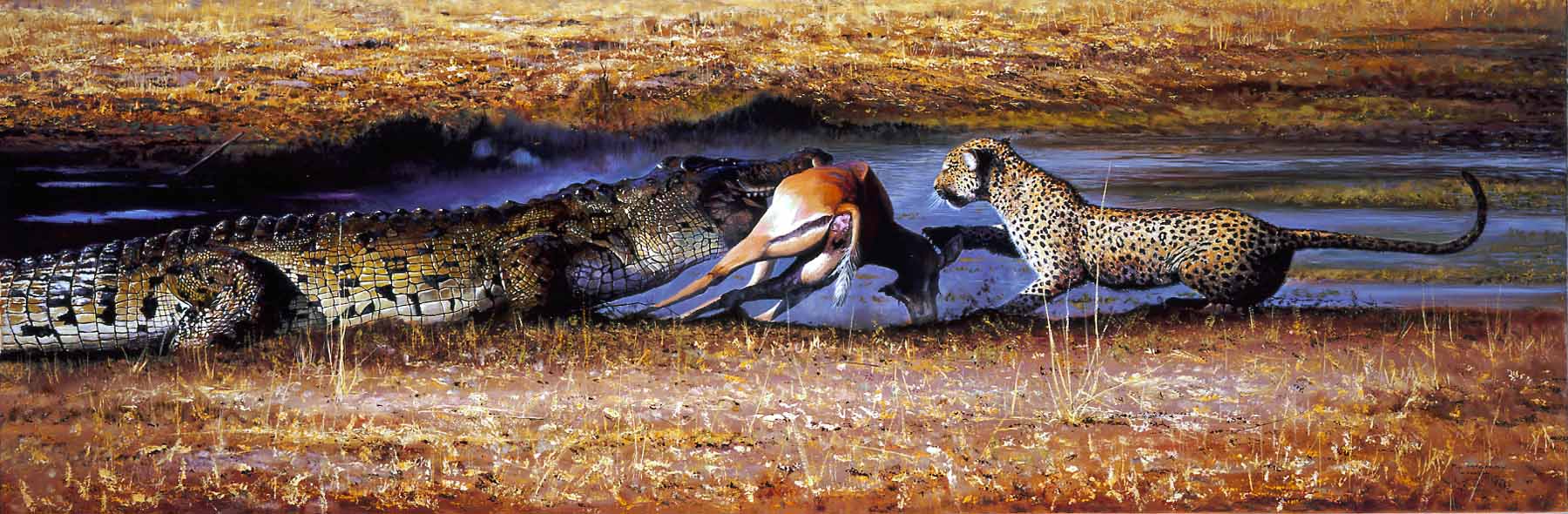
"Winner Takes All" by Pip McGarry, Oil on canvas, 60in x 20in, Sold to Private Collector.

“Winner Takes All” by Pip McGarry, Oil on canvas, 60in x 20in, Sold to Private Collector.

In the artwork above, “Winner Takes All” we see a hefty tug of war for any leopard to take on!

The hyper-realist detailing of this magnificent reptile’s scales and the width ways composition give this piece dramatic flair.  The sunlight reflecting from its mighty tail adds to the display of artistry.

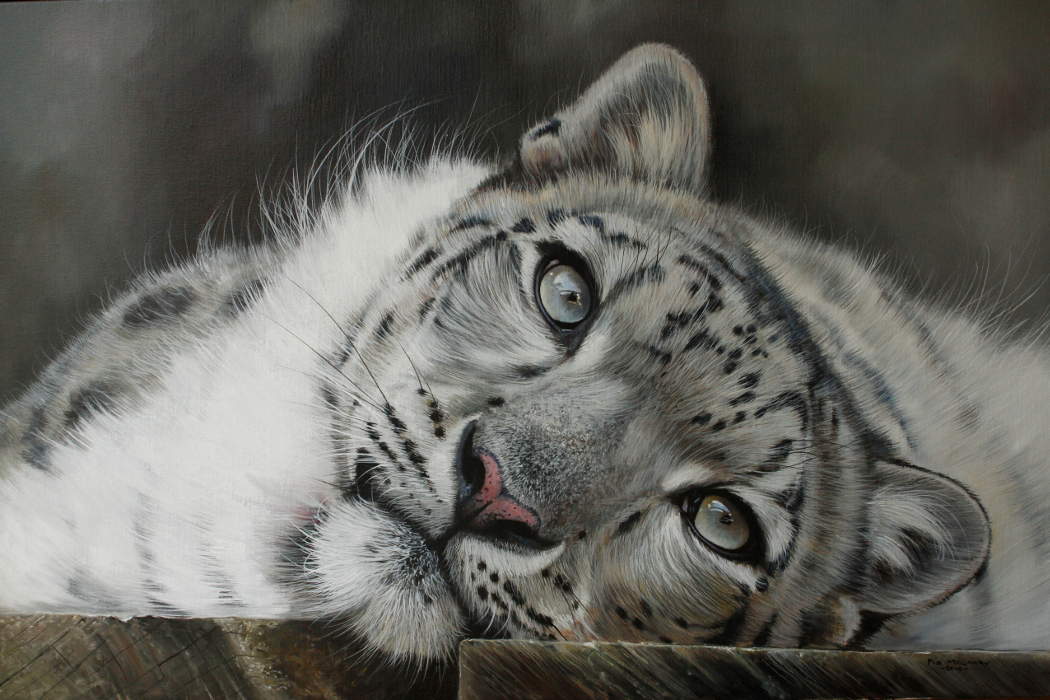
"Chilling Out" by Pip McGarry, Oil on canvas, 30in x 20in.

“Chilling Out” by Pip McGarry, Oil on canvas, 30in x 20in.

Snow leopards have always been one of my wildlife favourites.  Their elusive, specialist quality and patient nonchalence is breathtaking to watch.  The speed and fearless nature of their hunger-driven rocky descents into chasing mountain goats is a sheer cliff hanging sight to behold.

A Snow Leopard at relaxed ease like this in “Chilling Out” is a perfectly adorable painting.  Immediately this painting won me over.  Snuggling up to a snow leopard would be a dream come true.

Although definitely not for the faint-hearted.

Painting the intricacy of fur requires a lightness of strokes and wispy handling.  Selecting the best brush for the work is essential. Particularly noticeable to me is his usage and treatment of light throughout his work.  Strong noon sunlight contrasted with evening hues synonymous with the African plains and tropical landscapes.

Pip McGarry is expertly accustomed to using techniques to fine tune adjustments in texture, tone and density for his paintings.  Pip is also a highly accomplished art teacher with on-safari and studio workshop teaching experience encompassing two decades.

The snow leopard’s eyes in “Chilling Out” are completely alive, three dimensional and ponderous.

"Zebras Drinking, Namibia" by Pip McGarry, Oil on canvas, 30in x 20in, Sold at Summer Exhibition 2003.

“Zebras Drinking, Namibia” by Pip McGarry, Oil on canvas, 30in x 20in, Sold at Summer Exhibition 2003.

“Zebras Drinking, Namibia” is compositional brilliance almost entirely in black and white.  This painting demands that our brains make sense of each individual zebra.  Where one starts and where the other outline ends.  Very clever and uniquely distinct.

If property value is based on ‘Location, Location, Location’ then realist art value is based upon ‘Composition, Composition, Composition’.

You cannot better perfection.

Only then can we begin to compute the hyper-realist quality, their water drenched muzzles and trusting comradery.  Thirstiness as a splashing of the liquid surface.  Absolute markings around the head and necks ‘like fingerprints and stars’.

Pip McGarry has extensive wildlife television experience including judging “Wildlife Artist of the Year” for the British Broadcasting Corporation.  He has also been the Artist-in-Residence at Marwell Zoological Park in Hampshire, England for fifteen years.

You can see more about Pip and his artwork at his website here http://www.pipmcgarry.com/index.htm

Standard

The Edgar Degas Art Ballet

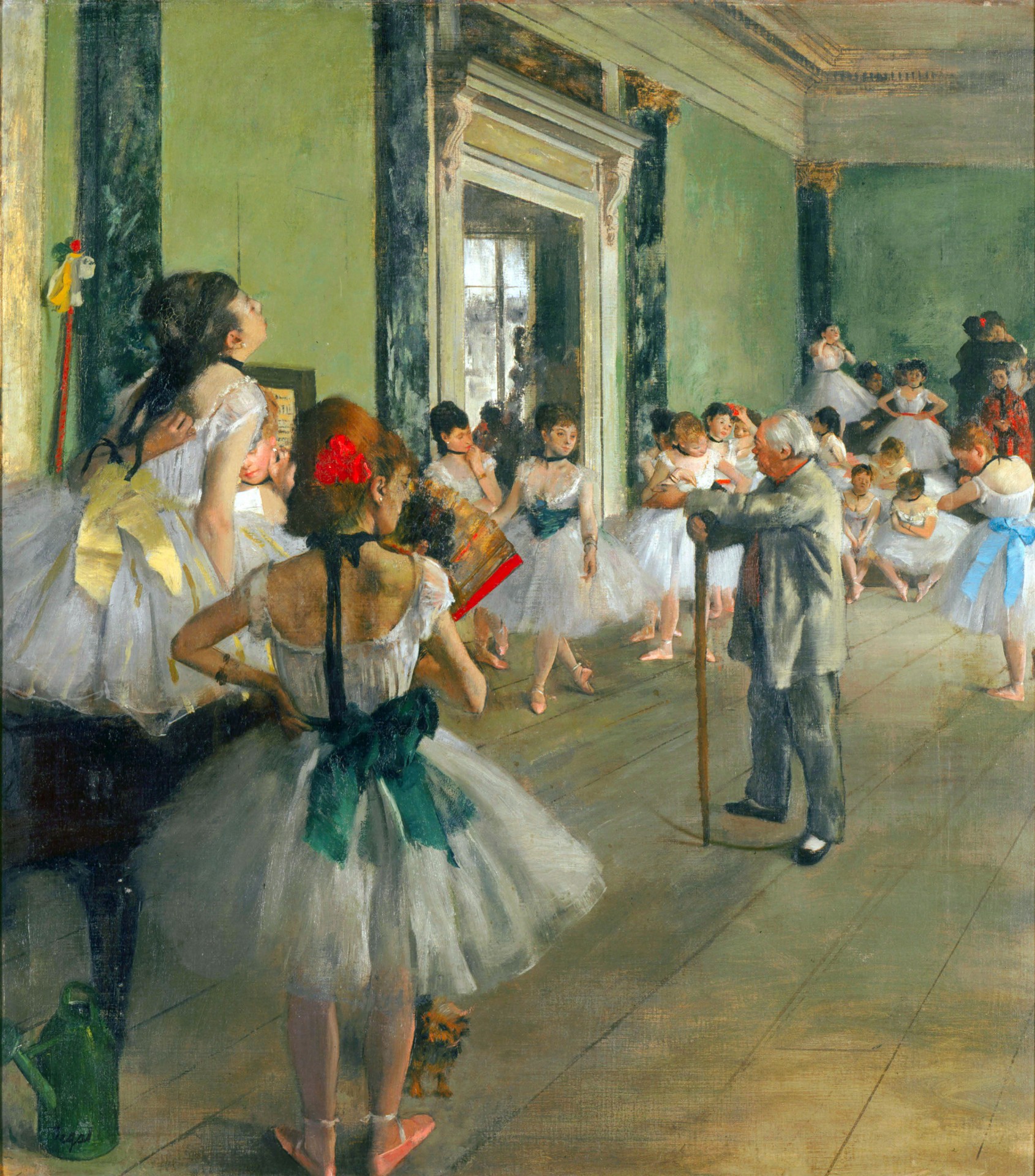
'The Ballet Class' [c1871-1874) by Edgar Degas (b1834-d1917), Oil on canvas, (H) 85 cm; (W) 75 cm

‘The Ballet Class’ [c1871-1874) by Edgar Degas (b1834-d1917), Oil on canvas, (H) 85 cm; (W) 75 cm

Edgar Degas born Hilaire-Germain-Edgar De Gas, 19 July 1834 – 27 September 1917 was a French artist famous for his paintings, sculptures, prints, and drawings. He is especially identified with the subject of dance; more than half of his works depict dancers.”

Opening quotation courtesy of Wikipedia.

Ballet dancers feature extensively by Degas.  Having seen Degas’ work for myself I can irrefutably attest to his awe-inspiring magnificence.  Please let me be clear, I’m talking about breathtaking quality.

The kind of art works that cause me to wonder-at.. much like a child seeing their first puppy.

‘Rover’ a Manchester Terrier popped his adorable puppy head out from our Dad’s coat jacket.  I was about nine years old.  If you had known our first family dog you would have to say his name was perfectly accurate.  Pretty much everyone within our neighbourhood knew him.  Even the butcher ten minutes walk away at the local shops!  Rover had been known to sit outside looking through the window, waiting.

A nearby family watched him enter their open-gated garden, take their large sheepdogs juicy bone from under its nose and leave like the SAS as if nothing had ever happened.  We only knew because they told us – astounded at his sheer audacity!  Rover once got locked in a neighbours garage, barking for a couple of hours to be let out.  They thought it was a neighbours dog, well it was, ours one road and cul-de-sac away.

As children we’d play with our friends and so the opportunity eventually arose for him to craftily sneak off to do ‘Rover’ business.  One of the funniest things was seeing him regularly ‘jogging’ in front of us, tongue-out looking back at us.  Wouldn’t mind except that we were at full speed on our pedal bikes!

Rover – “an animal which ranges over a wide area.”

Degas had a keen interest in gracefulness and the beauty of depicting honesty in his paintings.

‘The Ballet Class’ shown above has an excellent sense of perspective, order and formal instruction as its theme.  The dancers waist bows are multi-coloured with intentional shine or matte finish.  Floorboards and walls would be painted first ready for his complex ensemble of dancers in their individual postures.

Foreground-left, a girl is uncomfortable and fidgety.  Adding to the sense of flexibility and concentration required for intricate ballet moves.  Degas paints intellectual ideas.  Is this the young girl that attends classes for a few weeks then decides it’s not for her?

Her mother might say –  ‘You loved ballet and we brought you all these lovely clothes boutique et al.’

Their ballet teacher is rigid and strictly characterised in polar contrast to the dancers.  We need to ask – was this momentarily observed by Degas or a structured composition by design?

Likely both.

In 2004 I saw an impossible sight of human perception.  I spoke of this phenomenon to a rare few and made especially careful note.  In 2004 I stood by a paint artist working ‘plein air’ in Rhodes not far from the port itself.  Hidden deep was he, peaceful amongst an ‘orchard’ of trees and deep red flowers.  Likely the red hibiscus.

Speaking with the artist whilst he contrived artily of that gorgeous flower, painting also precisely of certain delicate observations.  His brush movements definitive and skilled.

Whosoever can paint as definitely as Edgar Degas deserves to be earnestly proud.  A Realist of his period and highly capable of masterful Impressionist work.

'Achille De Gas' in the Uniform of a Cadet (1856/1857) by Edgar Degas, Oil on canvas, 64.5 cm x 46.2 cm (25 3/8 in x 18 3/16 in)

‘Achille De Gas’ in the Uniform of a Cadet (1856/1857) by Edgar Degas, Oil on canvas, 64.5 cm x 46.2 cm (25 3/8 in x 18 3/16 in)

Achille Degas is his brother.  Posing here relaxed, casual and at ease in his Cadet uniform.

Photographs of paintings allow us glimpses.  Please trust me when I say that having seen ‘The Beggar Woman’ by Edgar Degas for myself that his work defies belief.  Paint has its own texture within oils.  The substance real and magical of properties through the cunning art of visual illusion.

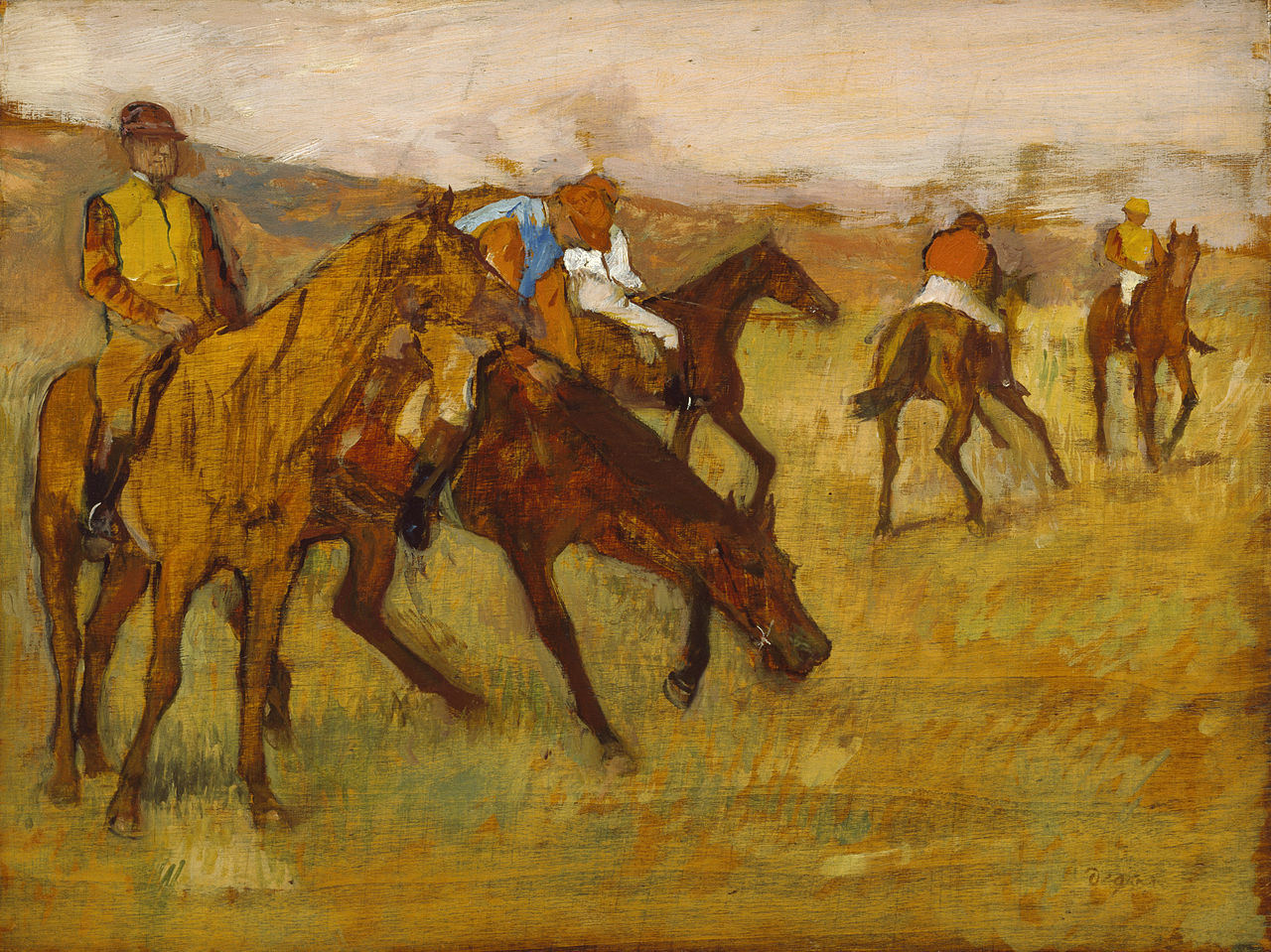
'Before The Race' by Edgar Degas, Oil on panel, (H) 26.4 cm (10.4 in). (W) 34.9 cm (13.7 in)

‘Before The Race’ (1882-1884) by Edgar Degas, Oil on panel, (H) 26.4 cm (10.4 in). (W) 34.9 cm (13.7 in)

Degas produced numerous compositions of horses and their riders.  I chose to include an Impressionist oil painting for this article.  The bowing horse is particularly alive to me.  Living.  Breathing.

That the painting is some 132 years old does not prevent me from wanting to know what on earth he is thinking bucking like this with his rider.  The far-left horse could be viewing the finish line already!  Or perhaps waiting for a gentle squeeze of knees and heels for the cantering.

The chromatic symmetry is a work of art all of its own.  Burnt umbers, oranges and yellows.  It allows for variety as an artist.  Sometimes its good to exclaim ‘What does my sky matter when the foreground subjects become our EVERYTHING.’

Diversity is depth of feelings.

'After The Bath, Woman Drying Her Neck' (1898) by Edgar Degas, (W) 25.59 in x (H) 24.41 in

‘After The Bath, Woman Drying Her Neck’ (1898) by Edgar Degas,
(W) 25.59 in x (H) 24.41 in

The most exciting thing about nude painting?

Naked trust.  Every single time.

Standard

Darren Baker Prime Real Estate

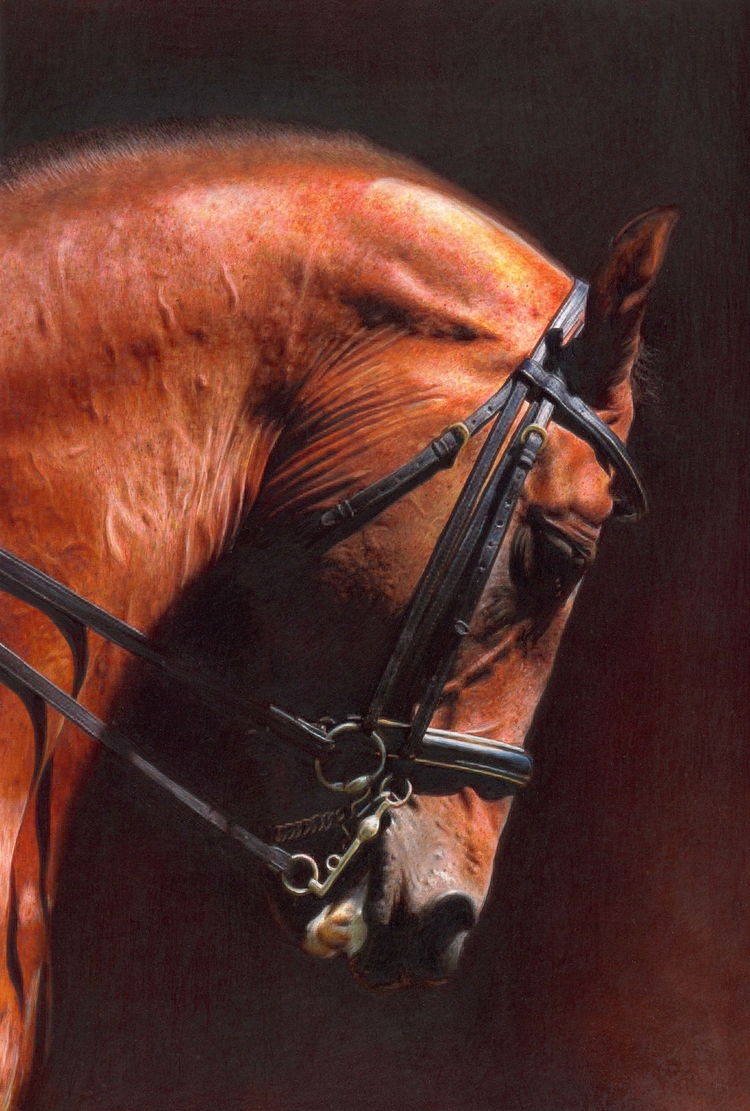
'Classical Horse' on canvas by Darren Baker, 36 in x 48 in

‘Classical Horse’ on canvas by Darren Baker, 36 in x 48 in

I wonder how especially delighted Equestrian art admirers would be for the opportunity of British artists Darren Baker and Sally Lancaster to produce an Art Exhibition together?

'Champagne' by Darren Baker, Oil on canvas, 28 cm x 40 cm

‘Champagne’ by Darren Baker, Oil on canvas, 28 cm x 40 cm

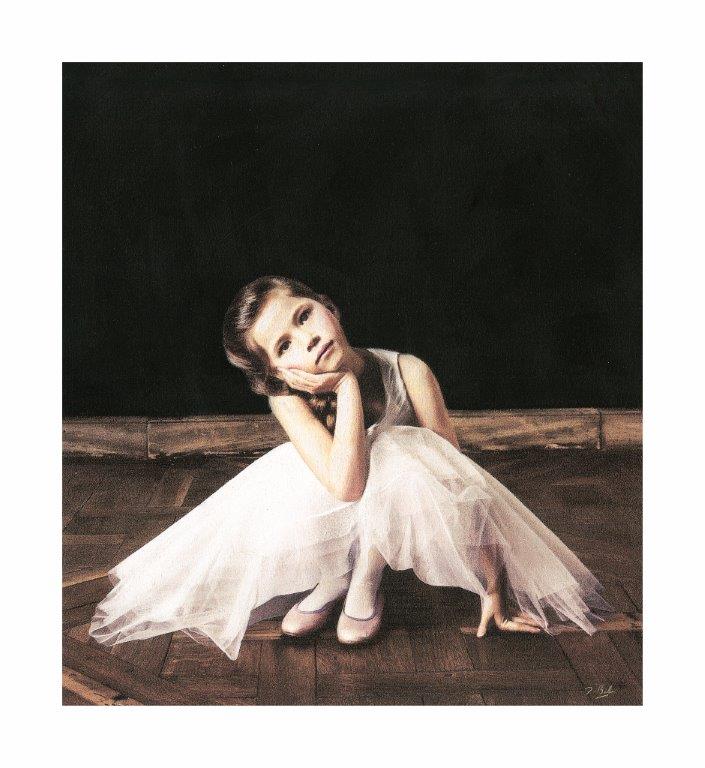
Ah, the Result.  Just look at our ‘Sweet Ballerina’ shown below, waiting patiently.

'Sweet Ballerina' by Darren Baker, 23 cm by 20 cm

‘Sweet Ballerina’ by Darren Baker, 23 cm by 20 cm (image shown with white border)

My favourite artists evoke an extraordinary sense of admiration.  Power of artistic quality.  Flair for vivid imagination.  Incredulous symbology.  Compositional genius.  Weightiness of message.

Darren Baker pushes the boundaries of hyperrealism straight up into the stratosphere.

Having actually experienced an olfactory moment whilst looking at an image of onions Darren Baker had painted is certainly profound.

Suddenly whilst writing this piece the artist John W Waterhouse has leapt into my mind.  The weightiness of Darren Baker’s technique allows comparison.  To appreciate my thinking further please read:

https://theunfathomableartist.wordpress.com/2014/08/21/john-w-waterhouse-the-lady-of-shalott/

And then we return to Darren Baker.

What makes my ‘olfactory moment’ intriguing is that I have anosmia.  Long attributed by myself as occurring from about 7 years of age.  Regrettably my olfactory sense is therefore extremely finite.  Only strong chemical smells can cause me to briefly capture the fleeting note of an aroma.

Vinegar and onions for instance.

Darren has either purposed to accomplish this olfactory wonder and/or his Realist crafting is so highly tuned that the subject detailing causes complimentary senses to become involved.  An artistic crafting of visual-memory triggers linked to additional senses other than sight and touch is certainly a commendable talking point.

Yet I speak from personal experience.  Perception being the culmination of all cognitive reasoning gathered together at the blink of an eye.  The sixth sense if you will.  Intuition.

Darren Baker is already demonstrating his capability at creating art that includes the sense of touch relative to the people, subjects or objects on view.  By sight.

Encourage and be encouraged.

Having felt the power of horses and the gracefulness of dancers myself.

To conjure a sense without the sense itself is a sheer feat of hand-to-brush-to-canvas wizardry.  Entirely at the forefront of Realist painting is the believability of depth and touch.  Highly delineated imagery presented conceivably.

Would it be correct to explain Realist art viewing as first ‘touching as if with one’s eyes?’.

Like the bonfire I did not turn aside from gazing towards in close proximity at 7 years of age.  The alluring art I could see dancing as fire-crackling mercilessly against a mountain of wood.  Interestingly at this same age I gazed surreally upon a low slung Sun in the sky, pausing whilst playing with friends.  Pondering its defiant blazing absurdity.

I find the whole idea that Darren has engineered onions and vinegar into compositional art recipes fascinating.  Look at the popularity of cookery shows we see in the televised media.

We love our international food heritage.

Few can hold their work up to the light with the Michelin Stars quality of excellence that Darren Baker boasts modestly through his paintings and eclectically acclaimed client list.

'Venice' by Darren Baker, pastel, 20cm x 25 cm

‘Venice’ by Darren Baker, pastel, 20 cm x 25 cm

Darren Baker’s work is unquestionably hyperrealist in quality.  The depth of field within ‘Venice’ shown above is a Smörgåsbord of places to explore with our eyes.  Reach out to touch your own, personal.  Painting.  Someone who cares for their art.

Realist painters often draw out the extraordinary from the seemingly ordinary.  In 50 years time Darren Baker will have future generations writing and commenting about his work.

The super-impressive charm of paintings such as ‘Herb Garden’ and ‘Breakfast Tea’ first caught my attention and proclamation of awe.  Successful commissions for Her Majesty Queen Elizabeth II, the Bahrain Royal Family and a recently opened Darren Baker Gallery in London 2014 speak volumes.  His exemplary talent and ultra-professionalism garnishing favourable influence.

Quite rightly the work of Edgar Degas follows in my next post.

Standard

Songwriting Mood With Added Swings, Dali-cious

Inspiration is often like the dances of butterflies.  Pretty and irrevocably beautiful.  Whilst I’m eager to paint soon, creating new song ideas and musical compositions has been lots of fun.

Most songwriters enjoy various layers of thought to their songs and I’m definitely no exception.  As a boy of three years of age I was, I’m told, a fan of Abba and Queen’s ‘Bohemian Rhapsody’.  I know this to be true.

Working out everything with reference to the latter lyrics was extremely satisfying, especially when my thoughts were rightly confirmed quite some time afterwards.

I recall a famous guitarist from another rock band stating that there was no way their lead singer could possibly have much meaningful sense or reason to some of the lyrics he had jotted in a mere matter of minutes.

I dissect whatever seems reasonable to gain an understanding of individual people.  Really though, can anyone know you better than yourself?

The strangest new chorus came to my mind the other day:

‘Have you seen the Cannibal?
Lurkin’ wanton inside your skull,
It’s kind of grey and alien!
Feedin’ on bloods limitation

Don’t get caught, don’t get scared
Cos when its hungry it don’t care
It’ll-sweep-you-off-the-floor, with.. your.. bones,
Its gaze turns your body putrefied Auld,
Like Seventy Nine to the Power of Ten’

Matt, The Unfathomable Artist – Copyright © 10th April 2015

Standard

Arcimboldo Assimilated

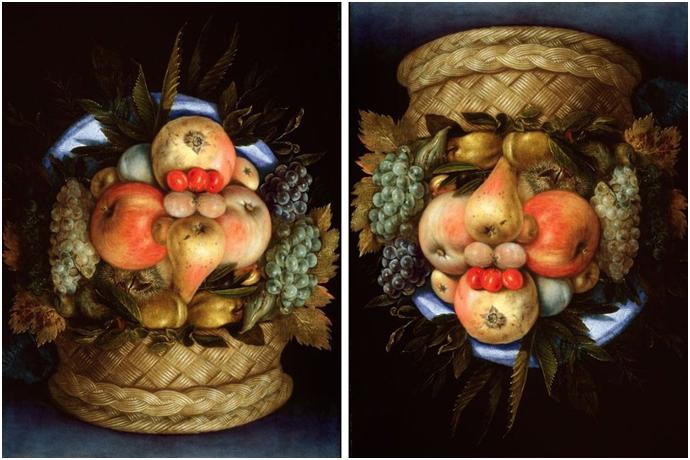
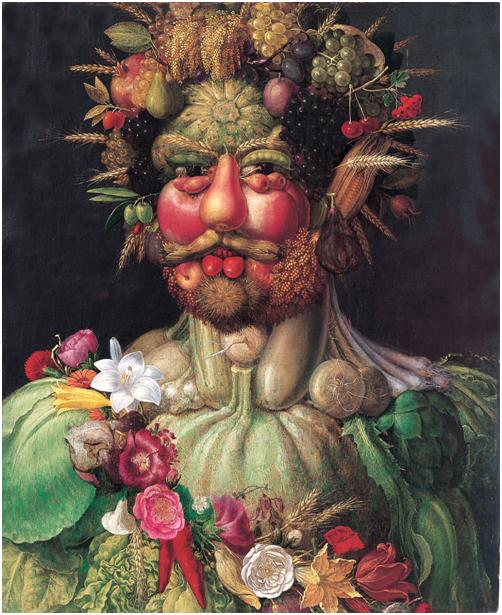
Pictured immediately below is a delicious basket of fruit with apples, grapes and pears ready for eating by Italian past Master Guiseppe Arcimboldo.

Auctioneers entitled the painting in sale lots as ‘A Reversible Anthropomorphic Portrait of a Man Composed of Fruit’.  It sold for $104,000 in 1999 and again a year later for $1.4 million through Sotheby’s.

Great art can be profitable and pleasurable to own.

The National Gallery of Art, The British Museum and New York Botanical Gardens have all paid homage to Guiseppe Arcimboldo in recent years.  Publicized acquisitions, exhibitions and events.

Arcimboldo like many Milanese artists was heavily influenced by Leonardo Da Vinci.  Whilst naturalistic drawings have been with us for millenia, artists like Da Vinci had begun to popularize nature in scientific terms of proportion, accuracy and physiology.

Da Vinci was by no means the first but we see a positive interest of intermingling man or woman with nature throughout Arcimboldo’s paintings.  This likewise influenced people to see their relationship with the natural world in a less religiously defined manner.  Not so frightening or mysterious to their superstitious sensibilities.

Did old world paintings contribute to a shift in how people viewed the mystery of life and our place in a mind-boggling Universe?  It would be fruitless to think otherwise.  Fruity wordplay huh.

The Unfathomable Artist poses amusingly in his mirror, raises his eyebrows up and smiles cheekily to himself.

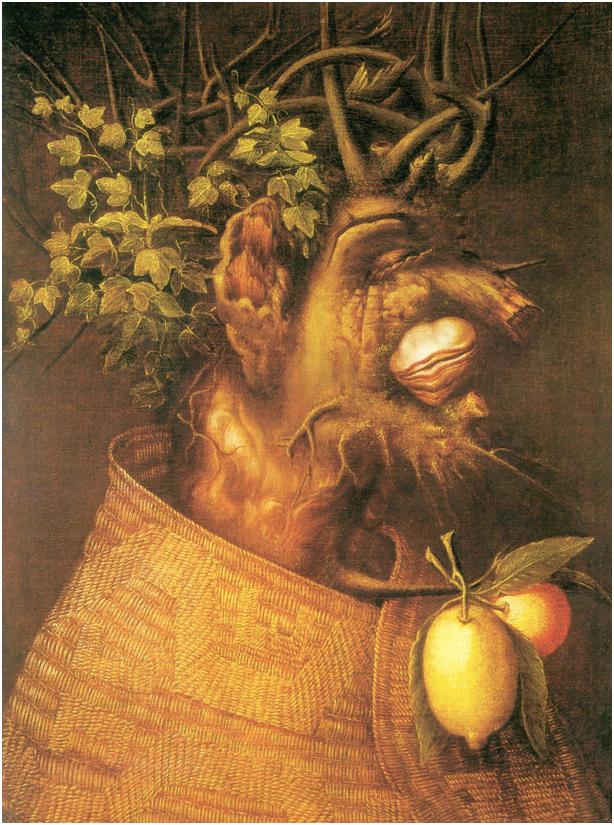
Speaking in musical terms we all appreciate that Antonio Vivaldi is famous for ‘The Four Seasons’.  Yet so too is Arcimboldo from a prior era.  Please take a look at ‘Winter: An anthropomorphic portrait of a man’ shown below:

Arcimboldo painted the seasons avidly. Perfecting and experimenting with compositions as all great artists do.  Looking at Winter version 3 above with lemons sprouting from the caricature’s neck one cannot help notice Guiseppe’s highly definitive textural style.  Equalled by art greats yet impossible to surpass.  Perfect is fit for purpose.  Rarely is perfection of itself.

Arcimboldo is to Wicker Baskets as Van Gogh is to Sunflowers.  Signed, sealed and delivered.  Owned.

Simile, reversible and object-orientated portraiture became his undoubted speciality from the 1560’s onwards especially following his appointment by Ferdinand I in 1562.

One of his most famous paintings, ‘Vertumnus’, painted for Rudolf II ‘Holy Roman Emperor’ is based on the Roman god of the seasons.  Shown below colourfully resplendent and might I say quite flattering when compared with some of his earlier portraits.

Rudolf II must have possessed a good sense of umor ad sanctimoniam affectans and respected Arcimboldo greatly to happily receive such a brilliant masterpiece.  It also shows the influential gravitas that well known paint artists held amongst royalty, aristocracy and the wealthy.  Historical diplomatic assignments by Sir Peter Paul Rubens dramatically attests.

Intellect, creativity and sensitivity.  We all have these qualities.

Portrait paint artists interact personably with people to fill a canvas.  What we see is what you get.  Honesty will always produce the best portrait in my opinion.  Every great portrait artist across any medium knows things about you whilst busily working away.

Oils become creative fruit juices swirling around our minds eager for the appropriate brush.

‘Vertumnus’ 1590/1.

Standard

Egyptian Art in Dubai

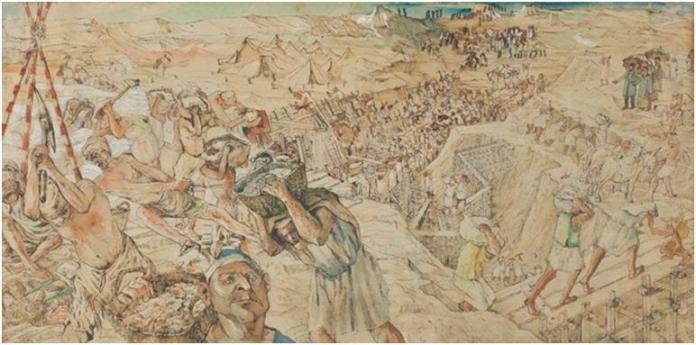
I would like to review ‘Construction of the Suez Canal’ by Abdul Hadi El-Gazzar.  It was acquired for $1.02m through Christie’s Dubai.  A new auction record for the artist.

Today my interest is in discussing this artwork, its historical reverberation and artistic value.

Quite some time ago I remember reading a specific story about a group of ancient Egyptian workers at Deir el Medina under Ramses III in the 12th Century BCE.

It intrigued me greatly.  The workers threw down their tools in protest due to a woeful lack of rations and peacefully complained to their Chief of Police.  Their complaint duly noted and directly quoted from an unedited English translation reads:

“The prospect of hunger and thirst has driven us to this; there is no clothing, there is no , there is no fish, there are no vegetables. Send to Pharaoh, our good lord, about it, and send to the vizier, our superior, that we may be supplied with provisions.”

Looking at El-Gazzar’s painting, shown above, we see the struggle of hard work.  An overseeing. Order. Logical procession. Monotony. Tented dwellings, perhaps for the workers.  A complex scene with varying angles and perspectives for the artist to deal with artistically and consider.

Sesostris, the Persian King Darius I, Ptoemy II and Napoleon Bonaparte have all been linked in historicity with the Suez Canal and the ancient waterways interconnecting the Red Sea and Mediterranean.

A flowing of water that spans some 4,000 years between these men respectively.

I cannot help wondering if El-Gazzar inadvertently placed himself in his own painting.  Overseeing.

Did you know that Rembrandt evolved and refined his art signature?  Will I use the same initialled signature my art teacher from school remarked upon favourably or will an artist grow and light upon a recognisable identity in good time.  My apologies, I digress momentarily.  Thoughts are sometimes like the dancing of butterflies.

Some painters are positively narcissistic, and it speaks much of their personal boldness and extrovert nature.  I feel El-Gazzar is somewhat subtle in his commentary within this painting.  Although he is exquisitely bold in most of his other artworks.

Construction of the Suez Canal is honest, warm and empathic.  An historical masterpiece.  El-Gazzar is a highly skilful painter, an artisan from ancient generations, happily gaining modern inspiration from Dali and Picasso with masterful creativity in his own right.

– Matt, The Unfathomable Artist

Standard

Art Dubai on March 18 – 21, 2015

Art Dubai Announces Dates For its Ninth Edition.

This Blog is brought to you by The Unfathomable Artist to highlight a Press Release from Art Dubai for their forthcoming Art Fair taking place in 2015.

Further details, including gallery pictures and Visitor information to Madinat Jumeirah can be found here:  http://artdubai.ae/.

A very relaxing and entertaining video from a previous Art Dubai fair can be viewed here:  http://vimeo.com/58004478.

Art Dubai 2015 will take place in the third week of March alongside a plethora of art, design and cultural events across the UAE and beyond.

Art Dubai, the leading international art fair in the Middle East and South Asia, announced today that its ninth edition will take place March 18 – 21, 2015, at Madinat Jumeirah in Dubai, United Arab Emirates.

Held under the patronage of His Highness Sheikh Mohammed bin Rashid Al Maktoum, Vice President and Prime Minister of the UAE and Ruler of Dubai, Art Dubai has become a cornerstone of the region’s booming contemporary art scene, both reflecting and acting as a catalyst in its extraordinary international growth over the past decade.

Art Dubai is recognised as one of the most globalised of meeting points in the art world today; the fair places an emphasis on maintaining an intimate, human scale while foregrounding quality and diversity.  The fair’s 85 galleries hail from 34 countries, and together present the work of around 500 artists.

Carefully selected, curated and presented through three distinct programmes – Contemporary, Modern and Marker – the galleries range from world – renowned dealers to upcoming artspaces.

In March 2014, 25,500 visitors attended the eighth edition of Art Dubai, including 70 museum groups and more than 400 curators and institutional representatives, confirming Art Dubai’s role as the meeting point in the Middle East and South Asia, and the global fair of choice for the art world.

The 2015 edition of the fair will run alongside Design Days Dubai – the world’s most diverse fair dedicated to limited collectible design – plus a myriad of other art – related events, exhibitions and cultural happenings in the UAE and across the region.

Next year’s Art Dubai will also coincide with Sharjah Biennial; the 12th edition of the renowned biennial, directed by Sheikha Hoor Al Qasimi and curated by Eungie Joo, also opens in March 2015.

“Building on the success of a phenomenal Art Dubai 2014, we’re thrilled to be working with our partners, galleries, artists, patrons and colleagues to present the ninth edition of the fair in March 2015,” said Antonia Carver, Fair Director, Art Dubai.

“Art Dubai has carved out a unique place for itself in an increasingly crowded artworld calendar and spring 2015 will be a particular time of celebration, given the strength of the programming at the fair and throughout the UAE and beyond.”

Standard