
If you were asked to talk about your favourite fruit, sport or hobby how long would I enjoy sitting and listening to you intently? Please think about what you would say to me. I am interested.
Perhaps one subject is more interesting to you than another? Well in discussing the most expensive artworks, I have chosen the paintings that I would like to include for the purpose of this blog. Given the opportunity I’m fairly confident I could talk about them all day.
Hopefully you will enjoy what I have to say about the paintings and learn something new you did not know.
For those still with me reading let us start with one of the most expensive oil paintings “The Card Players” (fifth version) by Paul Cézanne.
Here it is:
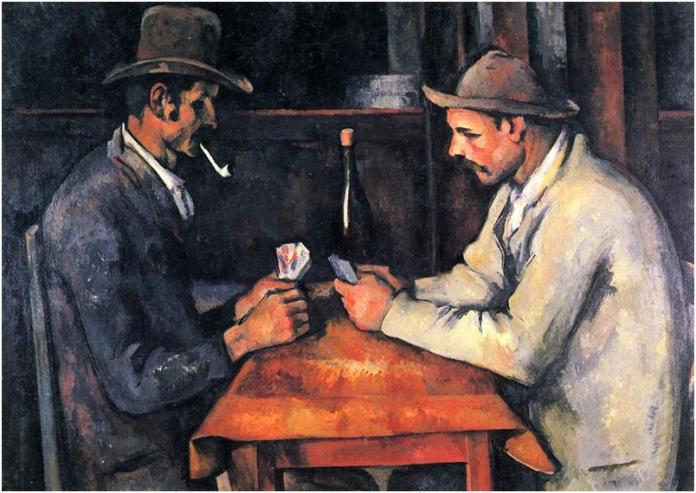
Cézanne likely chose a popular theme amongst artists past and present. Card playing remains highly popular in modern society so it makes sense for an artist to choose themes that will have relevance throughout time. Past cultures show the earliest known references to card playing at least as far back as Imperial China in the 9th Century A.D.
Of course it would be quite easy for me to reference the basis and idea for these cards to the ancient Middle Eastern world and bring it forward to us through every century and millennium. All that is required is slight of hand, a little magic and et voila.
A quick look at playing card paintings and surely many of us will remember those playing card paintings with dogs? I think they’re fabulous but let’s get back to “The Card Players”. What we are seeing here is the result of a concerted and perfected effort from Paul Cézanne to instill in us his personal vision for this popular theme.
Look at it. This masterpiece of art is truly absorbing. The composition draws us into the two players world of poise, concentration and importance. Clearly these two men have two different styles of card play. One is sat near bolt upright whilst the other is partly hunched. Both are serious players yet the man on the left appears relaxed in contemplative thought merrily with pipe in his mouth.
The player on the right looks somewhat forlorn don’t you think? Likely he is concerned at his hands prospects. Or maybe he is a seasoned hustler? Either way all this purposeful positioning doesn’t give us any space to conclude that this game is anything at all to do with sociable conversation.
The angle Cézanne has chosen for the playing cards gives us the appearance that the playing hand on the left is stronger, seemingly with nothing to hide from our personal viewing point. Naturally their hands rest upon the table in constant anticipation and the absence of drinking glasses gives us the impression that this is a competitive pastime where playing pride is at stake. The bottle has its cork stopped inside.
Everything is on hold. Sport is immensely competitive.
Perhaps Cézanne preferred the table to be centrally close in front of us, as if we’re sitting with them, to focus our attention along with the players? I’m personally sure of this ingenious possibility.
This composition invites us into the game as personal spectators with its minimalist intimacy. I say this because some of the versions of his playing card themed artworks involved other people in some way or another within the paintings.
There are more colourful versions of his playing card series whereas the painting you see here on this page has a pastel colour tone. Their faces are very expressionistic and there is no doubting the extremely fashionable influence of this art period during the late 19th Century.
An impressionistic art style that has stood the test of time into the 21st Century not least thanks to Paul Cézanne and his entire “The Playing Cards” series of paintings.
If you have chance to check out this particular series I’m sure you will see the individual emotion and artistic quality within each of these playing card paintings.
 The Unfathomable Artist