Artemisia Gentileschi The Baroquess

‘Judith and Her Maidservant’ by Artemisia Gentileschi, c1625-27, Oil on canvas, 184 cm (72 in) × 141.6 cm (55.7 in).

Art fans interested in Italian Baroque..

..Artemisia Gentileschi to the rescue.

In my opinion Artemisia can effortlessly flow between pre-Raphaelite, Renaissance and Baroque styles.  The latter style incorporating her most dominant structural preference.

Typically extreme contrasts between dark shading counter-referenced by strong natural or incandescent light upon subject/s revealing foreground details.

The Baroque style is often accompanied by dynamic, intense action designed to infuse a sense of pictorial awe and..

.. Controversy.

I could have happily chosen Orazio Gentileschi, her father, here: https://en.wikipedia.org/wiki/Orazio_Gentileschi to write about however I wish to balance my blog with various artists.  For further details about Artemisia Gentileschi’s life please read her Wikipedia page, here:

https://en.wikipedia.org/wiki/Artemisia_Gentileschi

The purpose of this article is to examine her artworks displayed on this page.

This original version of ‘Judith and Her Maidservant’, shown above, clearly emphasizes a female artist at the height of her ability.  A father and daughter learned of their craft.

Professional artists of their own volition.

The swaying candle flame, gripped sword at the ready, shadows exquisitely represented.  Seriously, we have never seen artistic shadow painted better.  A simple statement suffices, noting those superlative Baroque italics included.

Artemisia delivers to us a masterpiece as if with the birth pangs of effort and tumult.  It really is ‘As Good As It Gets’.

Except of course there is no romantic comedy in this painting.  A greying, lifeless severed head tells a completely different, graphically violent story.

Cardinal robe red drapery overhanging silent gestures tells of an urgent sense of concealment to their obvious caution.  Concerned expressions magnify their violent crime.

Only death now seems to be at peace following the previous painting Act scene #1 of ‘Judith Slaying Holofernes’ [c1614-20] by Artemisia Gentileschi, here https://en.wikipedia.org/wiki/Judith_Slaying_Holofernes_(Artemisia_Gentileschi)

Let thee shudder as we turn our attention to her next masterful painting chosen for this blog article:
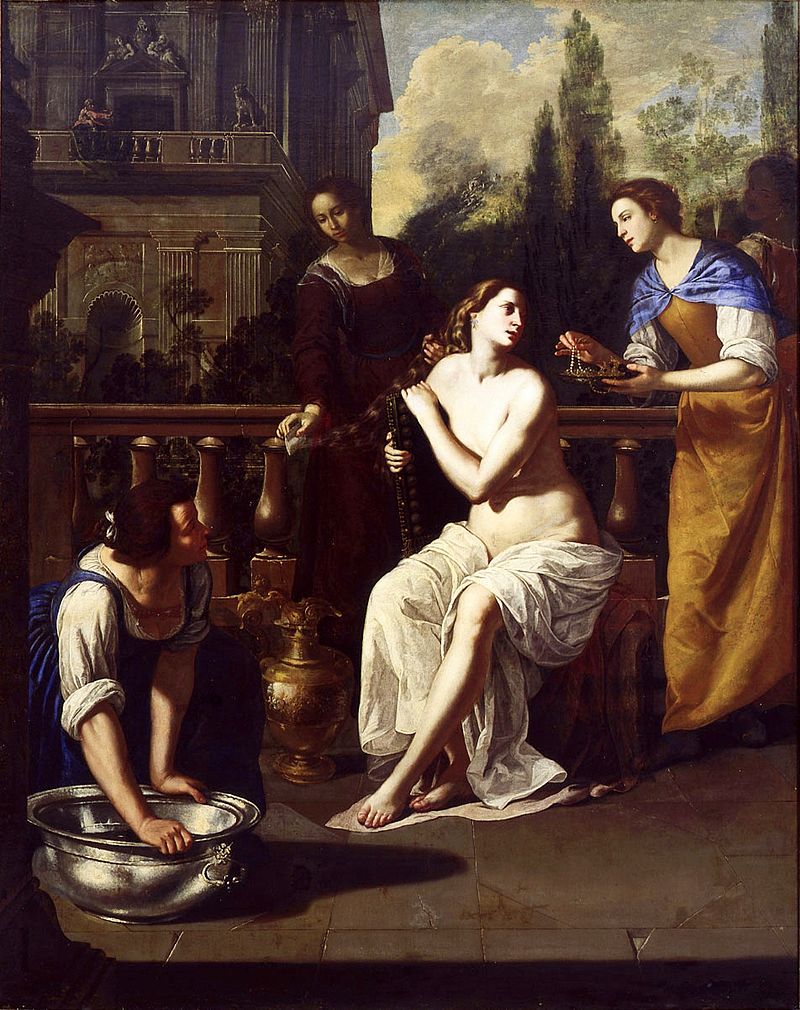
‘Bathsheba’ by Artemisia Gentileschi, c1636/7, Oil on canvas, 265.43 × 209.55 cm (104.5 × 82.5 in).

Immediately it was emotively certain for me to include an example amongst her distinctive ‘Bathsheba’ paintings, shown above.

Renaissance of composition.

For the love of goodness, please look at that silver bathing vessel.  It exudes perfect metallic strength, depth and solidity.  Should I ever paint metal like this I shall dance around a hallway with all the grace of a mountain goat cascading rocky climbs.

Glass in hand.  Celebratory.

Truthfully, Artemisia is modestly accentuating compositional skills at the very word of experts during her lifetime.  The architectural construction, also, Beyond Words.  The silks, sublime.

Everything in life has rhyme and reason.

The feminine figures foreground positively engages us as viewers.  Feigning, whilst attentive.  Could it be that the two standing attendants (maidservants) are competing with one another for Bathsheba’s favour?

Engrossed in their respective beautifying function.

Next I chose to venture a painting by Artemisia Gentileschi extolling her pre-Raphaelite competence:
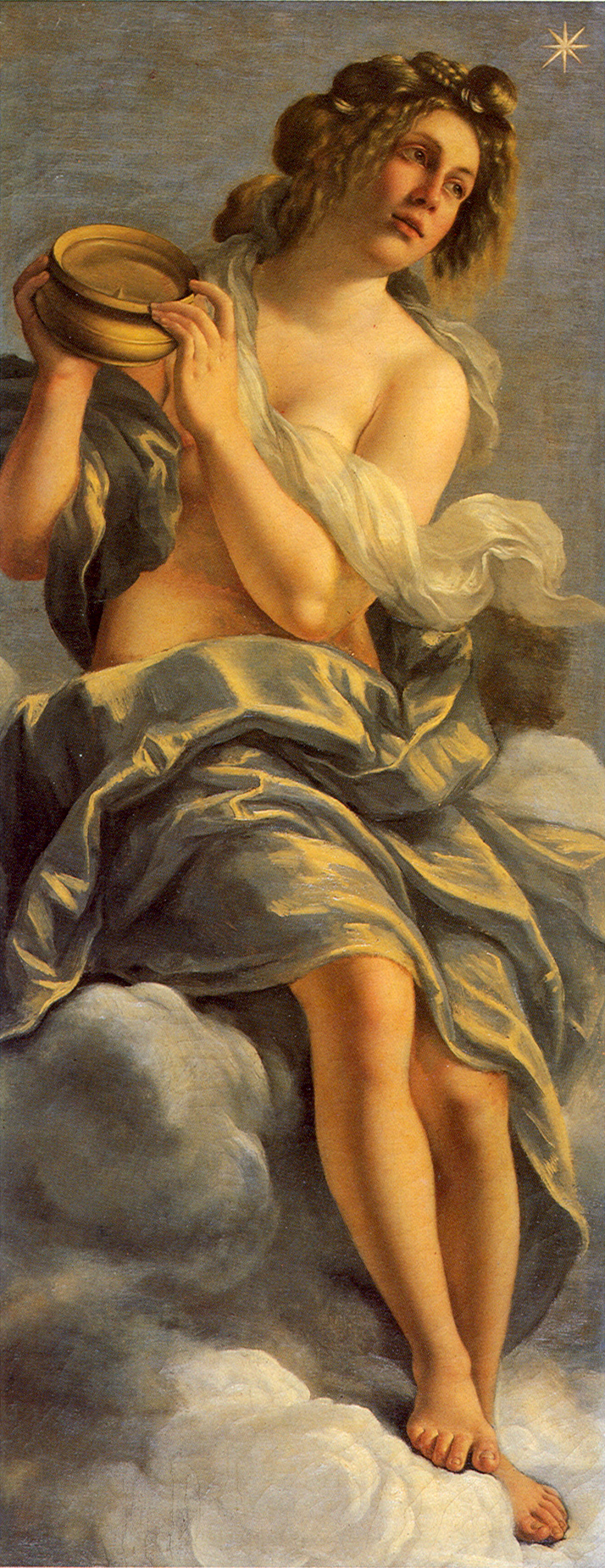
‘Allegory of Inclination’ by Artemisia Gentileschi, c1615
– 1616, ceiling canvas Casa Buonarroti, Galleria, Florence.

Heaven appears to be a firmament in this painting, ‘Allegory of Inclination’ by Artemisia Gentileschi.

Shown above.

Her dreamy-peculiar distant expression.  Sensuous handling of the subject material.  Modesty covered fleetingly as if by a soft breeze.  A bowl of revelation.  The star of Magi.  Hair tied attractively away from her face to depict important work with far-sighted vision.

Porcelain skin for chastity.  The absence of extreme shading for angelic purity.  Harmonious legs.  Withdrawn body posturing.

Artemisia Gentileschi is quite the feminist throughout her work.  I perceive her as willfully strong, confident and determined.  Respected as an equal both in society and as a female artist of her generation.

Michelangelo’s nephew, Michelangelo Buonarroti, does not surprise me with his considerable regard at choosing according to eQuality for work relating to the artistic interior decoration at Casa Buonarroti.

Artemisia delivers fine art each and every time.

‘Danaë’ by Artemisia Gentileschi, c1612, Oil paint, copper, 41.5 cm (16.3 in) × 52.5 cm (20.7 in).

Danaë ‘ shown above is an unusual composition.

This artwork, to my mind, describes two stories in one painting.  Especially with the interpolation between Danaë and various artworks of Cleopatra by Orazio and Artemisia.

Interestingly Orazio, her father [link shown earlier in this article] also uses similar gold coins falling in his $30.5 millionDanaë‘ masterpiece sold January 2016.

His ‘Danaë‘ painting here:

https://en.wikipedia.org/wiki/Dana%C3%AB_(Orazio_Gentileschi)#/media/File:Orazio_Gentileschi_-_Dana%C3%AB_and_the_Shower_of_Gold_-_2016.6_-_J._Paul_Getty_Museum.jpg

With professional art collecting all factors might be evaluated.  Historical, monetary, emotional, sentimental, proficiency, influence, provenance, creativity, artistic status and social interconnection.

That Artemisia was an industrious woman is a true testimony of her fighting spirit to achieve artistic greatness.  A spirit that urges a naturally gifted person without compromise to stand proudly with her peers.

Please note that a scholarly article is available online by Britiany Daugherty which includes inciteful research into Artemisia Gentileschi’s life and works, link here:

http://digitalcommons.unl.edu/cgi/viewcontent.cgi?article=1056&context=artstudents

Standard

le Renoir Surérogatoire

‘Luncheon of the Boating Party’ [1880 to 1881] by Pierre-Auguste Renoir, Oil on canvas, 51.26 in (h) x 69.13 in (w).

Continuing my tradition of providing Wikipedia links for artists, here is a link to the page of renowned French Impressionist painter Pierre-Auguste Renoir:

https://en.wikipedia.org/wiki/Pierre-Auguste_Renoir

For an interactive image ala ‘Luncheon of the Boating Party’ please click here and hover your mouse over the people in the painting: https://en.wikipedia.org/wiki/Template:Renoir-BoatingParty-ImageMap

Interlude.  I will return to writing this article after eating some much needed food and drinking a lovely cup of tea.  Sorry, Renoir’s painting has made me hungry and I simply cannot write another word after this one.

I wish my thoughts to flow satiated as I am.  Renoir’s work is precise, pastel-soft at times, spontaneous like eating, romanticized, prettily arranged and sometimes pre-Renaissance and/or pre-Raphaelite in style.

Pierre-Auguste is capable of realist depictions wherever he felt the subject material became ameliorated.  We see examples of this in his portraits of Claude Monet and Alfred Sisley, elevating their dignity and social standing.  Quite likely Renoir ‘clung to them’ with strong regard.

At this latter well known saying I thought immediately of Michel de Nostredame [Nostradamus – https://en.wikipedia.org/wiki/Nostradamus] and his distinctive oddities.

‘If a meteorologist predicts troublesome weather, for thoust seeth through eyes that you do not see – do you then say that the meteorologist is a god bringing it upon you?’

Eau de toilette.  It seemed strange for me to write this spontaneously until I then quickly read:

“Painting must not stink (purr) of the model and one must, neuertheless, smell (sentir) nature in it.” – Pierre-Auguste Renoir.  Quotation online in Bodies of Art: French Literary Realism and the Artist’s Model” by Marie Lathers.

__________________________________________________________________________

I wish to talk about ‘Luncheon of the Boating Party’ [1880 to 1881] by Pierre-Auguste Renoir.

The interaction between the characters is truly exceptional by any normal standards of paint art working.  Care, observance, ponderance, yearning, aloof inexperience, nervousness, mutual co-equal friendship, comfort, serious business discussion and guarded affection from others. __________________________________________________________________________

Thoughts arriving like the Sun at its travelling.  My brain is acting gregariously with a multitude of thoughts as I type.  Renoir’s artworks are enlivening my inspirations so I shall share a new saying from last night inspired of an ancient saying:

‘That we are travelling with the Sun at great speed in all four directions, actually seven, is insight beyond my comprehension at this time.’ – by Matt The Unfathomable Artist, September 2017.

G.R.A.V.>i>T.Y.

Σ

__________________________________________________________________________

‘Study of a Seated Bather’ [1897] by Pierre-Auguste Renoir features a dainty composition of a model bathing nude, shown immediately below:

‘Baigneuse Assise. Study of a Seated Bather.’ [1897] by Pierre-Auguste Renoir, Original softground etching in black ink [1897] signed with the artist’s signature stamp Also signed in the plate. From the edition printed by Louis Fort for Renoir (circa 1910). Edition first issued by Vollard to accompany the album: ‘La Vie et l’Oeuvre de Pierre-Auguste Renoir’, Paris 1919, On light cream wove paper. Sheet: 12 1/2 x 9 1/4ins. Plate: 8 5/8 x 5 3/8ins (220x137mm).

I enjoy all his nude artworks.  There is nothing more honest, intimate and natural than the naked human body as an artform.  Intimacy need not be brash, disrespectful or undignified.

Respecting the beauty of the human form, its near miraculous function and the emotions we feel through our bodies begins as a true gift.  The nakedness at birth.

The idea of birth brings me to the next painting, shown here:

‘Pink and Blue – The Cahen d’Anvers Girls’ [1881] by Pierre-Auguste Renoir, Oil on canvas, 119 × 74 cm (46.9 × 29.1 in).

The pensive almost lost-looks upon the girls faces is a glorious masterpiece within ‘Pink and Blue – The Cahen d’Anvers Girls’ [1881] by Renoir.

The sisters are trying to appear comfortable holding hands.  Alice Cahen on the left resting a hand upon her ribboned belt, no doubt tired from posing.  Her sister Elisabeth imagining her smile as best she can from quite sometime ago, I expect, as they patiently stand in complex finery.

They are so sweet.  Each expression a breath-takingly triumphant replication of life by the painter.

Quite Beyond Words.

Let’s take a look at ‘Pont-Neuf’ by Pierre-Auguste Renoir, shown below:

‘(le) Pont-Neuf’ [1872] by Pierre-Auguste Renoir, Oil on canvas, 74 cm × 93 cm (29.1 × 36.6 in).

It’s always very difficult to choose artworks for my page, however, I usually select spontaneously the paintings that appeal to me personally in some way.  If I wrote an article on a different timeframe a different painting would likely be presented.

We’re all influenced by mood and learned coincidence.

English artist L. S. Lowry must have loved this painting, well, I do hope he did see this artwork.

The symmetry, lines and perspective in ‘Pont-Neuf’ make this one of the most perfect cityscape paintings I’ve seen.  As a comparison of styles from the late 19th Century Impressionist Era to Contemporary early-21st Century artworks I would encourage you to view Titus Agbara‘s cityscapes:

‘Sunday Morning at Kessington Park Road’, also

‘Cambridge Circus – Where Thoughts Meet’ and his four-hour completed artwork of Scotney Castle as appropriate for this article, here:

https://www.saatchiart.com/titus_agbara

Renoir is to French Impressionist art as Titus Agbara is becoming to Nigerian Contemporary art.

Famous.

Standard