

‘Family & Beyond’ by Titus Agbara
Medium: Oil on Canvas
Size: 60 inches x 80 inches
Before you read my commentary about Titus Agbara and our fun Q&A session I’d like readers to imagine a very different kind of tranquility and frame of mind. I say this so that you may happily place yourself within Titus Agbara’s world.
People from Africa have the purest sense of language. A few years ago I was speaking to two African men who had travelled to the UK quite some years previous to live here. Their beaming faces clearly stood out to me along with the beautiful way they spoke. We shared some amusing stories prompting one of the African men to move his left leg slowly in front of him and then slowly behind him, standing on his right leg as he did so.
Whilst I watched him merrily rocking I asked him why he was moving his leg like this. With a huge smile he replied full of joy, ‘I am laughing, this is how we laugh. With our feet.’
That same African man was speaking to me like a man whose spirit was flying high in the clouds whilst yet perfect in his full soberness. That moment by definition is Natural Art. A culmination of specific people and their cultural style communicated to me through this one man.
Travel to Greece and you will see Greek friends naturally hugging each other with ease and an assured gracefulness. You already know the peoples inclined to bowing, those to handshaking and the peoples kissing from cheek to cheek. Natural Art tells us about people and their culture.
The photograph below is a beautifully classic diptych by Titus Agbara defining his artistic style:

‘Still At Peace’ by Titus Agbara
Medium: Oil on Canvas
Size: 40 inches x 60 inches
Titus works almost entirely with palette knives requiring the artisan skill and steadiness of surgeons who are themselves masters at their work. Titus’ style, as discussed in a previous blog about Morgan Weistling [My Morgan Weistling Blog Writeup] demonstrates a strong story-telling acumen within his art. Whereas Weistling prefers a romantic style, Titus is pragmatic and practical in depicting many of his life scenes.
Few paint artists are able to mix colours as masterfully as Titus Agbara and his American colleague aforementioned.
True, some paint artists choose to have a simplistic art palette in terms of colour and this also works well in producing fantastic art. Realist Landscapers and Life Scene artists invariably enjoy a superfluous array of colours and hue definitions. At his most frugal Monet was distressed at the limitation of his palette colours. He preferred the variety of colours that his success and wealth soon brought to him – literally by the couriers of his day.
This is why I make reasonable comparisons and continue this by asking you to please take a look at Thomas Eakin’s magnificent painting ‘The Gross Clinic’ here:
![The Gross Clinic [1875] by Thomas Eakins Oil on Canvas 240cm by 200cm](https://theunfathomableartist.co.uk/wp-content/uploads/2015/11/484px-eakinsthegrossclinic.jpg)
‘The Gross Clinic’ [1875] by Thomas Eakins
Oil on Canvas
240cm by 200cm
Great art speaks for itself and is commensurate to the sale price of art works – now and for the future. Ambitious artists like Titus will actively ensure their work is well-known internationally.
Art dealers are most interested in artistic quality, fame, influence and popularity. With this criteria in mind Titus’ impressive resume reads as a testimony to his life within the art world.
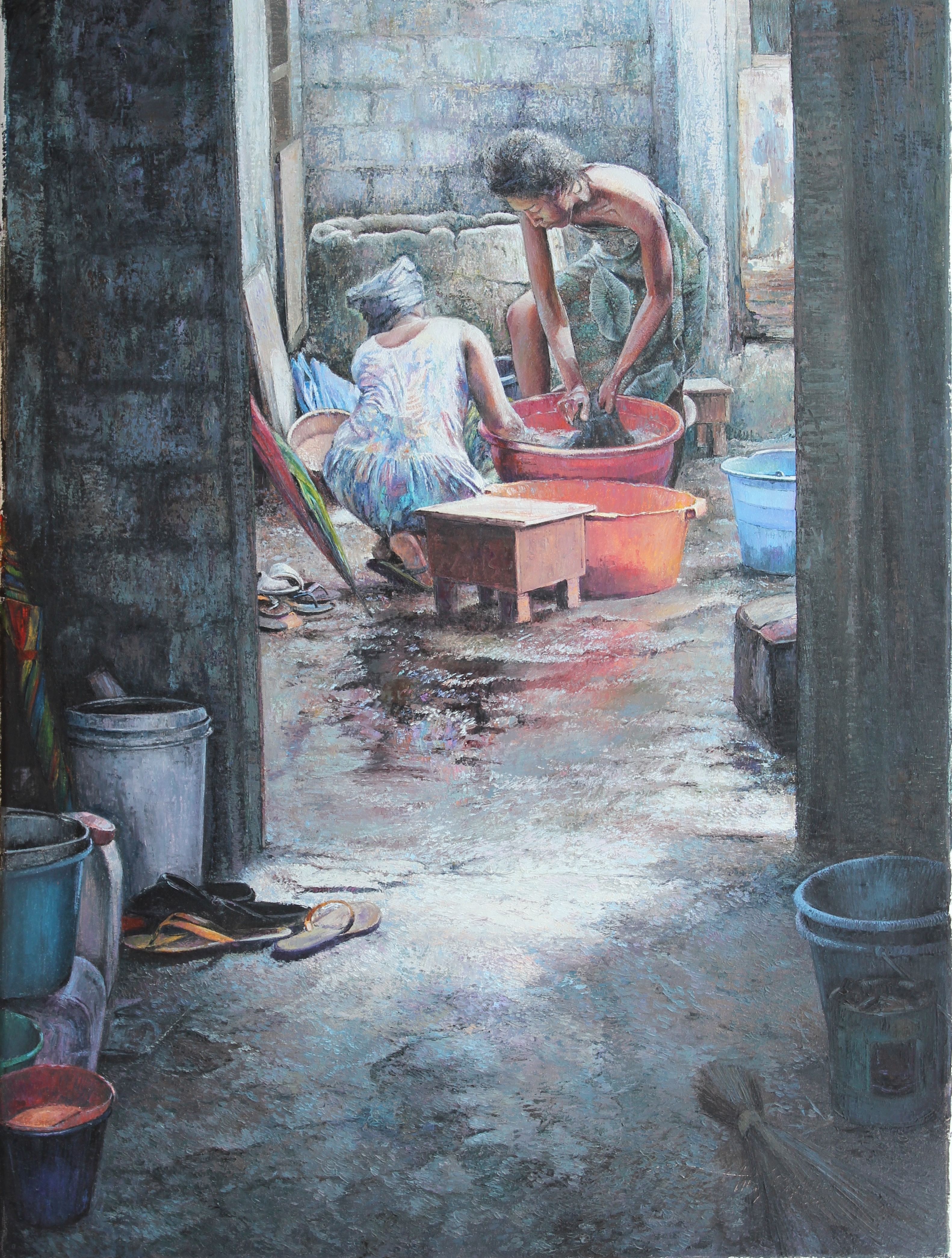
‘As Our Mother Told Us’ by Titus Agbara
Medium: Oil on Canvas
Size: 40 inches x 30 inches
Below Titus depicts a traditional African family cooking scene from a uniquely unusual angle and perspective. The art world always needs painters who have the courage to paint exactly what they see for all its natural beauty:
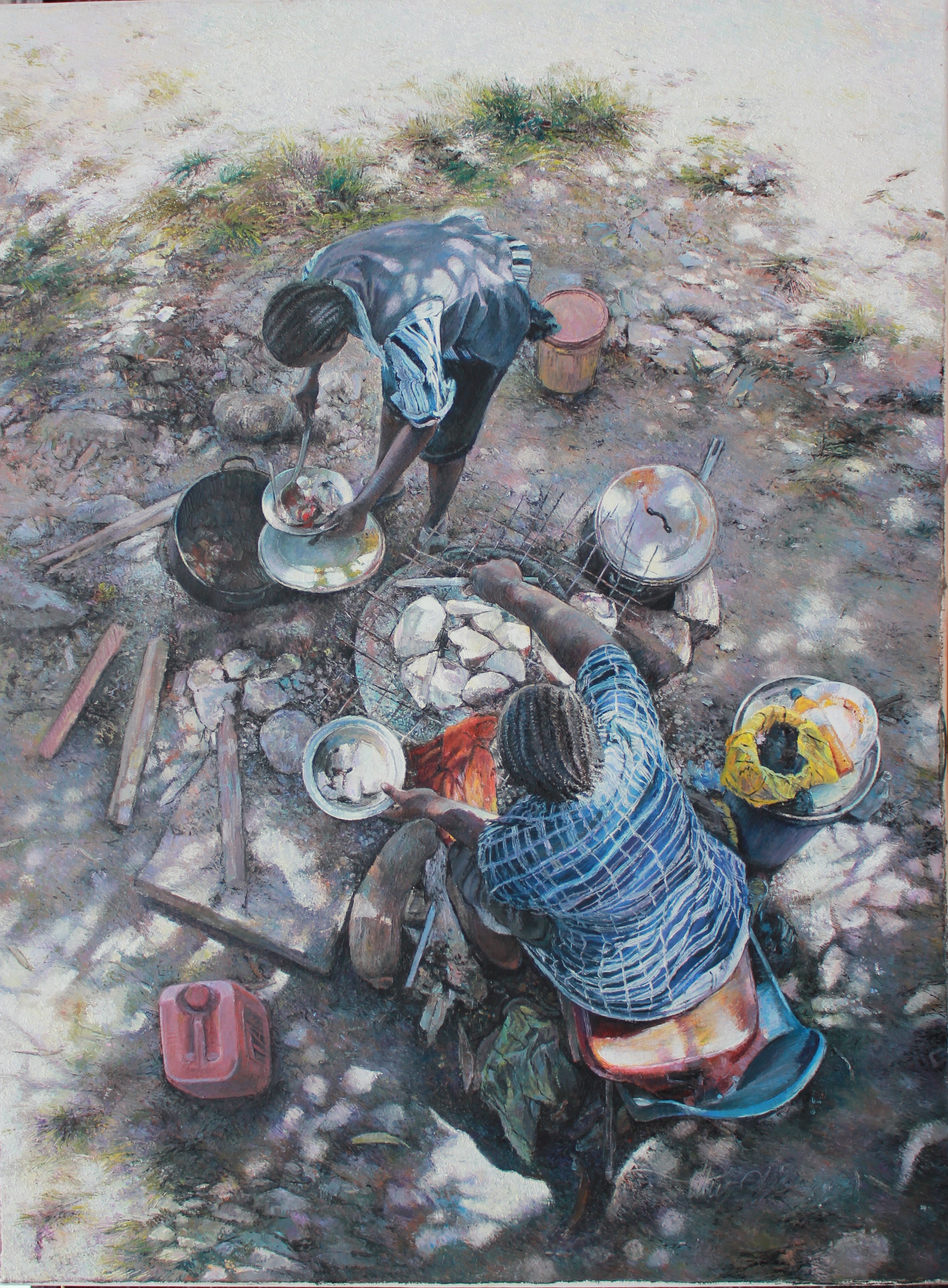
‘Inspirational Appetite’ by Titus Agbara
Medium: Oil on Canvas
Size: 40 inches x 30 inches
With depictions of serene beauty through his artistic flair let’s see what Titus Agbara has to say about his art shall we?
A Q&A with Titus Agbara:
Matt The Unfathomable Artist [Matt, TUA] – How long do you typically work on a painting?
Titus Agbara – “I think I could finish a painting for one month depending on how often I work on it. When I am into serious painting, yes, then I have to make sure I paint on a daily basis. I try to see if I can finish a painting within the space of three months.”
Speaking of his last two paintings ‘As Our Mother Told Us’ and ‘Inspirational Appetite:
Titus – “Yes, the two last works, each of them take me three months to finish.”
Matt TUA – “Is this because of drying times?” [during the painting process]
Titus – “No, its not the drying time because actually I don’t want my painting to dry on time before I finish it.”
As an artist myself I believe this reveals something about good technique and his insistence on a workable art process. Wet-on-wet oil application allows Titus to change aspects of his painting whilst it is in progress.
Referring to his work on Sky Arts ‘Portrait Artist of the Year 2014’, a nationally televised art show for the UK and Ireland which requires art competitors to complete a portrait painting within four hours:
Titus – “To complete a painting in four hours, yes, that’s why I had to work fast and make sure, but actually I do take my time. I feel a little relaxed when I’m around my studio.”
Matt TUA – “Yes, I don’t think there is a right or a wrong for any particular artist because that shows how proficient an artist is. To do the complex scene that you did on Landscape Artist of the Year 2015…”
Actually shown here, please take a look – Titus Agbara Time Lapse Video]
“…I was literally, I mean, I couldn’t believe how you could manage to do that in four hours. I really was very impressed. It was how much definition there was in it within four hours [that] is astonishing. I’m not surprised with the fees you are able to command with your work. It does come down to how accomplished an artist is.”
Titus mentions his Facebook page. You can see this here: Titus Agbara on Facebook].
Just imagine the dedication required to spend three months on a single painting with the modern speed of life! His commentary is in complete agreement with my own specified time frame to complete a painting. Usually I give myself three months to complete a new canvas dependent upon its size and complexity.
Matt TUA – “Do you see yourself working in television within an art capacity Titus? They have panels for judges and artists alike. Is that something you would actively seek?”
Titus – “Yes, it’s something I’d like to do. I’ll never like a situation where it’s just about my talent and that’s just for me alone. Well yes, I like to see young ones coming up.”
Matt TUA – “Yes, somebody with your experience and incredible CV dating back to the 90’s, you’ve got that, if you like, art pedigree. Your CV puts you in that position where people, execs, would be looking for that sort of experience.”
Matt TUA – “What advice would you give to new artists? You know, someone just starting out?”
Titus – “My advice for someone who is just starting out is the basic change. First of all you should apply to the principles of art and its element. Paint yourself with it, to which you learn about the experience. Its up to you how to identify yourself. Then start to look into yourself in whichever way you want to express yourself. Where you are starting from before you go to a particular place in life.”
Matt TUA – “I absolutely agree. That is the perfect answer really, I couldn’t have answered that better. Like you say, find out how you go about art making itself from a technique point of view and practice. Then look inside the person. Find out what they have to offer, what their style of art is and what they’ve got to say. I was thinking, do you have any self portraits?”
Titus – “Yes, for the Portrait of the Artist 2014 I had to submit a Self Portrait and that was my second portrait that I had done for myself.”
Matt TUA – “Do you have a favourite artist Titus? Someone from the past or present, someone who has most influenced your work?”
Titus – “I have stuck to one artist from my youthful age and that has been Monet. I’ve got some of his books. For artists of our time, yeah, I only get to look at your,.. [Titus is new to my art whereas I’ve known Titus’ work for sometime] ..to see how you paint and look at how you have done your own paint but for my initial starting age, yes, I think it was Monet’s painting that really inspired me a lot.”
[When professional artists look at their colleagues paintings we first look at the art itself just as everyone admires to do so. Then we become interested in knowing how they went about making their painting from a technical perspective.
For instance, the fact that I know Titus prefers to use his palette knives for delicate objects within his paintings truly amazes me.]
Matt TUA – “Well I’ve got to be honest I think Monet is probably a favourite for many of us and yes he is one of my favourites too without a doubt. Well, this is how you have developed such an extremely good portfolio and why you are able to sell your paintings at a premium price really in the competitive art market. So that is a good testimony to you and it certainly shows in your work. Well I hope you have enjoyed having a chat with me. I wish you every continued success with your art and hopefully we can keep in touch.”
Titus – “Thank you very much Matthew.”
Matt The Unfathomable Artist – “Thank you Titus, much appreciated.”
 The Unfathomable Artist