Banksy Is The Street Art Master.

'Keep Off Our Worms' - Banksy original graffiti artwork

‘Keep Off Our Worms’ (2014) – Banksy original spray paint artwork

In 2014 this original artwork, pictured above, appeared on a wall in Clacton-On-Sea, Essex, England one week prior to a UK Parliamentary by-election.

I see five grey looking pigeons and a bright-looking bird suspended upon a single ‘tight-rope’ perch.

What do you see?


'Laugh Now But One Day We'll Be in Charge' (2002) by Banksy - spray paint on canvas - 12in x 12in

‘Laugh Now, But One Day We’ll Be in Charge’ (2002) by Banksy – spray paint on canvas – 12in x 12in

I see a definitive quotation.  A statement referenced with a placard or a pinafore.

Is ‘Laugh Now, But One Day We’ll Be In Charge’, above, explaining animalistic human traits?  The fight for resources?  Or greed?

Should we imagine that brute force will gain authority over intellect?  Perhaps it touches upon equality, working conditions and slave labour?  How about the evolving cycle of Man vs Woman?  I’m not trying to provide a dominant argument here.

The beauty of a great artwork is personal opinion.  Provocation for thought and emotion.

The most recognisable street artist of our generation, Banksy, certainly makes international headlines time and again!  The exclamation felt quite natural to include.  ‘Read all about it, read all about it – Banksy has sprayed our walls and doors!’

People show strong appreciation when they know they are being loved.  Ideas challenged.  Behaviour scrutinised.

I personally chose the artwork images to display in this blog article.  Each original artwork has already been represented with worldwide coverage throughout the popular press.  Banksy creates street art that speaks influence and popularity.


'This'll Look Nice When It's Framed' by Banksy (2010, San Francisco)

‘This’ll Look Nice When It’s Framed’ by Banksy (2010, San Francisco, USA)

The above artwork – all photographs taken from the Banksy Website – appeared in the Mission District at Valencia and 20th Street, San Francisco, California, USA.

The artwork pensively references the historical viewpoint of ‘on-the-wall’ art pieces.


'Mobile Lovers' (2014) by Banksy

‘Mobile Lovers’ (2014) by Banksy

This depiction of a warm embrace, as pictured above, appeared on a doorway next to the Broad Plain Working With Young People club in April 2014.  It first sold for £403,000, which is a staggering price for any living artist to achieve.

With ‘Mobile Lovers’ Banksy is highlighting the disconcerting divide caused by our growing technological dependence offset against personable human interactions.  If unchecked this is a serious pandemic that is ‘sneaking up behind’ the human race in a multitude of ways.

It’s not difficult to observe people engrossed in their social media pages during get-togethers.  How can connecting be disconnecting at the same time?  What are the long-term effects?

Banksy uses his art and global appeal to help address this problem with a beautiful message.  Satirical and empathic, especially the choice of location – a youth centre.  A new technologically adept generation coming through.

Can modern relationships survive this technological minefield?

Much more than that, great artworks reverberate.  Their intrinsic value increases monetarily and intellectually from generation to generation.

Banksy is inspiring visionaries, a new stream of artists and The Public with his own carefully crafted style.  Challenging hard-line views with humour, stark remonstrations and perfectly executed art concepts.

Banksy is the ‘street art’ cool Andy Warhol of the people.

And we all know that there “Ain’t nobody cooler than that.” an artist said.

Standard

Empathic Depictions by Jean-Michel Basquiat

Untitled known as 'Two Heads on Gold', 1982. Acrylic and oil paintstick on canvas [80 × 125 in 203.2 × 317.5 cm]

Untitled ‘Two Heads on Gold’, 1982 by Jean-Michel Basquiat
Acrylic and oil paintstick on canvas
80 × 125 in- 203.2 × 317.5 cm

Today I finished watching the latter half of a docu-movie entitled Jean-Michel Basquiat: The Radiant Child.

Let me please ramp up some intellectual thoughts for your consideration.  Ok, well up until several weeks ago I didn’t know that Charles Bird King’s father was killed by a native American.  This would not be poignantly significant except that Charles Bird King is almost singularly remembered as one of the greatest historical portrait artists of native American culture in a truly positive light.  Dignifying the perspective of native Americans in his day and beyond to our time.

The question to ask from this docu-movie in my opinion is – How did Basquiat die at 27 years of age?  Obviously his lifestyle choice was conducive to this.  He was sucked up into a decadent torrent, seemingly casting himself off in an instant.

Can anyone here expect to cast a pebble into the sea only to find that same pebble rise to the surface of the waters and roll back towards you?  What you actually do is skim the pebble upon the surface many times to see it skipping along the smoothness of waves.

I’m deeply moved by this film because I see almost precisely the same sensitivity and fragility that Van Gogh no doubt possessed during his own lifetime.  37 years and 27 years is merely glancing at the surface of what life has to offer.

At this point I would mention that perhaps watching Pina (preferably in 3D) by Wim Wenders is also a strongly emotive film experience.  That is, if you would like to tap into your deep inner sensibilities for an hour or two.  Personally speaking I do sincerely become immersed in a range of emotions during these arty indulgences.

Back on track to Jean-Michel Basquiat.  Firstly a superior artist to any reference of what we might consider good or acceptable art in quality.  His drawing in a child-like manner explains how he felt as a person in this highly competitive commercial world.  Cartoonistic, raw and excitable in style.  Abrupt, often complex and bold.  Stark and beautifully complimentary.  Largely attractive colour contrasted arrangements.

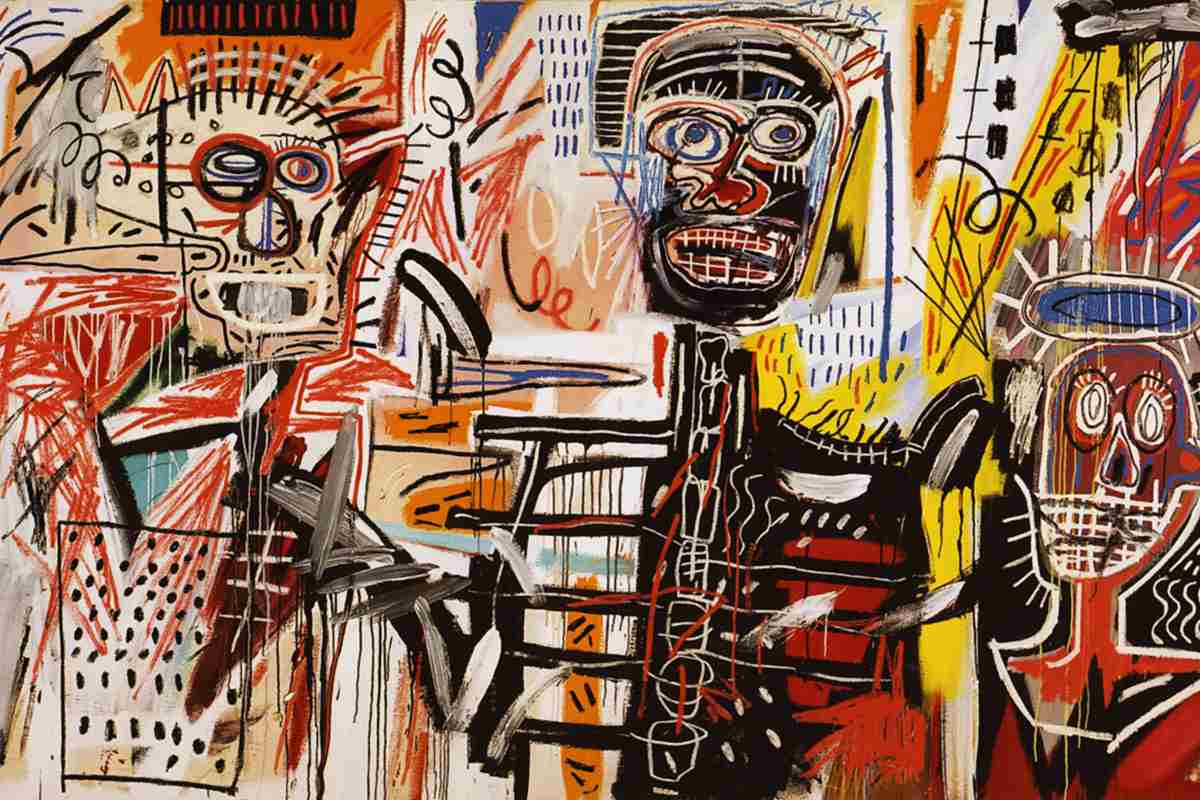
Philistines – 1982. Acrylic, crayon on canvas, 183 x 312.5cm.

Philistines – 1982 by Jean-Michel Basquiat
Acrylic, crayon on canvas, 183 x 312.5cm

Is Jean-Michel Basquiat explaining some of his own life experiences in his painting above?  I would strongly accept this hypothesis.

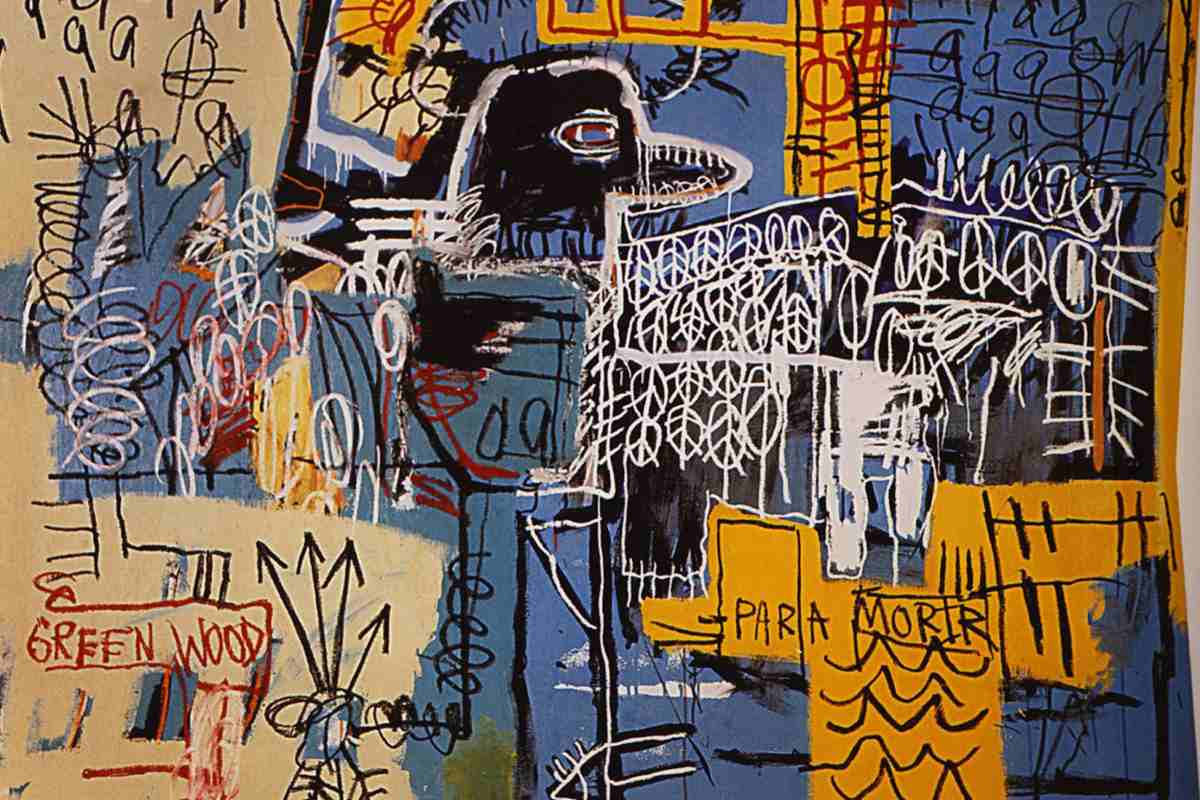
Bird on Money, 1981 by Jean-Michel Basquiat. Acrylic, crayon on canvas - 167.5 x 228.5cm

Bird on Money, 1981 by Jean-Michel Basquiat.
Acrylic, crayon on canvas – 167.5 x 228.5cm

Come on surely we would all like to own a Basquiat?  Colourful and interesting doesn’t even begin to describe a Basquiat.  His influence in artists like Banksy is almost a given.  Basquiat clearly dignifies many artists within his paintings so I think its posthumous reward his art is still living and breathing today.  Speaking street and high brow intellectualism as one.

Del Monte, c1984-1985 by Jean-Michel Basquiat and Andy Warhol. Synthetic polymer paint & silkscreen ink on canvas. 76 x 88 in. (193 x 223.5 cm)

Del Monte, c1984-1985 by Jean-Michel Basquiat and Andy Warhol
Synthetic polymer paint & silkscreen ink on canvas
76 x 88 in. (193 x 223.5 cm)

I’ve included this latter painting above to add controversy to the whole art valuation debate.  What is a piece of art worth?  This painting sold for $1,082,500.  Unusually Jean-Michel Basquiat chose not to use visible words or letters in this artwork.  The branding work is synonymous with Andy Warhol’s style.  An art collector would pay this sum purely based on the strong friendship that Andy Warhol and Jean-Michel Basquiat had or perhaps because JMB is a genius for unspoken commentary?

Art is each their own personal feeling.  But I tell you something, when I saw the slave ship briefly referenced in one of Jean-Michel Basquiat’s paintings during the docu-movie aforementioned, well, sometimes it takes time to see what an artist is saying or feeling on many levels.

Personally I think this is Basquiat referencing his savvy worldly acumen and woefully addictive tendencies with honest sentimentality.  I would be surprised if the brilliance of his style does not find influence in my own future artworks ‘through a new mind’ in some way.  I certainly hope so because I loved the man himself.  A great pity he is no longer with us as a person and masterful artist.

Standard