
Salvador Dali (born 1904 / died 1989) is one of the most flamboyant personas of the modern era.
Undoubtedly one of my favourite painting and sculptural artists with regards to technique, quality, creative thinking and his truly engaging humour.
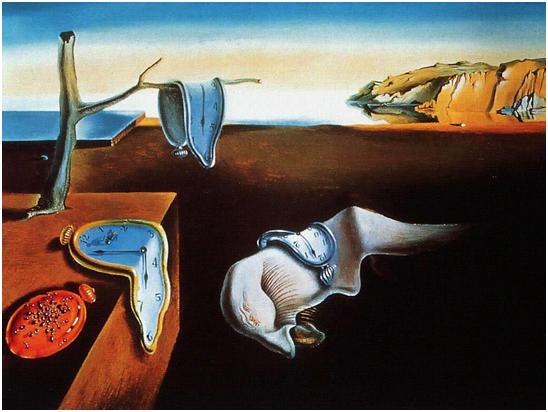
“The Persistence of Memory” is a visual decadence. An onslaught of human fragility and scientific frailty. Purely my own opinions here. I believe Dali is contrasting scientific achievements against a natural barren backdrop.
Death. Uncertainty. The tree almost seems to hold out a branch, much like Oliver Twist’s imploring hands. In an earlier Blog entitled ‘Botticelli’s Venus’ I mention that Dali gathered inspiration from Renaissance Art. Oh how true.
The distorted biological organism depicted centrally in “The Persistence of Memory” parallels Botticelli’s shell from ‘The Birth of Venus’.
Is Dali speaking in divinely spiritual terms to us as regards Time? Is it reflecting biological finality? Distortion is absolutely the overpowering word to describe this painting. A distortion of Time because Dali was fascinated by science and brilliant thinking.
Surely he has made clever use of renowned artistic references to subtly amplify his work. A shrewd patronage of past Art Masters to achieve recognition and acceptance in an art world that is highly perceptive of itself. Concentric and publicly inviting all at once.
Art is personal. It means something different from person to person. We each grow in the pleasure we gain from art over time.
Dali enjoyed the dark things, the decaying greyness, cracked and strangely putrefied representations. An ugly beauty painted with considerable insight, purpose and commentary.
This is Dali’s creative world. It’s not all fruit bowls and silvery fish. Dali possessed a deathly perception of the world despite his immense secular success.
Salvador was a marketing genius naturally gifted in influencing and persuading visually. Dali is a character at the upper echelon of his personal craft because we remember him and his work.
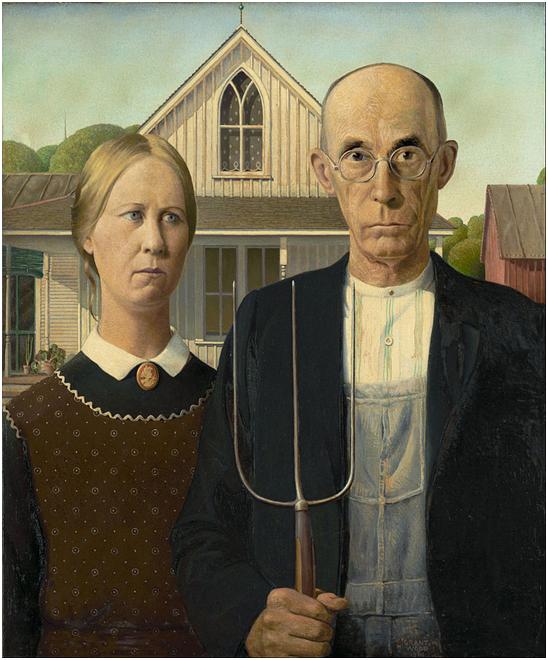
“American Gothic” completed in 1930 by Grant Wood is painted using oil on beaverboard.
It is probably representative of moderate mid-belt America with reverent white collars clearly depicted. The pitchfork simile in the detailing of the man’s shirt succinctly implies he is the embodiment of his own pitchfork.
Is this what Grant Wood is saying to you? A hard working farmer.
Their expressions are notably stern. Kind of unfriendly. Uninviting. A contrast of disinterest and attentiveness. Wood has positioned the couple at a safe distance from their house.
Wood may have been expressing sympathy for Iowan farmers. Reading newspapers of his day might help confirm the artists mindset prior to painting.
Wood used Nan Wood Graham as the model and a male dentist, Dr. Byron McKeeby, to expressively portray the characterisations. Did Grant indeed provide artistic direction for their intensely emotional faces?
Sitting for an artist is exhausting let alone standing. Try scowling for an hour and see how you get along.
Iowan residents were historically upset with the painting’s unfavourable stance. Although one painting cannot possibly begin to explain the disposition of every person in an area covering 56,000 square miles. Or for that matter America as a country – being as this is entitled the ‘American Gothic’.
Anyway, is this Gothic in architecture or nature? It’s a worthwhile question to contemplate. A possible viewpoint of this painting. Is being Goth a dark romanticism of inanimate things or the personality of the individual(s) sewn into their psyche?
In some regards I feel that this painting could broad base represent most any country of the world. A family. A house. An occupation. A way of life. Wood explicitly appreciated the importance of family and our instinctive need to protect the people and things around us.
Whilst some Iowans felt it was unfairly judgemental they can treasure that Grant gladly included his own sister in what has become his most famous painting. This tells us that Wood is an intellectually considerate and honest man as far as our imperfections allow. He emphatically stated that he wanted to get to know Iowa better.
I think Grant Wood genuinely had a close affinity with Iowa.
The brushwork detailing is stunning. Brushwork is the subject of my next Blog article, so please get ready for some delicious fruit bowls.
 The Unfathomable Artist